
PennantPark Investment Corporation: Middle-Market Lending Dynamics, Credit Exposure, and the Stakes of Capital Discipline
PennantPark’s recent earnings stability and ongoing monthly dividends highlight the resilience of its middle-market lending model. Yet, the company’s exposure to highly leveraged, below-investment-grade borrowers and reliance on external funding sources heighten sensitivity to credit cycles and competitive pressures.
The cited source reports dividend-related activity; that disclosure alone does not establish dividend-policy continuity, management confidence, or a material constraint on capital flexibility. However, the underlying risks of lending to highly leveraged companies, sector concentration, and funding leverage remain central to the long-term thesis.
PennantPark Investment Corporation occupies a specialized niche in the U.S. financial ecosystem by channeling capital to middle-market companies that are often overlooked by larger banks. While the company’s value-oriented approach and experienced management have delivered stable recent results—including a steady dividend and earnings that met expectations—the core risk remains its exposure to highly leveraged, below-investment-grade borrowers. This makes PennantPark’s future performance particularly sensitive to credit cycles, sector health, and the company’s ability to maintain disciplined underwriting and funding flexibility.
The cited source reports dividend-related activity; that disclosure alone does not establish dividend-policy continuity, management confidence, or a material constraint on capital
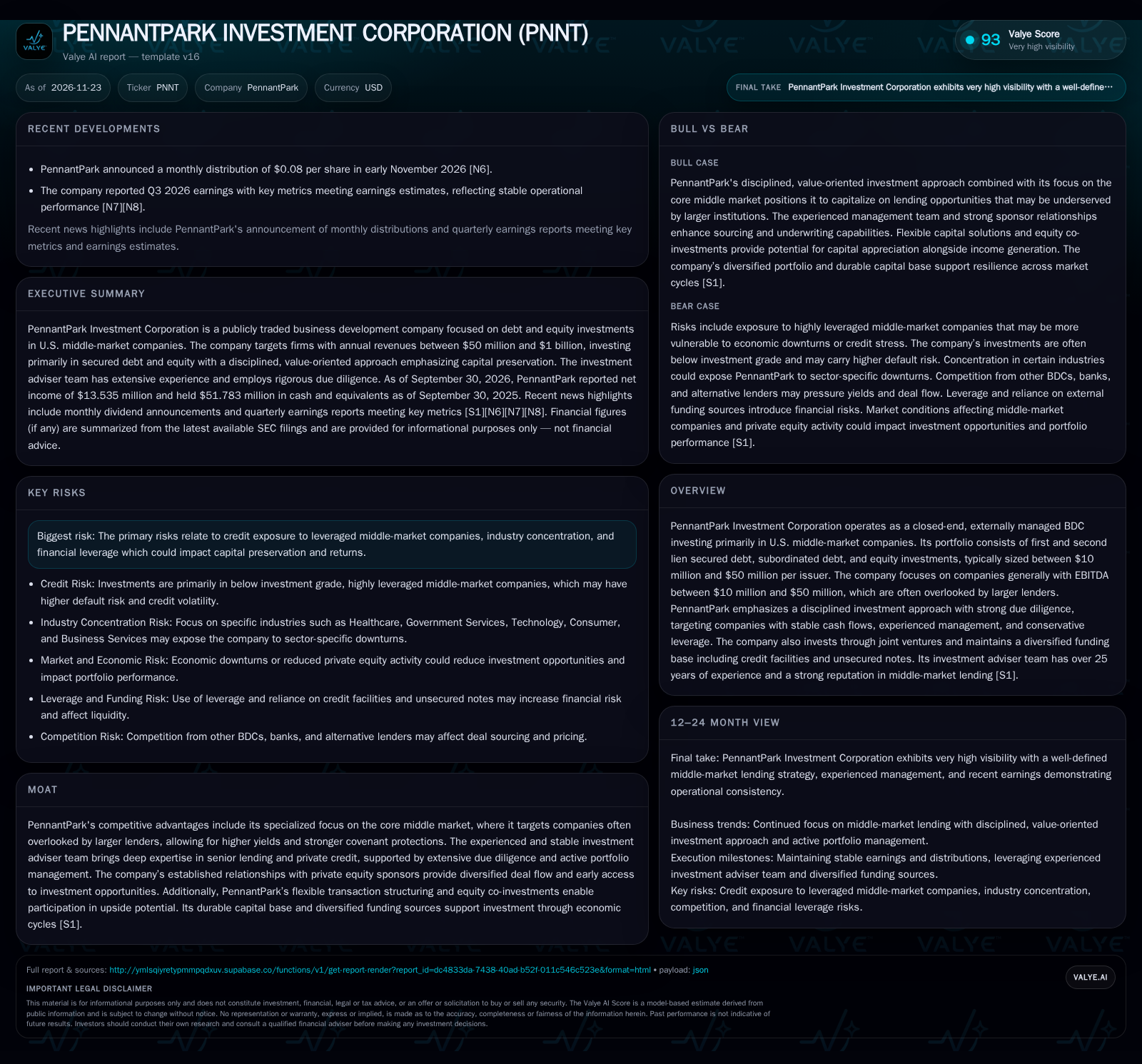
PennantPark reported net income of $13.535 million for the period ended September 30, 2026, demonstrating continued profitability in its core lending business [S1]. As of September 30, 2025, the company held $51.783 million in cash and equivalents, providing a snapshot of available liquidity at the prior fiscal year-end [S1]. In November 2026, PennantPark announced a monthly distribution of $0.08 per share, underscoring ongoing commitment to shareholder returns and signaling confidence in recurring portfolio cash flows [N6]. Q3 2026 earnings met key estimates, reflecting operational consistency and suggesting portfolio resilience despite persistent credit and competitive pressures [N7] [N8]. These facts frame a business that is delivering on its stated objectives, at least in the near term, but do not by themselves resolve the longer-term questions of credit risk management and sustainable yield.
How PennantPark’s Middle-Market Lending Model Generates Income and Navigates Risk
PennantPark’s economic engine is built on originating and holding a diversified portfolio of first lien, second lien, and subordinated debt, with selective equity co-investments in U.S. middle-market companies [S1]. Revenue is primarily driven by interest income from these loans, with additional upside potential from equity stakes. The company typically targets investments in the $10 million to $50 million range per issuer, a segment characterized by higher yields and bespoke structuring opportunities compared to broadly syndicated large-cap loans.
The business model relies on a mix of fixed and variable economics. Interest income and fees from debt instruments are relatively predictable, but credit losses and recoveries can introduce significant volatility, especially given the below-investment-grade profile of borrowers (often BB to CCC rated) [S1]. Operating leverage is moderate: while external management fees and deal origination costs are incremental, scale can enhance efficiency if asset growth outpaces fixed overhead.
Funding is achieved through a combination of revolving credit facilities, unsecured notes, and securitized debt, with portfolio rotation and public/private offerings supplementing liquidity [S1]. This structure supports deployment flexibility but introduces interest rate and refinancing risk, especially in tightening credit environments. The ability to maintain net interest margins while controlling credit losses is the central determinant of long-term profitability.
Specialization, Sponsor Relationships, and the Limits of Differentiation in Middle-Market Lending
PennantPark’s competitive positioning centers on its focus in the core middle market, targeting companies often overlooked by larger banks and institutional lenders [S1]. This segment offers higher yields and greater covenant protections, but also exposes lenders to higher default risk. The company’s edge is further supported by an experienced investment team with deep expertise in senior and mezzanine lending, as well as established relationships with private equity sponsors that drive differentiated deal flow.
However, the middle-market lending space remains highly competitive. Other BDCs, private credit funds, and non-bank direct lenders target similar opportunities, often with aggressive pricing or looser covenants. As capital continues to flow into the asset class, yield compression and underwriting discipline become key battlegrounds. PennantPark’s ability to source proprietary deals, maintain rigorous due diligence, and flexibly structure transactions may support relative outperformance, but there are few structural barriers preventing competition from eroding margins over time.
Substitution risk is also present: as market conditions evolve, borrowers may refinance with banks or tap public markets, reducing the supply of attractive lending opportunities. Conversely, in risk-off environments, PennantPark’s access to durable funding and relationships could become more valuable if capital becomes scarce.
Disciplined Underwriting and Portfolio Rotation Unlock Superior Risk-Adjusted Returns
The most favorable outcome for PennantPark hinges on its ability to consistently originate high-yielding, well-structured loans to resilient middle-market borrowers while minimizing credit losses. If the company’s disciplined, value-oriented underwriting continues to identify companies with robust cash flows, conservative leverage, and strong management, PennantPark could generate above-peer net interest margins and participate in equity upside through co-investments [S1].
A supportive macroeconomic backdrop—characterized by moderate growth, low defaults, and healthy private equity activity—would further enhance deal flow and portfolio performance. Falsification would involve a spike in non-accrual loans, portfolio markdowns, or dividend cuts despite stable industry conditions.
Earnings Consistency Amid Cyclical Credit and Competitive Headwinds
The most plausible scenario is one in which PennantPark maintains stable earnings and dividend distributions but faces periodic headwinds from credit cycles and competitive pressure. The company’s rigorous underwriting and diversification across industries such as Healthcare, Government Services, Technology, Consumer, and Business Services provide some resilience [S1]. However, periodic industry downturns, borrower-specific stress, or rising funding costs may pressure margins and increase credit losses.
Evidence to the contrary would include persistent underperformance relative to peer BDCs, significant increases in portfolio risk metrics, or an inability to access funding on competitive terms.
Credit Deterioration and Funding Constraints Erode Income and Capital Preservation
A negative outcome emerges if PennantPark’s exposure to highly leveraged, below-investment-grade middle-market borrowers results in elevated defaults and credit losses—especially in the event of a macroeconomic downturn or sector-specific stress. Such a scenario would likely be compounded by increased competition driving down yields and tighter credit markets raising funding costs or limiting refinancing options.
This could manifest as a rising proportion of non-accrual loans, portfolio markdowns, falling net investment income, and ultimately reductions in or suspension of the dividend. If the company is forced to sell assets at distressed prices or cannot roll over its debt on reasonable terms, NAV erosion and loss of investor confidence could follow. Confirmation would come from reported spikes in non-accruals, dividend cuts, or negative revisions to NAV guidance; falsification would require robust credit performance even in adverse macro conditions.
What Could Change the PennantPark Thesis in the Next 12-24 Months
Trends in non-accrual loans and realized credit losses—if disclosed—will be critical for assessing asset quality and underwriting discipline.
Changes in net investment income per share, which would signal margin resilience or compression amid evolving credit and funding environments.
Dividend coverage ratio, if disclosed, as a measure of the sustainability of current distributions.
Access to and terms of new funding—such as changes in credit facility covenants, interest rates, or maturities—that could impact liquidity and leverage.
Portfolio concentration by sector and issuer, with increased concentration heightening downside risk.
Competitive dynamics in middle-market lending, particularly shifts in deal terms, pricing, or covenant structures.
Management’s commentary on pipeline quality, underwriting standards, and portfolio rotation, which would help gauge future deal flow and risk appetite.
Any changes in regulatory or tax treatment of BDCs or RICs, which could alter the economics of the model.
Disclaimer: This is research-only, informational analysis and not investment advice. It may include AI-generated interpretation and general industry context. Always verify important details using primary sources.

Comments