
Fluence Energy: Battery Supply Agreements, Cybersecurity Headwinds, and the Challenge of Achieving Scale in Energy Storage
Fluence Energy’s 2026 results spotlight the tension between scale ambitions in grid-scale energy storage and persistent headwinds from manufacturing delays, cybersecurity costs, and ongoing net losses. With long-term battery supply agreements and involvement in marquee projects, the company’s ability to convert operational visibility into sustainable margins remains a central question.
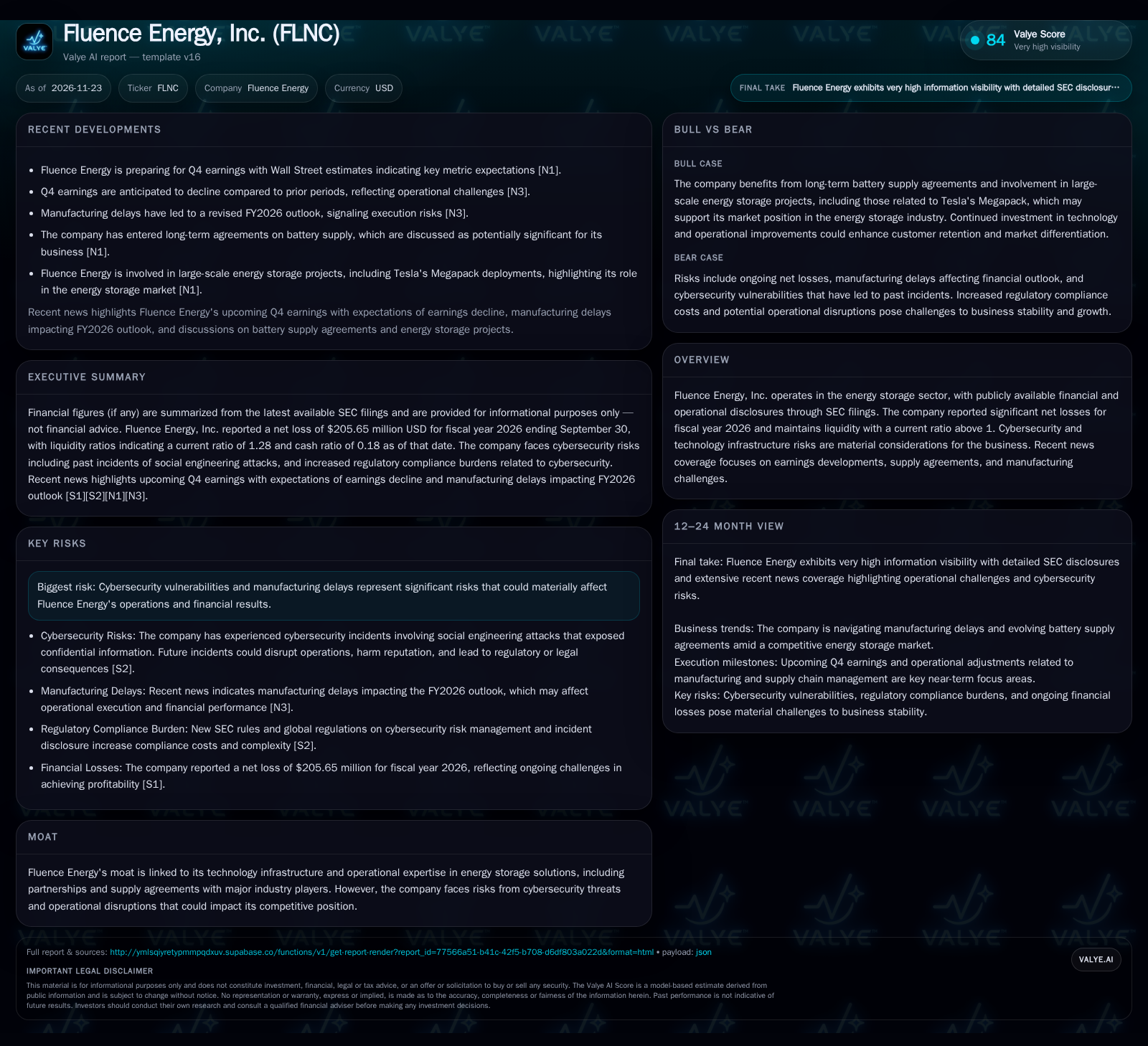
Fluence Energy reported a FY2026 net loss of $205.65M and faces persistent operational and cybersecurity risks. While battery supply agreements and large-scale project involvement could support growth, manufacturing delays and rising compliance costs weigh on the path to profitability [S1] [N1] [N3].
Fluence Energy stands at a crossroads typical of high-growth energy storage players: its expanding footprint in grid-scale projects—including high-profile collaborations—contrasts sharply with recurring net losses, manufacturing setbacks, and a mounting compliance burden. The company’s 2026 disclosures reveal both the opportunities and vulnerabilities inherent in the sector. Investors must weigh whether scale and strategic supply agreements can ultimately translate into a profitable, defensible business—or whether persistent execution and external risk factors will continue to challenge the thesis.
2026 Financials, Operational Setbacks, and the Strategic Importance of Battery Supply
As of September 30, 2026, Fluence Energy reported $352.81 million in cash and equivalents, current assets of $2.45 billion, and current liabilities of $1.91 billion, resulting in a current ratio of 1.28 and a cash ratio of 0.18 [S1]. The company posted a net loss of $205.65 million for fiscal 2026, with negative EPS of $1.51 [S1]. Wall Street expects Q4 earnings to decline, reflecting ongoing operational challenges [N3]. Fluence has secured long-term battery supply agreements, which are widely discussed as potentially crucial for business continuity and project delivery, particularly in the context of large-scale deployments such as those involving Tesla’s Megapack [N1]. Cybersecurity events in mid-2026 exposed confidential information, leading to greater compliance obligations and cost structure pressures, though no material operational disruption was reported [S2].
How Scale, Contract Structure, and Fixed Costs Shape Fluence’s Economics
Fluence Energy’s business model is centered on the design, integration, and delivery of grid-scale energy storage systems, often structured around multi-year supply agreements and large project deployments. Revenue is typically driven by the volume and value of systems delivered, with project-based contracts likely mixing hardware (battery modules, inverters) and software/services for system management. Hardware margins in energy storage are generally thin, especially for integrators without proprietary cell manufacturing, making scale and supply chain efficiency critical to margin improvement.
Fixed costs are rising, not only from R&D and technology infrastructure investments but also from regulatory compliance and cybersecurity. The company’s ongoing net losses suggest that current gross margins and/or operating leverage are insufficient to cover this cost base. Manufacturing delays and supply chain disruptions can further erode margins by increasing costs or causing project slippage, with potential liquidated damages or reputational impacts.
Long-term battery supply agreements may help stabilize input costs and availability, potentially supporting volume growth and backlog conversion. However, the ability to secure price-competitive, flexible supply remains key—especially as battery prices fluctuate and global supply chains remain volatile. If Fluence can leverage scale to negotiate better terms and optimize system integration, positive operating leverage could emerge. Conversely, persistent delays or cost overruns could keep the company sub-scale and structurally unprofitable.
Competitive Dynamics in Grid-Scale Storage: Partnerships, Substitution, and Technology Risks
Fluence operates in a fiercely competitive space, facing integrators, vertically integrated battery manufacturers, and energy technology conglomerates. Its competitive position is partially underpinned by long-term battery supply agreements and involvement in high-profile projects, but these do not guarantee pricing power or customer lock-in. Partnerships with marquee players such as Tesla (via Megapack deployments) may provide reputational benefits and pipeline visibility, but also expose Fluence to the risk of being squeezed on margins or displaced as vertically integrated competitors expand their own integration and software capabilities.
Technology differentiation—such as proprietary software for energy management, grid services, or advanced controls—could provide a moat if it delivers demonstrable customer value and is difficult to replicate. However, the pace of innovation in battery chemistry, power electronics, and AI-driven optimization means switching costs may remain low unless Fluence achieves deep integration with customer operations or regulatory frameworks.
Substitution risk is real: utilities and project developers can source directly from battery OEMs, or leverage turnkey solutions from other integrators. Persistent cybersecurity incidents or manufacturing missteps could further erode customer trust and competitive standing.
When Battery Supply Agreements and Scale Unlock Margin Expansion
A favorable outcome for Fluence would see long-term battery supply agreements ensuring stable, competitive input costs, enabling reliable project execution and backlog conversion. If the company successfully addresses manufacturing delays and leverages improved supply chain coordination, it could accelerate revenue recognition and improve project margins. Enhanced software offerings or integration services could further differentiate the value proposition, potentially unlocking higher-margin recurring revenue streams.
Upside would be confirmed by sustained revenue growth with improving gross margins, evidence of backlog conversion at healthy margins, and a reduction in net losses or a pivot to profitability. Additional signals would include new multi-year project wins, customer retention on integrated software platforms, and no material cybersecurity or compliance disruptions. If Fluence demonstrates the ability to turn scale and supply agreements into a defensible margin structure while containing compliance costs, the thesis for sustainable growth becomes more robust.
Operational Progress Tempered by Margin Pressure and External Risks
The most plausible scenario is that Fluence continues to grow its project pipeline and revenue base, leveraging its battery supply agreements to maintain delivery schedules and customer relationships. However, gross margins remain under pressure due to cost inflation, competitive pricing, and ongoing manufacturing challenges. Cybersecurity and regulatory compliance costs persist as a drag on operating leverage, limiting near-term progress toward profitability.
This scenario would be supported by moderate revenue growth, a stable or slightly reported liquidity-ratio trends, and net losses narrowing only gradually. Evidence would include continued project wins but with tight margin disclosure, incremental software/service adoption, and periodic disclosures of compliance or cybersecurity investments. The absence of major operational disruptions, but also the lack of a clear inflection to positive earnings, would confirm this baseline trajectory.
Manufacturing Setbacks and Cybersecurity Breaches Amplify Financial Strain
A negative scenario would see manufacturing delays and supply chain disruptions persist or worsen, leading to missed project deadlines, cost overruns, or contractual penalties. If battery supply agreements prove too rigid or not price-competitive, margin compression could intensify. Repeated or more severe cybersecurity incidents could damage customer trust, trigger regulatory fines, or result in material operational disruption.
Downside would be evidenced by declining revenue, deteriorating current and cash ratios, escalating net losses, and negative headlines regarding project execution or security breaches. Loss of key customers, reduced backlog, or publicized disputes with battery suppliers would further reinforce a bearish outlook. In this scenario, the company risks being marginalized by more integrated or technologically advanced competitors.
Milestones and Metrics That Will Shape Fluence’s Margin Trajectory and Strategic Viability
Gross margin trends quarter-over-quarter, especially as new projects are delivered and battery supply agreements take effect, would help test whether scale is translating into profitability.
Backlog conversion rates and the composition of backlog by contract type (if disclosed) would illuminate the sustainability of the revenue pipeline and exposure to margin risk.
Frequency, severity, and business impact of cybersecurity incidents—along with corresponding compliance costs—will be critical for gauging operational resilience.
Project delivery timelines and disclosures regarding manufacturing or supply chain delays will indicate execution capability and risk of cost overruns.
Software/services revenue mix and growth (if disclosed) would clarify the potential for higher-margin, recurring revenue streams beyond hardware integration.
Any material changes in the terms or partners of long-term battery supply agreements would signal shifts in input cost structure and supply security.
Customer retention rates, especially for integrated platform solutions (if available), would provide insight into switching frictions and competitive durability.
Disclaimer: This is research-only, informational analysis and not investment advice. It may include AI-generated interpretation and general industry context. Always verify important details using primary sources.

Comments