
Vivakor’s Integrated Midstream Ambitions Collide with Liquidity Pressure and Remediation Execution Risk
Vivakor, Inc. combines contract-backed oil logistics with a bet on remediation technology, but a stressed balance sheet and unproven new segment create a high-stakes inflection.
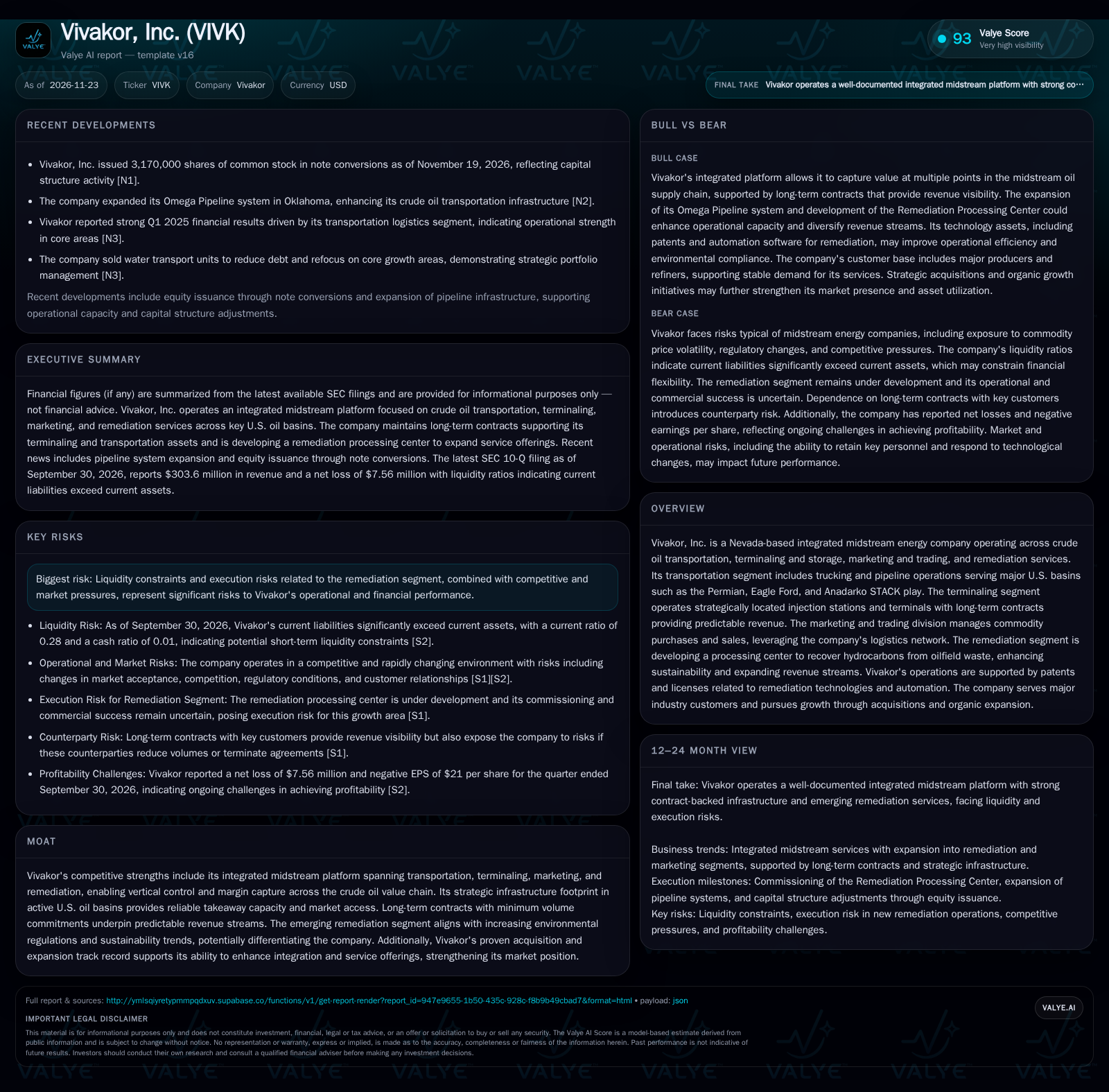
Vivakor operates a diversified midstream platform spanning oil transportation, terminaling, and marketing, anchored by long-term contracts and major industry customers. The company is expanding through pipeline infrastructure and a new remediation segment designed to recover hydrocarbons from oilfield waste. The success of the remediation center and ability to stabilize cash flow will determine whether Vivakor’s integration strategy delivers durable value or exposes it to mounting financial strain. [S1] [S2] [N1] [N2]
Vivakor, Inc. sits at an inflection point as it seeks to leverage its vertically integrated midstream oil platform and patented remediation technology to capture value beyond traditional logistics. The company’s long-term contracts and blue-chip customer base provide a degree of revenue stability, while recent infrastructure expansions and a forthcoming remediation center could unlock new markets. The next phase will hinge on Vivakor’s ability to translate its asset footprint and technology bets into sustainable cash flow and margin improvement—or risk being forced to retrench in the face of mounting financial pressures.
Liquidity and Expansion: Vivakor’s Immediate Crossroads
Vivakor reported $303.6 million in revenue for the quarter ended September 30, 2026, but posted a net loss of $7.56 million and negative EPS of $21 per share. The company's balance sheet reveals pronounced short-term financial stress, with cash and equivalents of just $399,750 against $71.3 million in current liabilities, yielding a current ratio of 0.28 and a cash ratio of 0.01. The recent issuance of 3,170,000 shares in note conversions further underscores the ongoing need for external financing and the pressure to stabilize operations. [S2] [N1] [N2]
The company’s terminaling and storage operations are partially insulated by long-term contracts—such as a 10-year take-or-pay agreement at the Colorado City, Texas terminal and contracts with Denbury Onshore at Delhi, Louisiana—which provide some revenue visibility. The RPC, designed to process 800 tons per day of oilfield waste, is scheduled for commissioning in early 2026 and represents a strategic bet on environmental services and hydrocarbon recovery. [S1]
Revenue Streams, Margin Structure, and the Stakes of Integration
Vivakor’s business model is built on capturing margin at multiple points in the crude oil value chain. The transportation segment mixes pipeline and trucking, both capital-intensive but offering different economics: pipelines generally provide higher fixed-cost leverage and lower variable cost per unit, while trucking offers flexibility but with lower margins and higher per-barrel costs. Terminaling and storage, particularly when supported by long-term take-or-pay contracts, can yield stable, recurring revenue with relatively predictable cash flows and lower operational volatility.
The marketing and trading arm is inherently more volatile, with margins dependent on the spread between purchase and resale prices of crude and related commodities. This segment’s profitability can swing with market conditions and may be used to optimize utilization of transportation and terminaling assets, but it also exposes Vivakor to price risk and working capital demands.
The emerging remediation segment is intended to process oilfield waste and recover hydrocarbons, creating a new revenue stream that could command premium pricing if it delivers both environmental compliance and resource recovery for oilfield operators. However, the ramp-up of such a facility typically involves high upfront capital costs, uncertain customer adoption, and operational learning curves. If successful, the RPC could offer higher-margin, ESG-aligned revenue with potential for recurring contracts if oilfield waste disposal and remediation are regulated or incentivized.
Operating leverage is a double-edged sword: fixed infrastructure costs mean incremental volumes can drive outsized EBITDA improvement, but underutilization or contract loss can rapidly erode cash flow. Vivakor’s capital requirements—evident in recent infrastructure expansion and equity issuance—suggest ongoing dependence on external funding until new segments mature or profitability improves.
Integrated Model versus Traditional Midstream and Environmental Services
Vivakor’s integrated platform positions it to compete with both traditional midstream oil companies and emerging environmental service providers. Its footprint in major producing basins—Permian, Eagle Ford, Anadarko—grants access to significant crude flows, and long-term terminaling contracts provide some insulation from spot market volatility. However, the company faces competition from larger, better-capitalized midstream peers that may offer lower pricing, broader service networks, or more robust potential financial flexibility.
The remediation segment targets a different set of competitors: specialized environmental remediation firms and oilfield service providers. Vivakor’s approach, leveraging proprietary technology and automation for hydrocarbon recovery, could differentiate it if it achieves reliable performance and regulatory approval. However, entry barriers in remediation are not only technological but also commercial—oilfield operators are risk-averse, and adoption often hinges on regulatory mandates, proof of cost savings, and demonstrated environmental benefit.
Customer concentration is a double-edged sword: while major producers and refiners (e.g., Marathon, ConocoPhillips, BP) provide scale and credibility, they also have negotiating leverage and can switch providers if Vivakor’s services fail to deliver on price, reliability, or compliance. Counterparty risk is thus material, especially in the context of long-term contract exposure.
How Remediation Success and Asset Utilization Could Drive a Turnaround
A favorable outcome for Vivakor hinges on two reinforcing dynamics: successful commissioning and commercial ramp-up of the Remediation Processing Center, and improved utilization of its expanded midstream infrastructure. If the RPC proves technically reliable, cost-effective, and compliant with environmental regulations, it could attract recurring oilfield waste streams from existing and new customers, diversifying revenue and improving blended margins. Integration with Vivakor’s transportation and marketing network could further optimize logistics and create cross-selling opportunities.
Confirmation would come from disclosed multi-year remediation contracts, rising volumes processed at the RPC, and evidence of premium pricing or margin expansion attributable to the new segment. Additional signs would include higher asset utilization rates in the pipeline and terminaling businesses, extension or expansion of key customer contracts, and stabilization or reversal of net losses. Successful refinancing or equity raises on more favorable terms would also signal improved market confidence.
Navigating Tight Liquidity While Incremental Growth Remains Unproven
The most plausible trajectory is one where Vivakor continues to operate its core midstream segments with moderate volume growth, supported by existing long-term contracts, but faces persistent liquidity constraints and slow progress in the remediation business. The RPC’s commissioning may experience delays or slower-than-expected customer adoption, limiting near-term revenue impact. Terminaling and pipeline operations remain stable but do not deliver enough incremental cash flow to offset ongoing net losses or materially strengthen the balance sheet.
Evidence supporting this scenario would include flat or only modestly growing revenue, continued low cash balances, further equity or debt issuance to meet working capital needs, and limited disclosure of remediation segment contracts or volumes. Absence of major contract wins or asset sales would reinforce the view that Vivakor is treading water operationally while seeking a breakthrough in its new segment.
Liquidity Crunch and Remediation Setbacks Force Retrenchment or Restructuring
If the RPC fails to achieve commercial traction—due to technical, regulatory, or market barriers—or if the midstream platform loses key contracts or faces operational disruptions, Vivakor could face escalating financial distress. Acute liquidity pressure, as evidenced by the current balance sheet, could force asset sales, unfavorable financings, or even restructuring if near-term cash requirements outstrip available resources.
This scenario would be confirmed by missed or delayed debt payments, distressed equity issuance, disclosures of asset divestitures at suboptimal valuations, or negative customer developments (such as the loss or renegotiation of long-term contracts). Regulatory setbacks or operational incidents at the RPC, combined with persistent net losses and no visible path to cash flow breakeven, would raise the risk of a downward spiral.
Milestones That Will Reveal Whether Vivakor Can Realize Its Integrated Ambitions
Commissioning, operational uptime, and throughput volume at the Remediation Processing Center in Harris County, Texas—disclosed in quarterly reports or investor updates—will be critical to gauge whether the new segment can deliver on its promise.
Any announced multi-year remediation or waste processing contracts, especially with existing major customers, would signal commercial traction and recurring revenue potential for the RPC.
Update frequency and terms of long-term terminaling and pipeline contracts—extensions, expansions, or renewals—would help test the durability of Vivakor’s core revenue base.
Cash and equivalents on the balance sheet, along with the pace and terms of new equity or debt issuances, will indicate whether liquidity is stabilizing or further dilution/distress is likely.
Reported asset utilization rates in pipeline and terminaling segments, if disclosed, would show whether recent infrastructure expansions are translating into higher throughput and margin leverage.
Gross and segment-level margin disclosure, especially for the remediation business as it ramps, would help clarify whether the new offering is accretive or dilutive to overall profitability.
Any regulatory or operational incidents—such as environmental compliance issues or accidents at the RPC—would materially impact both the remediation segment’s prospects and broader company risk profile.
Customer concentration metrics and counterparty updates: changes in the mix or terms with key customers (e.g., Marathon, BP, ConocoPhillips), would illuminate Vivakor’s dependency and resilience to contract churn.
Disclaimer: This is research-only, informational analysis and not investment advice. It may include AI-generated interpretation and general industry context. Always verify important details using primary sources.

Comments