
PFLT: Implications of Limited Disclosure for Business Insight
With no recent news, operational detail, or financial disclosure, PFLT presents an unusual challenge for analysis: investors must work from industry priors and scenario logic, not concrete company evidence. This forces a focus on what limited transparency signals about risk, business model possibilities, and what would need to change for a thesis to emerge.
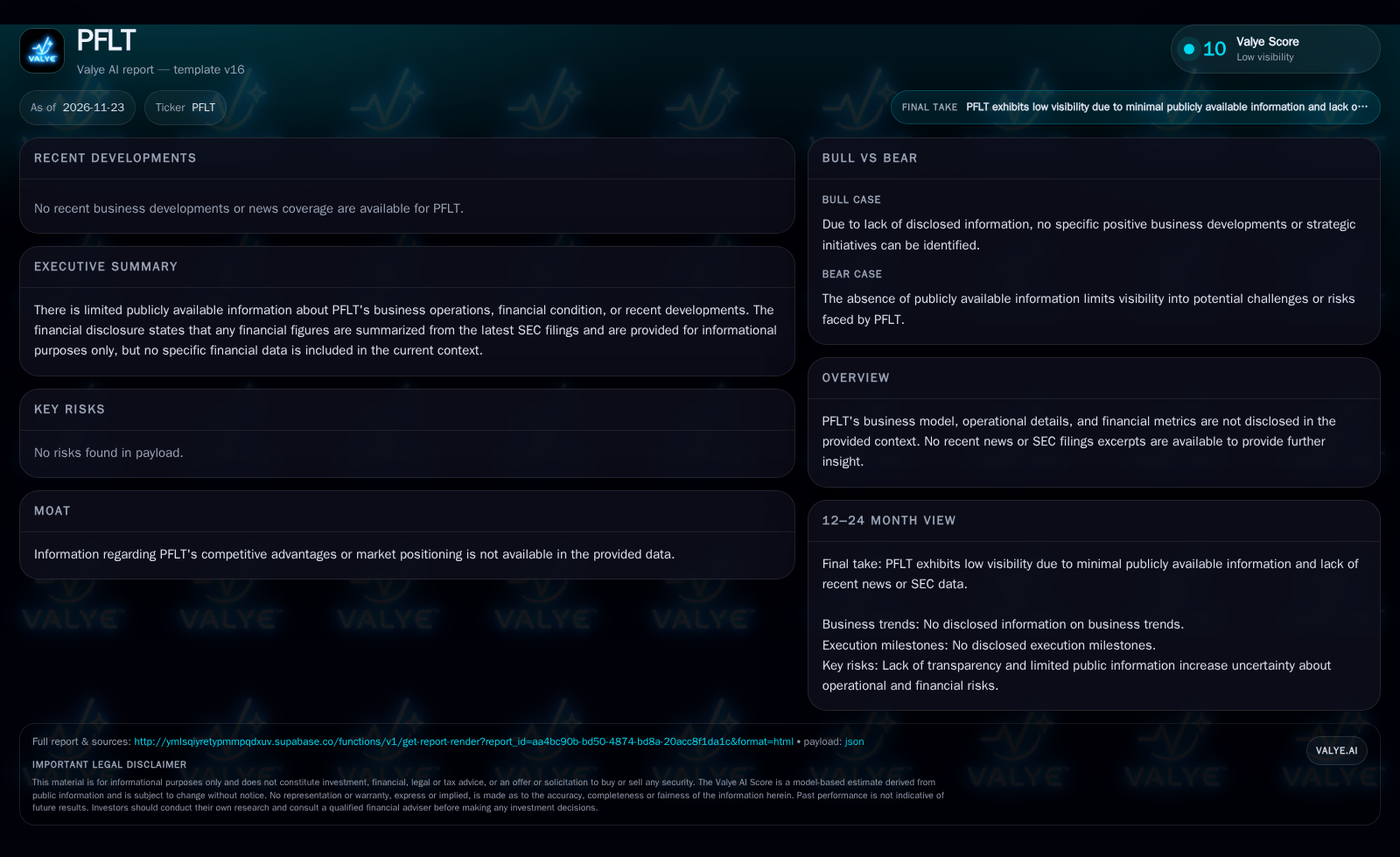
PFLT currently offers no substantive public disclosures regarding its operations, financials, or recent developments. This lack of transparency raises uncertainty around its business model, risk profile, and potential competitive positioning. Investors are forced to rely on generic industry frameworks and scenario planning rather than company-specific analysis. The core question is whether this opacity is a temporary reporting gap or a structural feature—each with very different implications for future value.
PFLT stands out less for what is known about its business than for what is not. With no recent operational updates, financials, or news coverage, the company occupies a unique analytical blind spot. This extreme opacity leaves investors without the usual anchor points of revenue, margin, or strategic milestones, forcing reliance on industry heuristics and scenario logic. The central issue is not the specifics of PFLT's business, but rather what the lack of disclosure itself signals about its risk profile, governance, and potential for value realization.
Insights Gained from Current Disclosure Gaps
As of November 2026, there are no recent business developments, news releases, or SEC financial disclosures available for PFLT. This absence of information is itself the most material fact: it precludes any direct assessment of the company’s current operations, financial condition, or strategic direction. In markets where transparency and timely reporting are baseline expectations, such a gap raises fundamental questions about governance, regulatory standing, and access to capital.
The lack of disclosure may indicate a number of underlying realities: PFLT could be a dormant entity, a non-operating shell, or a company in transition following a delisting, restructuring, or change of control. Alternatively, it could be a smaller entity that has not prioritized regular investor communications. Regardless of the underlying reason, the immediate consequence is that investors face maximal uncertainty and must price in both the risks of the unknown and the costs of illiquidity and information asymmetry.
Exploring Potential Business Models and Their Economic Effects
Without disclosure of revenue sources, cost structure, or capital needs, the economics of PFLT’s business remain speculative. If PFLT operates in a typical middle-market lending or specialty finance role (as the ticker might suggest), its core economics would likely hinge on net interest margin, credit risk management, and leverage. Such models generally rely on spread income between loan yields and funding costs, with fixed costs concentrated in underwriting, compliance, and portfolio management. Operating leverage can be substantial, but so can exposure to credit cycles and liquidity mismatches.
Alternatively, if PFLT operates outside financial services, the core business model could range from fee-based services to asset-intensive operations. In either case, the absence of disclosure makes it impossible to assess fixed versus variable costs, capital intensity, or required scale for profitability. The lack of financials also precludes any concrete view on cash runway, ability to withstand shocks, or capacity to reinvest in growth.
Further dissecting potential business models, if PFLT operates within the specialty finance sector, its risk-return profile would be heavily influenced by underwriting standards and portfolio diversification. A well-diversified loan book can mitigate idiosyncratic risk, but concentration in niche sectors or borrower types could amplify vulnerability to economic cycles. Moreover, funding strategy—whether reliant on wholesale funding, securitization, or equity capital—would critically shape liquidity risk and cost of capital. Understanding these dynamics is essential because variations in leverage and funding mix can lead to materially different outcomes under stress scenarios, affecting both solvency and profitability.
Assessing Competitive Standing Amid Sparse Information
With no information on products, customers, or markets, PFLT’s competitive positioning can only be inferred in relation to generic industry peers. If PFLT is in financial services, it would typically compete on pricing, underwriting discipline, and access to deal flow against both traditional banks and alternative lenders. In other sectors, relevant competitive axes might include technology differentiation, customer relationships, or regulatory compliance.
The lack of public disclosure itself puts PFLT at a disadvantage relative to peers with more transparent reporting. Investors and counterparties may be less willing to engage with opaque entities, and the company may face higher costs of capital or reduced deal opportunities as a result. In industries where reputation and trust are critical, persistent opacity can erode competitive standing over time.
In addition to the direct competitive factors, PFLT’s market positioning may also hinge on its adaptability to evolving regulatory and technological landscapes. Firms that proactively integrate regulatory compliance and leverage technology for underwriting or customer engagement often gain a competitive edge through operational efficiency and risk mitigation. Conversely, entities with opaque operations may struggle to keep pace with such shifts, potentially resulting in cost disadvantages or regulatory scrutiny. The interplay between governance quality, transparency, and innovation capacity can thus be a decisive factor in sustaining competitive advantage, especially in sectors where trust and compliance are paramount.
Transparency or Strategic Change as a Catalyst for Value Creation
The most favorable scenario for PFLT is one in which the current information vacuum is temporary and gives way to renewed disclosure, external audit, or a strategic event (such as an acquisition, recapitalization, or major partnership). Such a shift would allow investors to assess the underlying business, potentially revealing hidden value, underappreciated assets, or a viable path to growth.
Evidence that would confirm this scenario includes the release of audited financials, initiation of regular investor communications, new board appointments, or coverage from reputable industry analysts. A return to SEC filing compliance or uplisting to a major exchange would be strong signals that PFLT is re-engaging with public capital markets. If PFLT were to announce a significant commercial partnership or transaction, that could also serve as external validation of its business viability.
A strategic shift toward transparency might also unlock new financing avenues beyond traditional equity markets. For instance, improved disclosure could facilitate access to debt capital markets or structured financing, which often require rigorous reporting standards. This expanded capital access could reduce funding costs and enable growth initiatives or balance sheet optimization. Additionally, enhanced transparency may attract strategic partnerships or joint ventures, as counterparties typically seek reliable information to assess risk and alignment. Therefore, the pathway to value creation is not solely through re-rating of equity but also through operational and potential financial flexibility gained from credible market engagement.
Prolonged Opacity Maintaining Investor Hesitancy
The most plausible scenario, absent new information, is that PFLT remains in a state of minimal disclosure, with little to no market engagement or operational visibility.
The base case would be confirmed by continued absence of filings, news, or third-party validation. Prolonged opacity could result in further marginalization of the equity, loss of analyst coverage, and reduced ability to attract institutional capital. Conversely, any resumption of basic disclosure or external engagement would begin to challenge this base view.
Consequences of Ongoing Opacity on Regulation and Valuation
The most adverse scenario is that PFLT’s lack of transparency reflects deeper structural or regulatory problems—potential insolvency, loss of licensure, or ongoing disputes that preclude normal reporting. In this scenario, value destruction could be rapid and irreversible, especially if counterparties withdraw, regulators intervene, or default events occur.
Confirmation of this negative scenario would include formal delisting, bankruptcy filings, regulatory sanctions, or the emergence of legal disputes. Even absent formal distress, persistent opacity could result in a permanent loss of market confidence and a collapse in trading liquidity, making recovery increasingly unlikely.
Specific Developments That May Alter the PFLT Outlook
The public release of audited financial statements or a new SEC filing would be the most direct signal of renewed operational transparency.
Initiation of regular investor communications, such as earnings calls, press releases, or investor presentations, would help establish ongoing engagement.
Appointment of new directors or high-profile executives could signal a strategic pivot or governance refresh.
Announcement of a major transaction, partnership, or external investment would serve as external validation of business viability.
Coverage initiation by a reputable sell-side analyst or industry research firm would lend credibility and increase visibility.
Evidence of regulatory approval, relicensure, or uplisting to a major exchange would indicate improved compliance and market access.
Disclaimer: This is research-only, informational analysis and not investment advice. It may include AI-generated interpretation and general industry context. Always verify important details using primary sources.

Comments