
Digital Brands Group: Navigating Liquidity Strain and Multi-Channel Retail Ambitions
The company's survival and potential rebound will depend on its ability to convert strategic moves into financial traction amid limited disclosure and sector headwinds.
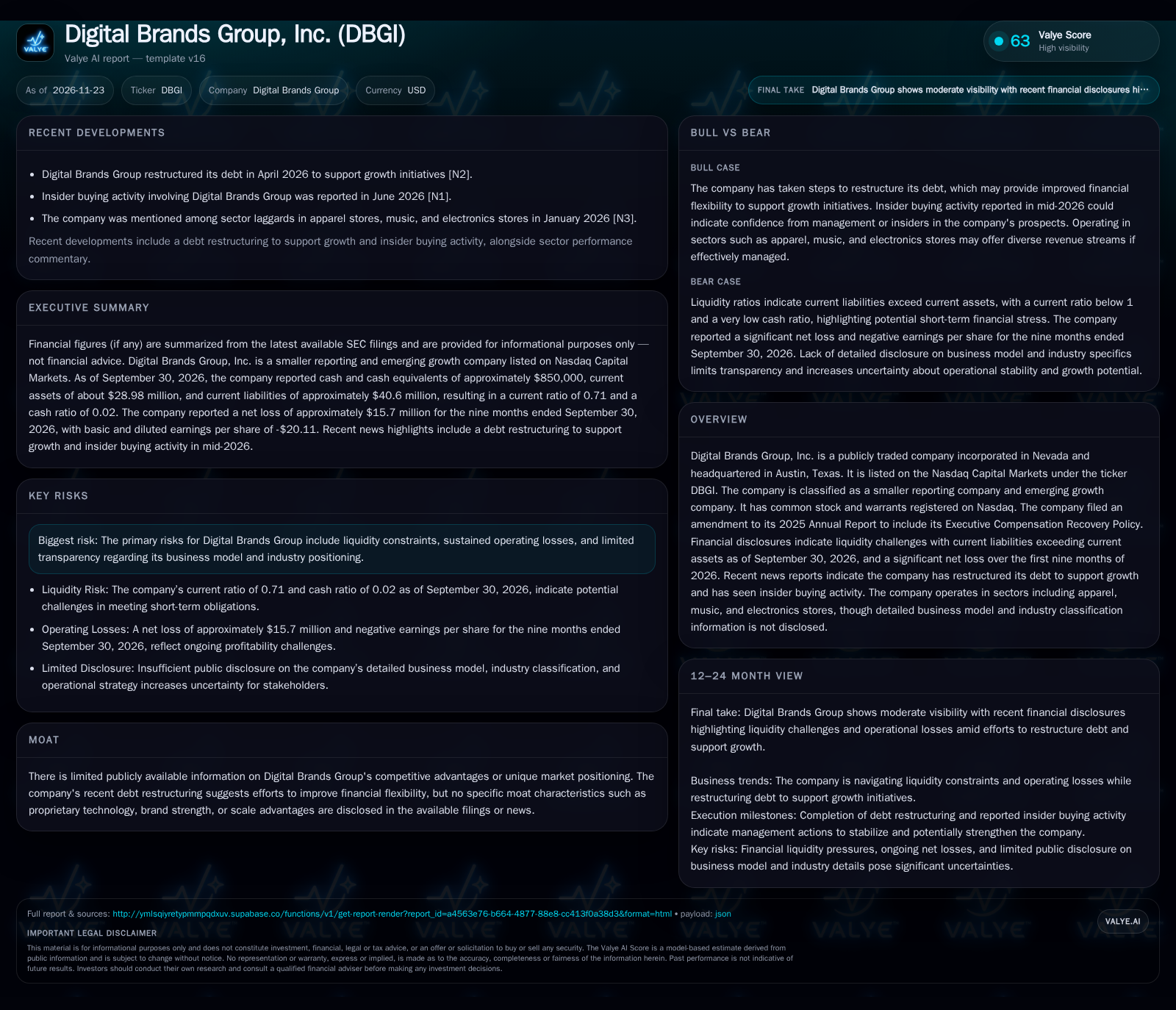
Digital Brands Group reports severe liquidity pressure, with current liabilities far outstripping assets and a substantial net loss year-to-date. Recent debt restructuring and insider buying point to management's efforts to stabilize the business, but persistent operating losses and lack of detailed business model disclosure create high uncertainty around the company’s ability to execute its omni-channel retail ambitions and stem cash burn. The next phases hinge on tangible improvements in inventory efficiency, customer acquisition economics, and the sustainability of its capital structure. [S2] [N2] [N1]
Digital Brands Group, a Nasdaq-listed omni-channel retailer in apparel, music, and electronics, stands at a financial crossroads. The company’s latest filings reveal acute liquidity pressure, with current liabilities meaningfully outpacing current assets and only $850,000 in cash to cover short-term needs. Despite debt restructuring and insider buying that hint at management’s resolve, persistent operating losses and a lack of granular business model transparency leave the company’s turnaround potential highly contingent on execution and external financing conditions. The next twelve months will be critical as Digital Brands Group seeks to translate its multi-channel retail ambitions into operational and financial stability.
Liquidity Crunch and Losses Define the Near-Term Landscape
As of September 30, 2026, Digital Brands Group’s financial position is characterized by acute liquidity stress: current liabilities stand at $40.6 million against current assets of $28.98 million, resulting in a current ratio of just 0.71 and a cash ratio of 0.02. This means the company has only $850,000 in cash to address over $40 million in short-term obligations, underscoring a pressing need for either improved operating performance, additional financing, or further restructuring to avoid a cash crunch. [S2]
The company reported a net loss of $15.7 million for the first nine months of 2026, with diluted EPS of -$20.11, reinforcing the reality of persistent negative operating leverage. [S2]
In April 2026, Digital Brands Group restructured its debt, an action intended to provide breathing room for growth initiatives, though the precise terms and impact on future cash obligations are not disclosed. [N2]
Insider transaction activity was reported in the cited source; this activity does not by itself establish insider confidence. [N1]
How the Economics of Omni-Channel Retail Could Play Out
Digital Brands Group’s commercial ambition is to drive sales through a blend of direct-to-consumer (DTC) e-commerce, physical showrooms, and wholesale partnerships. This omni-channel model theoretically offers the ability to boost customer lifetime value and optimize inventory by leveraging data from multiple sales channels.
In practice, the economics of this approach are challenging: DTC channels can command higher gross margins but often require heavy digital marketing spend, while wholesale partnerships offer volume and brand reach but typically at lower unit margins. Physical retail, especially for an emerging brand, introduces significant fixed costs (leases, staff, inventory risk) and can exacerbate negative operating leverage without sufficient sales density.
The company’s own discussion of 'closet share' and customer data analytics suggests an intent to maximize repeat purchases and optimize inventory turns, which—if executed well—could lower markdown risk and improve working capital efficiency. However, the persistent net losses and reported cash balance indicate that, so far, these theoretical advantages have not translated into sustainable positive margins or cash generation.
Given the current asset and liability structure, the business is likely reliant on outside capital or supplier credit to fund ongoing operations, especially as inventory makes up a significant portion of current assets and may not be easily liquidated at book value in a distress scenario.
Assessing the Company’s Place in a Crowded and Fragmented Market
Digital Brands Group operates in the intensely competitive sectors of apparel, music, and electronics retail. These markets are characterized by low switching costs, high customer acquisition costs, and rapid shifts in consumer preferences—factors that tend to favor scale players, established brands, or companies with differentiated product or digital capabilities.
The company’s stated omni-channel strategy is common among both legacy retailers seeking to modernize and digital-first brands looking to expand offline. Without evidence of proprietary technology, unique brand equity, or supply chain advantages, Digital Brands Group may struggle to defend margins or build meaningful customer loyalty in the face of well-capitalized competitors and fast-moving direct-to-consumer challengers.
The lack of detailed disclosure on the company’s specific brands, target demographics, or competitive differentiators further clouds assessment of its position. In such markets, retail execution, inventory discipline, and customer retention are critical—and any missteps can quickly translate into cash flow strain and lost relevance.
A Path to Stabilization: Unlocking Value from Omni-Channel Integration
The bull case for Digital Brands Group rests on its ability to leverage omni-channel distribution and data-driven customer insights to drive higher repeat sales, optimize inventory, and improve gross margins. If debt restructuring provides sufficient runway, and the company can successfully execute on its strategy—by increasing 'closet share,' reducing inventory markdowns, and improving digital marketing efficiency—there is potential for a virtuous cycle of improved cash conversion and operating leverage.
Confirmation of this scenario would require evidence of sequential improvement in gross margins, reduced inventory days, lower customer acquisition costs, and positive operating cash flow. Additional signs would include successful renegotiation of supplier terms, new wholesale contracts, or a material reduction in short-term liabilities.
Conversely, the absence of margin improvement, continued high cash burn, or failure to grow direct-to-consumer revenue share would falsify this upside scenario.
Stuck in the Middle: Limited Progress, Ongoing Financial Stress
The most plausible near-term scenario is that Digital Brands Group continues to face financial headwinds, with incremental improvements from debt restructuring offset by persistent operating losses and liquidity strain. The company may achieve modest growth in certain channels or improve inventory management, but absent a step-change in execution or external capital, the current asset-liability mismatch will remain a central constraint.
This scenario would be confirmed by continued net losses, stable or worsening current and cash ratios, and limited evidence of gross margin or cash flow improvement. Small-scale insider buying or periodic restructuring may provide temporary support but are unlikely to change the fundamental trajectory unless accompanied by operational turnaround.
A move toward stabilization would be signaled by sequential reductions in net loss, improved inventory turnover, or successful refinancing at favorable terms. However, persistent negative cash flow or inability to raise new capital would reinforce the base case of ongoing distress.
Liquidity Squeeze Triggers Forced Restructuring or Asset Sales
In the adverse scenario, Digital Brands Group’s liquidity position deteriorates further, with cash burn accelerating and no access to additional outside capital. Suppliers or creditors may tighten terms, and the company could be forced into distressed asset sales, deep discounting, or even restructuring under creditor protection.
Evidence for this scenario would include a further decline in current or cash ratios, missed payments to suppliers, auditor going-concern warnings, or disclosure of covenant breaches. Inventory write-downs, abrupt management turnover, or emergency financings at punitive terms would also be red flags.
Falsifying this scenario would require clear evidence of new capital raised, a material and sustained improvement in liquidity metrics, or a sharp turnaround in operating cash flow.
Milestones That Will Clarify Digital Brands Group’s Trajectory
Sequential quarterly changes in gross margin and inventory turnover would help test whether omni-channel strategies are translating into improved unit economics.
Operating cash flow trends—particularly whether the company can stem cash burn or achieve positive free cash flow—are critical for assessing near-term solvency.
Disclosure of new or expanded wholesale contracts, if any, would clarify the company’s ability to drive volume and improve channel mix.
Evidence of successful supplier renegotiations or extended payment terms would signal improved potential financial flexibility.
Updates on debt covenants, refinancing terms, or new credit facilities would help assess the sustainability of the capital structure.
Any changes in management or board composition could indicate strategic or financial inflection points.
A useful metric would be customer acquisition cost relative to lifetime value, if disclosed, to gauge the efficiency of marketing spend and retention.
Disclosure of inventory write-downs, markdown rates, or aged inventory levels would provide insight into the risk of further cash flow pressure.
Disclaimer: This is research-only, informational analysis and not investment advice. It may include AI-generated interpretation and general industry context. Always verify important details using primary sources.

Comments