
Global AI, Inc.: Ambitions in Agentic AI Confront Liquidity Strain and Execution Complexity
Global AI, Inc. marries enterprise-focused agentic AI development with a roll-up acquisition strategy, targeting regulated verticals and advanced automation.
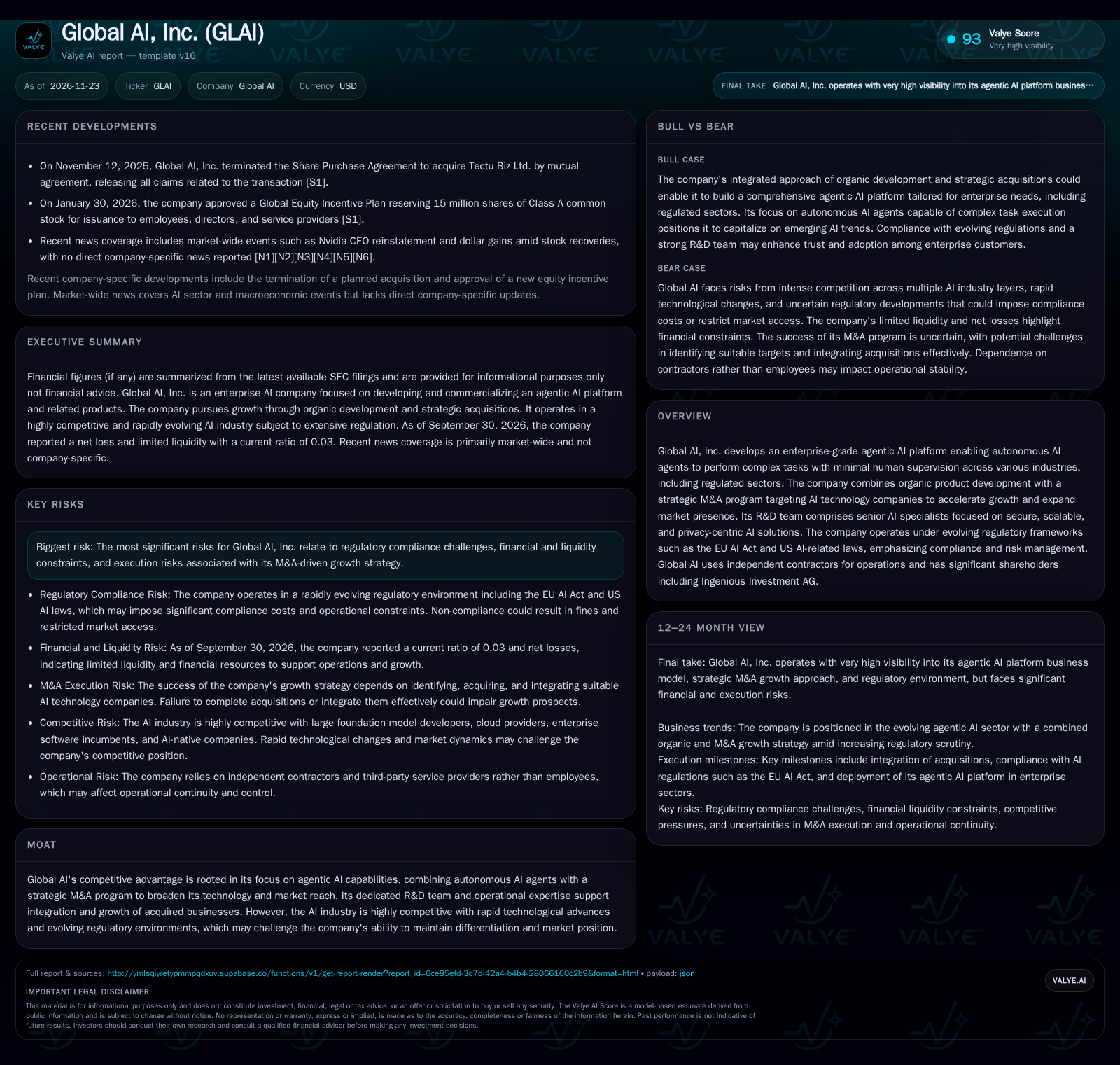
Global AI, Inc. develops enterprise-grade agentic AI solutions and pursues growth through both organic product development and strategic acquisitions. Its future hinges on successful acquisition execution, regulatory compliance, and the ability to demonstrate commercial traction in demanding enterprise markets. [S2]
Global AI, Inc. has positioned itself at the intersection of enterprise automation and agentic AI, aiming to capture demand for autonomous digital agents in regulated sectors through both organic development and strategic acquisitions. Whether Global AI can convert its technological ambition and acquisition pipeline into sustainable, scalable enterprise value remains highly contingent on securing funding, delivering operational integration, and navigating a complex regulatory environment.
Liquidity Strain, Net Losses, and Strategic Pivots Define the Near-Term Landscape
As of September 30, 2026, Global AI, Inc. reported cash and equivalents of just $22,327 against current liabilities of $8.28 million, resulting in a current ratio of 0.03 and a cash ratio of zero. This signals acute liquidity pressure and a reliance on external funding or rapid operational turnaround for continued viability. The company posted a net loss of $1.24 million for the quarter ended September 30, 2026, and annual revenue for 2024 was only $24,896—underscoring that Global AI remains pre-scale in terms of commercial traction. [S2]
Strategically, the company terminated a planned acquisition of Tectu Biz Ltd. in November 2025, demonstrating both the fluidity and execution risk in its M&A-driven growth model. In January 2026, Global AI established a substantial equity incentive plan, reserving 15 million shares for issuance—an indicator of its intent to attract and retain talent as it scales. [S1] [S2]
Operationally, Global AI continues to rely on independent contractors and third-party service providers, with no employees as of December 31, 2025. This structure may offer flexibility but raises questions about continuity, culture, and the ability to execute complex integration projects.
Agentic AI Platform: Revenue Potential and Structural Cost Challenges
Global AI’s business model is built around the development and commercialization of an enterprise-grade agentic AI platform—software designed for autonomous, multi-step digital and physical task execution. In principle, this positions the company to participate in high-value enterprise automation, where software is increasingly delivered as a subscription or via usage-based models, driving recurring revenue and attractive gross margins if product-market fit is achieved.
However, with reported annual revenue of under $25,000 in 2024 and ongoing net losses, Global AI has yet to demonstrate meaningful commercial adoption or operating leverage. The company’s use of independent contractors and reliance on third-party service providers likely shifts some fixed costs to variable, but may also increase integration and coordination overhead, especially as it attempts to scale through acquisitions.
The M&A strategy introduces capital intensity—not only for transaction consideration but also for post-acquisition integration, product enhancement, and go-to-market expansion. Without significant recurring revenue or a robust balance sheet, Global AI may remain dependent on external capital to fund its acquisition pipeline and organic R&D. If commercial adoption accelerates, the model could shift toward positive cash flow and margin expansion, but the current financials do not yet support this trajectory. [S2]
Navigating a Crowded Enterprise AI Landscape with a Niche Agentic Focus
Global AI operates in a hyper-competitive environment spanning foundation model developers, hyperscale cloud providers, enterprise software incumbents, and AI-native vertical specialists. Its agentic AI focus—systems capable of autonomous multi-step workflows—targets a differentiated but rapidly mainstreaming segment, especially as large incumbents and emerging startups race to productize agentic capabilities for regulated industries.
Potential competitive advantages could include deep vertical integration (especially for regulated sectors), proprietary agent orchestration IP, and the ability to rapidly integrate acquired technologies. However, these are theoretical unless the company demonstrates adoption and retention among enterprise customers.
Counterforces include the pace of technological change (with open-source and closed-source foundation models rapidly advancing), the resource depth of larger competitors, and increasing regulatory scrutiny. Global AI’s reliance on acquisitions for technology breadth and market reach means its competitive position is only as strong as its ability to identify, close, and successfully integrate targets—an inherently risky and resource-intensive process.
Switching frictions in enterprise AI can be high due to integration complexity and compliance, but Global AI must first establish itself as a trusted, mission-critical provider before these dynamics can benefit its business.
Acquisition Synergy and Regulatory Compliance Unlock Enterprise Adoption
The most favorable scenario for Global AI involves successfully executing its M&A pipeline—acquiring and integrating complementary AI technology companies that accelerate platform capability, expand the customer base, and create cross-selling opportunities. By leveraging its R&D team to enhance acquired products and ensuring compliance with evolving regulations (such as the EU AI Act), Global AI could position itself as a go-to provider of agentic AI for regulated enterprises.
Enterprise customers may be increasingly motivated to adopt agentic AI solutions that reduce manual workflows, enhance compliance, and deliver measurable ROI. If Global AI can demonstrate robust security, privacy, and regulatory adherence, it may win long-term contracts in banking, insurance, or healthcare. Confirmation of this scenario would come from disclosed multi-year enterprise deals, recurring revenue growth, successful post-acquisition integration milestones, and evidence of customer wins in regulated sectors.
This scenario would likely require new equity or partnership funding to bridge the current liquidity gap, along with visible progress on both organic and acquired product adoption.
Incremental Progress Amid Capital Constraints and Integration Risk
The most plausible trajectory sees Global AI making incremental progress—potentially closing one or two small acquisitions and continuing to refine its agentic AI platform, but with persistent capital constraints limiting the pace and scale of execution. Revenue may begin to build from a handful of enterprise pilots or early contracts, especially in geographies or verticals with less competitive intensity.
Operationally, the reliance on contractors could allow for short-term flexibility but may hamper the company’s ability to deliver complex, customized solutions or to integrate acquired businesses effectively. Regulatory compliance efforts may consume significant resources, slowing go-to-market and increasing cost structure.
Evidence confirming this base case would include modest revenue growth (if disclosed), continued net losses, delayed or staged acquisition closings, and incremental—but not transformative—commercial wins. Falsification would require either a dramatic funding round, material recurring revenue growth, or the announcement of a large-scale, integrated enterprise deployment.
Liquidity Crisis and M&A Stagnation Impede Platform Development
Failure to demonstrate compliance with high-risk AI regulations may close off key enterprise verticals, while large competitors accelerate their own agentic offerings.
Operational disruption could be amplified by the lack of a core employee base, making it difficult to maintain continuity or pivot strategy. If integration of any completed acquisitions falters, the company may face write-downs, customer attrition, or reputational damage.
Confirmation of this scenario would include further deterioration in current ratios, the absence of announced acquisitions or commercial contracts, layoffs or contractor departures, and regulatory setbacks that restrict product launch in key markets.
Milestones and External Factors That Will Define Global AI’s Strategic Trajectory
Evidence of new funding—whether through equity, debt, or strategic partnerships—would be critical to assessing the company’s ability to continue operations and pursue acquisitions.
Disclosure of new enterprise contracts, especially in regulated sectors, would help validate commercial traction for the agentic AI platform.
If disclosed, recurring revenue growth and the proportion of multi-year or subscription-based contracts would test the viability of the company’s business model.
Acquisition closings and subsequent integration milestones (customer retention, technology roadmap convergence) would signal operational execution capacity.
Regulatory developments—such as certification under the EU AI Act or successful audits—would help assess the company’s ability to serve high-risk markets.
Changes in the company’s contractor-to-employee mix, or the establishment of internal teams in key functions, would clarify operational scalability.
Any restructuring, layoffs, or cost-cutting measures could indicate acute financial stress or a pivot in strategy.
Disclaimer: This is research-only, informational analysis and not investment advice. It may include AI-generated interpretation and general industry context. Always verify important details using primary sources.

Comments