
Exyn Technologies: Expanding Autonomous Robotics Ecosystem Faces Financial and Execution Crosswinds
Exyn Technologies reported 28% sequential revenue growth and 69% year-over-year gross profit growth in Q3 2026, extending its AI autonomy software to third-party drones and joining a major DOE mining initiative.
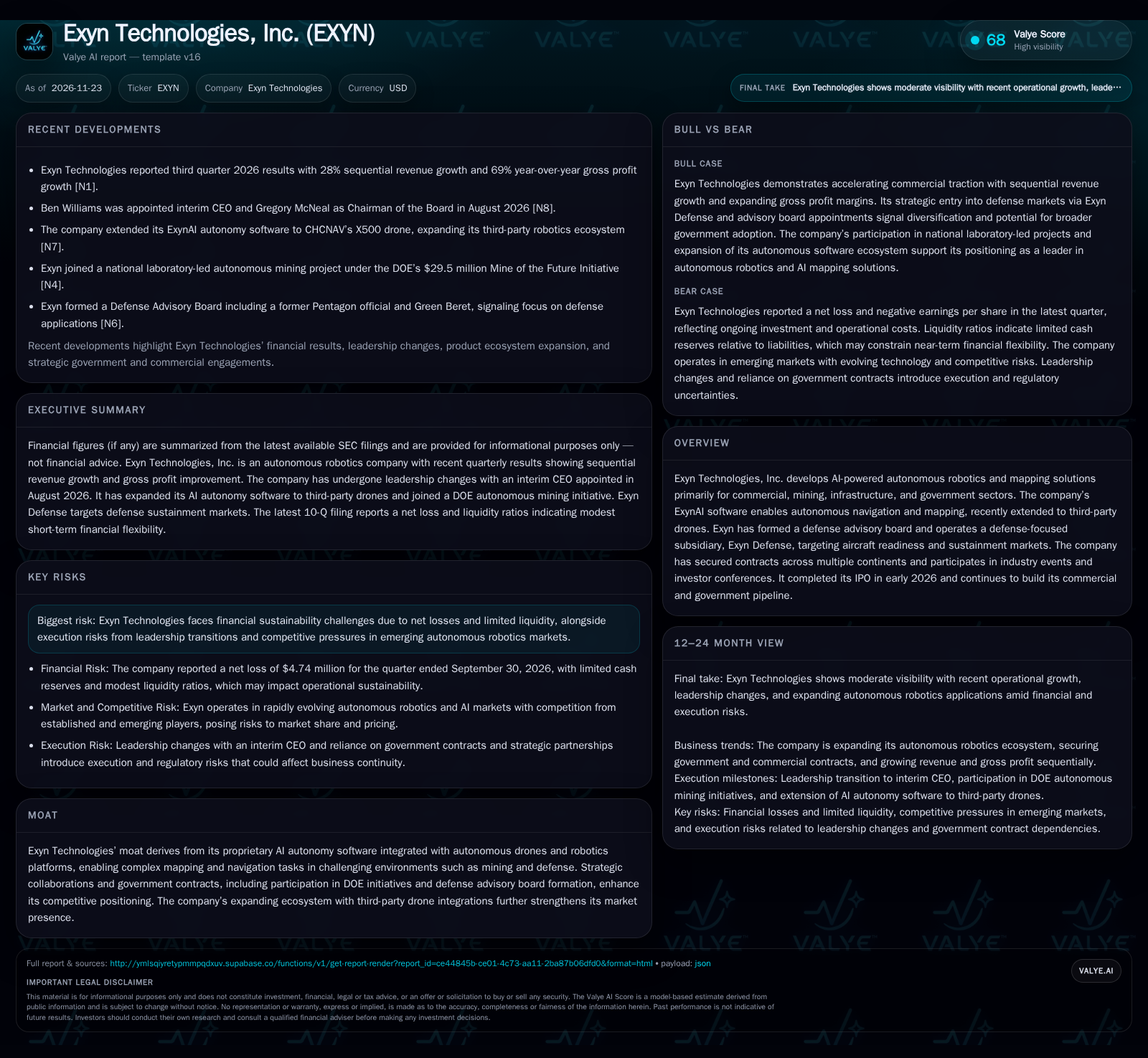
Exyn Technologies reported 28% sequential revenue growth and 69% year-over-year gross profit growth in Q3 2026, extending its AI autonomy software to third-party drones and joining a major DOE mining initiative. [N1] [S1] [N7] [N4] [N8]
Exyn Technologies stands at a pivotal juncture in the commercialization of autonomous robotics and AI-powered mapping. The company’s Q3 2026 results reflect strong revenue and gross profit momentum, underpinned by product ecosystem expansion and entry into high-profile government initiatives. Yet, these operational gains are tempered by continued net losses, reported liquidity position, and leadership changes, sharpening the focus on whether Exyn can translate technical and commercial advances into long-term financial sustainability and defensible market share.
Recent Momentum and Strategic Shifts Define Exyn’s Current Landscape
Exyn Technologies reported 28% sequential revenue growth and 69% year-over-year gross profit growth for the quarter ended September 30, 2026, suggesting that its solutions are gaining traction across target markets. This topline acceleration coincides with the company’s expansion of its ExynAI software platform to third-party drones, notably the CHCNAV X500, which broadens its robotics ecosystem and potentially increases its addressable market. In parallel, Exyn has joined the Department of Energy’s $29.5 million Mine of the Future Initiative, positioning itself within a national laboratory-led autonomous mining project—a signal of credibility and potential pipeline expansion in industrial and government verticals. Leadership transitions, including the appointment of Ben Williams as interim CEO and Gregory McNeal as Chairman, add complexity to execution during this critical phase. [N1] [N7] [N4] [S1] [N8]
Revenue Streams, Cost Structure, and Leverage Dynamics in Autonomous Robotics
Exyn’s business model blends hardware-enabled software sales, ExynAI software licensing, service contracts, and support agreements. This hybrid revenue mix means that gross margins could expand as software and recurring service components rise as a share of revenue—especially if third-party drone integrations drive more software-only deployments and reduce capital intensity. However, hardware sales and integration projects likely still contribute materially to current revenues, constraining near-term margin upside and exposing the company to supply chain and working capital risks typical in robotics hardware.
Operating leverage is plausible if Exyn can shift its revenue mix toward higher-margin software licensing and services, while maintaining R&D and SG&A discipline. The company’s net loss ($4.74 million in Q3 2026) underscores that scale and cost control remain elusive at current volumes. Capital needs could remain significant, driven by ongoing product development, sales expansion, and the working capital required for hardware fulfillment. [S1]
Participation in government initiatives and defense markets could offer larger contract sizes and multi-year visibility if Exyn can convert pilots into recurring engagements. However, government contracting cycles are long and unpredictable, and the company’s financial disclosures do not establish the duration or recurrence of current contracts. Ultimately, sustainable profitability will depend on Exyn’s ability to scale its installed base, increase software/service mix, and manage cost growth as it pursues multiple verticals.
Ecosystem Expansion, Proprietary Autonomy, and the Challenge of Entrants and Substitutes
Exyn’s competitive positioning is anchored by its proprietary Level 4B autonomy software, which allows unmanned systems to operate in GPS-denied, hazardous, or complex environments—capabilities critical for mining, infrastructure, and defense use cases. The extension of ExynAI to third-party platforms, such as CHCNAV’s X500 drone, signals a shift from a closed hardware-software stack to a broader ecosystem approach. This could accelerate adoption by reducing customer switching costs and making Exyn’s solutions accessible to a wider range of OEMs and end-users.
However, the autonomous robotics landscape is intensely competitive, with established industrial automation players, specialized drone manufacturers, and AI navigation startups all vying for share. Larger competitors may have deeper balance sheets, broader product portfolios, and established government contracting relationships. Technology substitution risk is also present, as advances in machine vision, edge computing, or alternative autonomy stacks could erode Exyn’s differentiation if it cannot maintain a technical lead.
Switching frictions may be moderate in mining and infrastructure, where workflow integration and safety certifications create some customer lock-in. In defense, barriers are higher due to security clearances and procurement cycles, but these markets are also susceptible to shifting budget priorities and regulatory hurdles. Exyn’s participation in high-profile initiatives and formation of a defense advisory board may enhance credibility, but must be converted into durable, recurring business to create a true moat.
From Ecosystem Expansion to Recurring Revenue: What a Breakout Could Look Like
A favorable scenario for Exyn hinges on the successful scaling of its third-party software integrations, converting pilot deployments into multi-year, recurring contracts in mining, infrastructure, and defense. If ExynAI becomes the autonomy layer of choice for a critical mass of OEMs and large end-users, the company could shift its revenue base toward high-margin software licensing and support, driving operating leverage and improved gross margins. Participation in the DOE’s Mine of the Future Initiative could serve as a showcase, leading to broader industry adoption and follow-on government projects.
Confirmation of this scenario would include disclosed multi-year contract wins, rising software/service share of revenue, and evidence of expanding installed base via third-party platforms. Gross margin expansion and narrowing operating losses would strengthen the case that Exyn is achieving scale and moving toward self-sustaining profitability. Strategic partnerships or additional government awards, particularly in defense, would further validate the company’s positioning and enhance revenue visibility.
Navigating Growth Pains: Incremental Progress with Persistent Frictions
The most plausible outcome is that Exyn continues to grow its commercial and government pipeline, delivering sequential revenue growth and incremental gross margin improvement as software integrations increase. However, hardware sales, custom deployments, and ongoing R&D will likely remain significant cost drivers, resulting in continued net losses in the near term.
Confirmation of this base case would be continued sequential revenue growth, stable to improving gross margins, but ongoing operating losses and limited cash flow generation. Customer wins in mining and government would support the growth thesis, but the absence of multi-year recurring revenue disclosures or material balance-sheet improvement would indicate that the company is still in a transitional phase. The risk of dilution or additional capital raises remains present unless operating leverage improves materially.
Liquidity Squeeze and Execution Stumbles Could Stall Commercialization
The adverse scenario is defined by a failure to convert pilot projects and ecosystem momentum into recurring, high-margin revenue streams. If hardware-centric contracts dominate, or if government and industrial pilots do not scale to production, Exyn could face continued net losses without the scale necessary to cover fixed costs. Further, supply chain disruptions, competitive wins by larger players, or regulatory/budget delays in defense or mining could erode growth prospects.
Leadership instability could compound execution risk, and failure to secure new contracts or renewals would likely trigger a reassessment of the company’s ability to remain a viable independent operator. Evidence of this downside would include shrinking or flat revenue, deteriorating gross margins, rising payables, or emergency capital raises. [S1]
Milestones and Metrics That Will Determine Exyn’s Long-Term Trajectory
Sustained sequential revenue growth and gross margin expansion, particularly from software and service contracts, would indicate successful transition to a higher-value model.
Disclosure of multi-year, recurring contract wins—especially in mining, infrastructure, or defense—would help test the durability and scalability of Exyn’s business.
Third-party OEM integrations: tracking the number and strategic significance of new platform partnerships would clarify ecosystem reach and adoption velocity.
Cash flow from operations and changes in working capital would provide insight into the company’s ability to self-fund growth and withstand short-term shocks.
Gross R&D and SG&A spending trends, relative to revenue, would reveal whether Exyn is achieving operating leverage or facing cost containment challenges.
Leadership stability and management team depth: further turnover or difficulty in attracting experienced executives could signal execution risk.
A useful metric would be customer retention or renewal rates, if disclosed, to gauge satisfaction and recurring revenue potential.
Disclaimer: This is research-only, informational analysis and not investment advice. It may include AI-generated interpretation and general industry context. Always verify important details using primary sources.

Comments