
Shreya Acquisition Group: SPAC Deadline Dynamics, Trust Mechanics, and the Stakes of Target Selection
With its $110 million IPO proceeds in trust and a 12-month shot clock ticking, Shreya Acquisition Group faces the classic SPAC dilemma: can it identify and close a compelling business combination before time, costs, and redemption pressures erode its capital base and shareholder value?
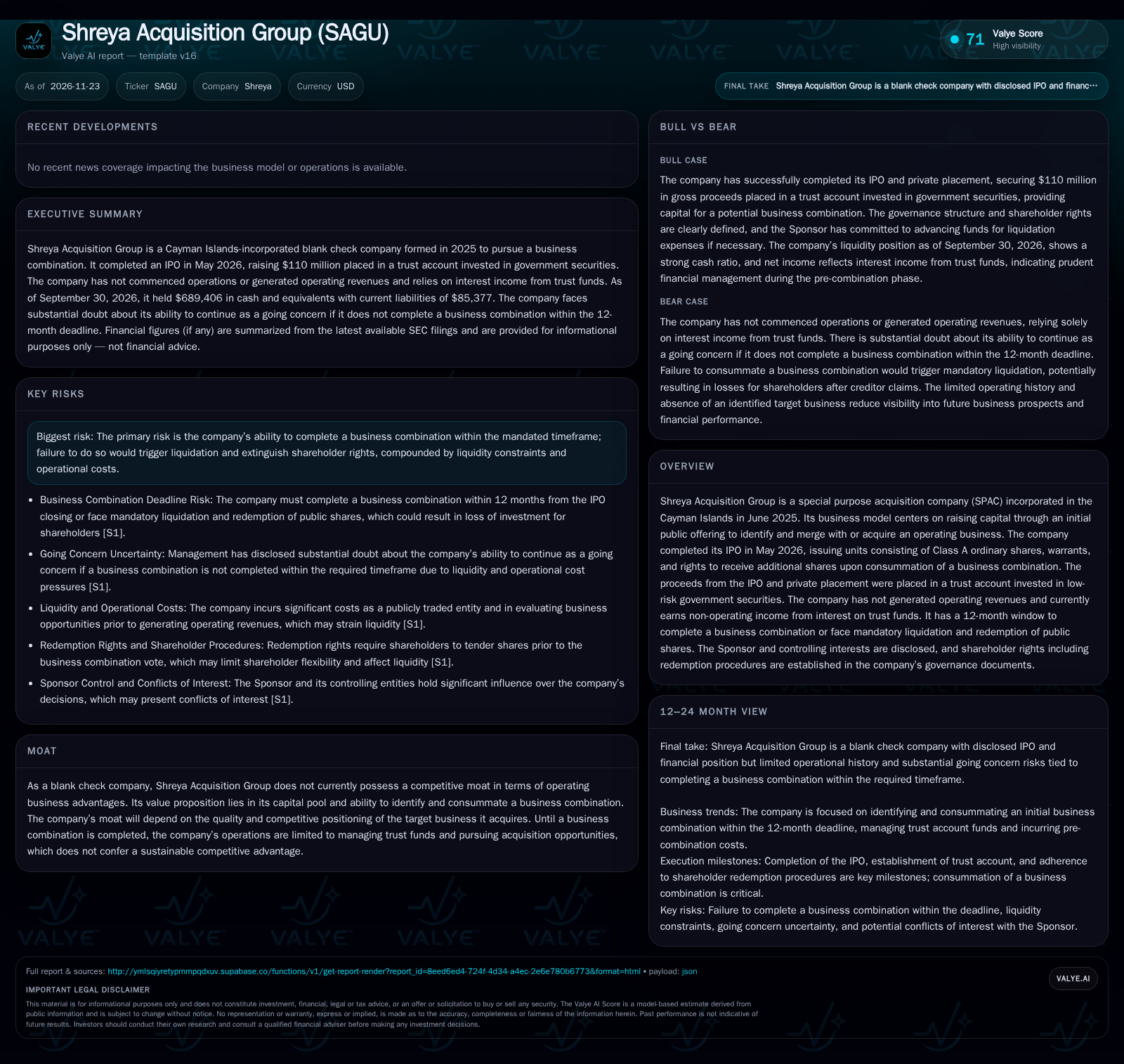
Shreya Acquisition Group (SAGU) is a Cayman Islands-incorporated SPAC with $110 million in trust, no operating revenues, and a 12-month deadline post-IPO (May 2026) to consummate a business combination or face liquidation. The company currently earns only interest income on trust assets and reports substantial doubt about its ability to continue as a going concern if no deal is completed in time. The commercial outcome hinges entirely on target selection, deal execution, and the interplay between sponsor incentives, redemption rights, and the SPAC capital structure. [S1] [S2]
Shreya Acquisition Group embodies the classic pre-deal SPAC profile: a $110 million trust raised in May 2026, a ticking 12-month clock, and zero operating revenue as it hunts for a merger target. The company’s entire value proposition now hinges on its ability to identify and consummate a business combination before the mandatory liquidation deadline, all while navigating sponsor incentives, shareholder redemption rights, and the erosive pressure of public company costs. With substantial doubt about its ability to continue as a going concern if no deal is struck, SAGU’s near-term trajectory will be defined by the quality of its target pipeline, the efficiency of its deal process, and the market’s willingness to support the eventual transaction. [S1] [S2]
IPO Proceeds, Trust Structure, and the Countdown to Combination
Shreya Acquisition Group completed its IPO on May 8, 2026, raising $110 million through the issuance of 11 million units at $10.00 per unit, with an additional $1.917 million from a private placement to the sponsor. All proceeds are held in a trust account invested in U.S. government securities or money market funds, consistent with standard SPAC mechanics. As of September 30, 2026, the company had not commenced operations and reported no operating revenues, with net income of $917,339 for the quarter entirely attributable to interest income from the trust account. The SPAC has a 12-month window from IPO closing to complete a business combination, after which it must liquidate and return funds to public shareholders. Management has disclosed substantial doubt about continued operations if a business combination is not completed within this timeframe, highlighting the existential importance of deal execution. [S1] [S2]
SPAC Economics: Trust Yield, Cost Drag, and the Capital Stack
Shreya’s economic model is typical of blank check companies: pre-combination, it earns only interest on trust assets, while incurring public company and diligence-related costs. These fixed costs—audit, insurance, legal, administrative—are not offset by operating revenues, so the cash outside the trust (reported at $689,406 as of September 30, 2026) is steadily eroded. The trust itself is insulated and protected for public shareholders, who have redemption rights at a pro rata share of the trust upon combination or liquidation. The sponsor’s private placement units and founder shares are at risk of total loss if no deal is completed, but potentially highly lucrative if a successful business combination occurs. The economic tension is between maximizing the quality of the target and completing a deal before cost drag, redemptions, or deadline pressure erode the capital base. The 12-month window, with possible extensions if approved by shareholders, creates a high-stakes, time-bound search process.
The interplay between trust yield and cost drag creates a delicate balancing act for SPACs like Shreya. While the trust assets are conservatively invested to preserve capital and ensure liquidity for redemptions, the low yields on government securities and money market instruments limit the ability to offset ongoing expenses. This dynamic places a premium on minimizing non-essential costs and efficiently managing the deal pipeline to avoid unnecessary dilution or cash burn. Furthermore, the sponsor’s incentive alignment is nuanced: while they benefit from deal completion through founder shares and warrants, excessive pressure to close a suboptimal transaction can erode long-term shareholder value, potentially leading to reputational damage that undermines future capital raises or sponsor partnerships.
SPAC Market Competition and the Implications of Sponsor Incentives
Shreya operates in a crowded SPAC environment, where competition is not for customers but for attractive, willing targets. Its main assets are its $110 million trust, its sponsor’s network and reputation, and its ability to move quickly. However, hundreds of other SPACs compete for the same pool of targets—often driving up valuations or forcing sponsors into riskier or lower-quality deals as deadlines approach. Unlike operating companies, Shreya cannot claim a moat; its competitive position will only be defined at the moment a business combination is announced. Sponsor incentives (founder shares, warrants, and control over the process) can sometimes lead to deals that prioritize deal completion over long-term shareholder value, especially as the deadline looms. The redemption feature, allowing shareholders to exit for their trust share, further complicates deal economics and post-combination capitalization.
Competition among SPACs intensifies as the deadline approaches, often compressing the margin for error in target selection and negotiation. Sponsors must weigh the trade-off between pursuing higher-quality but potentially more complex or time-consuming deals versus lower-quality targets that can close swiftly but may underperform post-merger. The presence of redemption rights adds another layer of complexity: high redemption rates reduce the effective deal equity, forcing sponsors to seek additional PIPE capital or accept higher leverage, which can strain the post-combination balance sheet and operational flexibility. Thus, the sponsor’s network and reputation are critical assets, enabling access to proprietary deal flow and credible PIPE investors that can mitigate these risks.
High-Quality Target, Low Redemptions, and Sponsor-Shareholder Alignment Drive Value
The optimal outcome for Shreya is the identification and successful closing of a high-quality, growth-oriented target at a reasonable valuation. If the sponsor’s network yields a proprietary or underappreciated target—particularly in one of the stated focus sectors (health and wellness, hospitality, media and entertainment, shipping, infrastructure, or waterways tourism)—the deal could attract positive market reception, low redemptions, and strong post-merger performance. Evidence confirming this would include an announced business combination with a target that has a credible management team, robust historical and projected financials, and clear sector tailwinds, as well as a low level of shareholder redemptions at the merger vote. High-quality PIPE (private investment in public equity) participation would further validate the transaction. Conversely, a lack of such signals would falsify the upside thesis.
A high-quality target that aligns well with the SPAC’s stated sector focus can create synergies that drive superior post-merger growth and operational improvements. If the target possesses strong cash flow generation, scalable business models, and defensible market positions, the combined entity may benefit from enhanced access to public capital markets, improved governance standards, and strategic initiatives funded by the SPAC’s capital infusion. Additionally, low redemption rates signal shareholder confidence, preserving deal equity and enabling more robust investment in growth initiatives. Alignment between sponsor and shareholder interests—manifested through transparent communication and disciplined valuation discipline—further supports sustainable value creation beyond the initial business combination.
Deal Completion at Deadline, Moderate Redemptions, and Post-Merger Uncertainty
The most plausible course is that Shreya identifies an acceptable but non-transformative target as the deadline approaches, reflecting the typical SPAC pattern. In this scenario, a deal is announced within the 12-month window, but the market reaction is muted; a significant portion of public shareholders may choose to redeem their shares for trust value, reducing the capital available to the target post-merger. The sponsor’s economics are preserved by getting a deal done, but post-combination performance depends on the quality of the target and the operating environment. Confirmation would come from a late-stage deal announcement with moderate-to-high redemption rates and limited PIPE support. Falsification would be a failure to announce any deal before the liquidation deadline, triggering a return of capital to shareholders and loss of sponsor investment.
Deadline Expiry, Liquidation, and Sponsor/Shareholder Losses
The negative scenario is straightforward: Shreya fails to identify or close a business combination within the required timeframe, resulting in mandatory liquidation and redemption of public shares. Public shareholders receive their pro rata share of the trust account, potentially minus any tax or liquidation expenses, but lose any upside optionality. The sponsor’s private placement and founder shares become worthless. Confirmation would come from a lack of deal announcement as the deadline nears, continued going concern warnings, and ultimately a liquidation filing. Falsification would require evidence of a completed business combination or a credible extension approved by shareholders.
Milestones and External Factors That Will Define Shreya’s Outcome
Announcement of a definitive business combination agreement, including details on target quality, sector, and financials.
Shareholder redemption rates at the time of merger vote, if disclosed, as a proxy for market confidence and capital retention.
PIPE investment participation and terms, which would indicate third-party validation and incremental capital support.
Progress toward regulatory approvals and completion milestones for any announced transaction.
Sponsor loans or additional capital infusions to cover operating costs, if required and disclosed.
General and administrative cost trends, as persistent cost drag could erode non-trust liquidity and pressure the deal timeline.
Shareholder votes on deadline extensions or transaction approval, which test both sponsor influence and investor sentiment.
Updates to going concern disclosures, especially if deadline pressure intensifies without deal progress.
Disclaimer: This is research-only, informational analysis and not investment advice. It may include AI-generated interpretation and general industry context. Always verify important details using primary sources.

Comments