
KALA BIO’s Strategic Pivot: Clinical Progress and Platform Expansion in a Revenue-Free Biotech Model
With no reported revenue and a development-stage profile, KALA BIO, Inc. is relying on clinical milestones and new strategic partnerships—including a pending telehealth acquisition—to reset its value proposition.
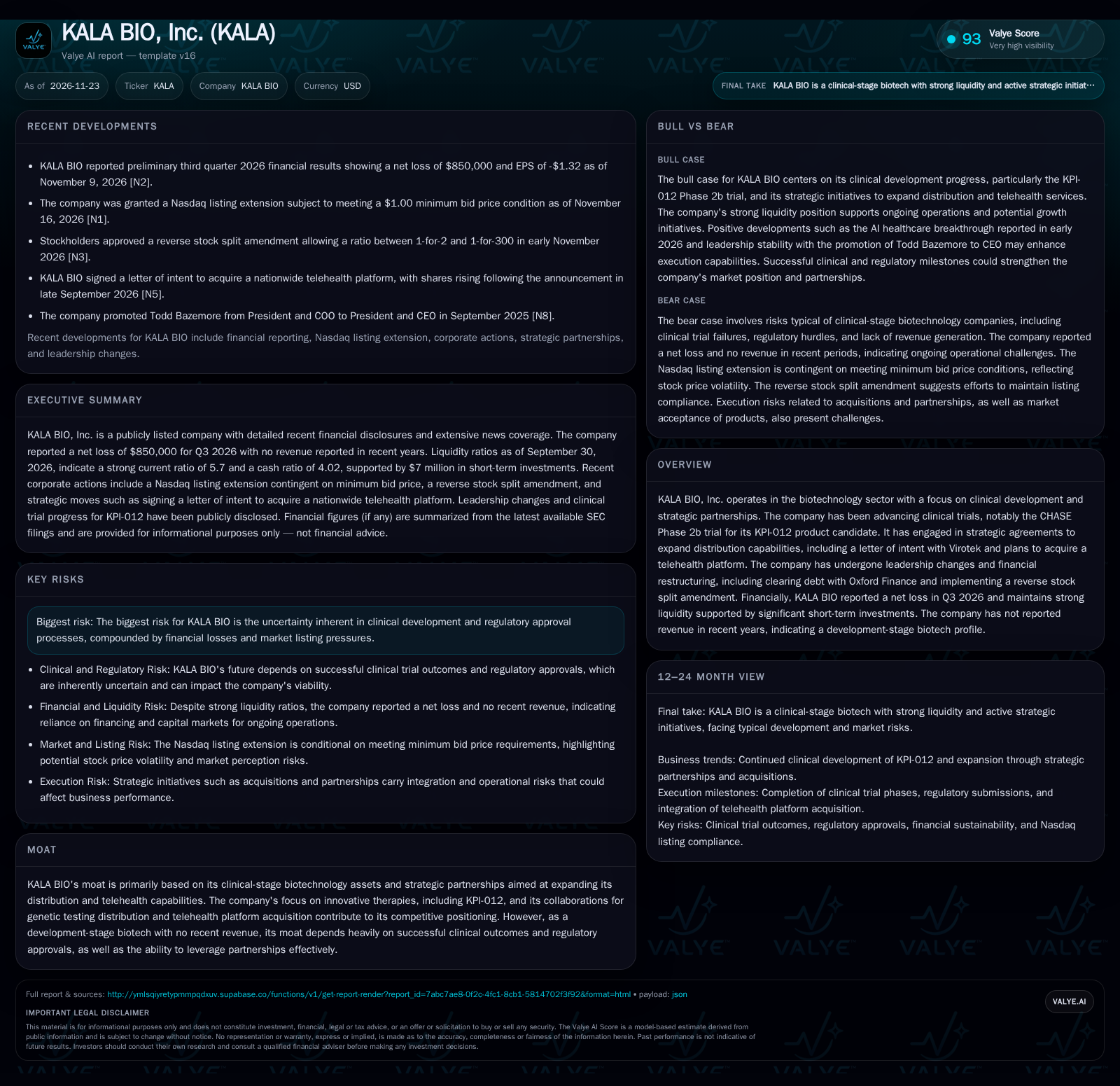
KALA BIO is a clinical-stage biotech with no recent revenue, significant cash and short-term investments, and a reported current ratio. Its future hinges on the KPI-012 clinical program, strategic platform expansion—including a planned telehealth acquisition—and maintaining Nasdaq listing compliance. Execution and regulatory risks remain acute as the company seeks to transition from R&D to commercialization or platform monetization.
KALA BIO, Inc. stands at a strategic crossroads, exemplifying the high-stakes, binary nature of development-stage biotechnology. The company’s financial disclosures show a business with reported liquidity position but persistent losses and no reported revenue—a classic pre-commercial biotech profile. Recent moves, including a letter of intent to acquire a telehealth platform and advancing its KPI-012 clinical program, suggest an ambition to transform from a single-asset R&D company to a broader healthcare platform. With a Nasdaq listing extension in hand but under the shadow of a minimum bid price requirement, KALA’s near-term trajectory will depend on clinical trial outcomes, the successful execution of strategic partnerships, and its ability to convert innovation into a sustainable business model.
Liquidity, No Revenue, and Platform Expansion: The Present State of KALA BIO
The company reported cash and liquidity metrics for the period; these figures do not by themselves establish operating runway, investment capacity, financial flexibility, or financing capacity. [S2] Despite this, the company posted a net loss of $850,000 for Q3 2026 and, critically, has not reported any revenue since at least 2017 [S2]. The company recently signed a letter of intent to acquire a nationwide telehealth platform, indicating a strategic move to diversify its business model and potentially create new revenue channels [N5]. Additionally, KALA BIO received a Nasdaq listing extension, but this is contingent on meeting a $1.00 minimum bid price, highlighting market and compliance pressure [N1]. These facts frame KALA as a company with financial runway but no commercial validation, facing a pivotal period as it attempts to transition from pure clinical development to broader healthcare delivery.
How KALA BIO’s Business Model Could Evolve—and Where the Economics Might Emerge
KALA BIO’s current business model is typical of pre-commercial biotech: high fixed costs for R&D, negligible variable costs, and no operating revenue. Operating leverage is negative at this stage, as increased spending does not yield revenue until (or unless) a product is approved and commercialized.
The economics could shift dramatically if KPI-012 achieves positive clinical outcomes and secures regulatory approval. At that point, the company could monetize its asset through direct commercialization, licensing deals, or partnerships with larger pharmaceutical firms. Each pathway would have different margin profiles: direct commercialization would require further investment in sales and manufacturing infrastructure but could capture higher gross margins, while licensing would provide lower but less risky milestone and royalty streams.
The planned acquisition of a telehealth platform hints at a potential hybrid model, where KALA could begin generating service or platform revenues ahead of, or in parallel with, product-based revenue. If the telehealth business is already operational and scalable, it could provide a recurring revenue base and a channel for future product launches or patient engagement. However, absent detail on the target’s business mechanics, it remains unclear whether this would meaningfully shift KALA’s economics in the near term or simply add further execution complexity.
Strategic Partnerships and Clinical Assets: Where KALA BIO Sits in the Biotech and Digital Health Landscape
KALA BIO’s competitive position is currently defined more by potential than by realized market share. Its clinical-stage asset, KPI-012, targets a high-value segment of the ophthalmology market, where successful entrants can command premium pricing and face limited direct competition until patent expiration. However, the pre-commercial status and lack of revenue mean KALA is not yet a direct competitive threat to incumbent pharma or established digital health players.
The company’s partnership with Virotek for exclusive U.S. distribution of genetic testing and the telehealth platform LOI suggest a strategy to build a differentiated ecosystem spanning therapeutics, diagnostics, and digital care. If executed, this could create a modest moat via integrated offerings and patient data, particularly if combined with proprietary clinical assets. Still, the competitive advantage remains largely theoretical until clinical and commercial proof points are established.
KALA faces competition from both established biopharma companies developing ophthalmology assets and digital health startups scaling telehealth and genetic testing. Barriers to entry in biotech remain high due to regulatory, capital, and clinical expertise requirements, but digital health is more crowded and subject to rapid technological substitution and shifting payer/provider preferences.
What Could Unlock Value: Clinical Success, Regulatory Wins, and Platform Integration
The most favorable scenario for KALA BIO involves a successful readout from the KPI-012 Phase 2b trial, followed by prompt progression to pivotal studies or partnership/licensing deals with established pharmaceutical companies. Regulatory approval would enable either direct commercialization or lucrative out-licensing, with milestone and royalty streams potentially transforming the company’s economics.
Simultaneously, if the telehealth acquisition closes and is integrated effectively, KALA could establish an early recurring revenue base and a differentiated go-to-market channel for its clinical assets. The combination of proprietary therapeutics and digital care could attract payer/provider partnerships or additional acquirers seeking integrated models.
Evidence that would confirm this upside: positive Phase 2b and subsequent trial results; regulatory submissions and approvals; closure and operational integration of the telehealth platform; disclosure of revenue generation or commercial contracts; and any partnership/licensing announcements with major pharma or digital health players.
Development-Stage Realities: Slow Progress, Ongoing Losses, Execution Risk
The most plausible trajectory for KALA BIO is a continuation of its development-stage profile: ongoing R&D spend, no near-term revenue, and periodic strategic announcements as the company seeks to maintain investor interest and listing compliance. Clinical progress on KPI-012 could be incremental, with topline data by Q3 2025 but a likely multi-year path to any regulatory approval or monetization.
The telehealth acquisition may close but could require significant integration, technology, and marketing investments before contributing meaningfully to the top line.
Evidence supporting this scenario includes continued net losses, limited or no revenue disclosure, delays in clinical or regulatory milestones, and additional financing or stock split actions to maintain listing status.
Clinical or Regulatory Setbacks and Market Pressures Could Force Strategic Retrenchment
Adverse outcomes for KALA BIO would stem from clinical trial failures, regulatory setbacks, or inability to close and integrate the telehealth acquisition. A negative or inconclusive KPI-012 Phase 2b result would significantly impair the company’s value proposition, likely triggering investor flight and renewed listing risk.
If the telehealth acquisition falls through or fails to generate meaningful revenue, KALA’s diversification strategy would be compromised, leaving it exposed as a single-asset, pre-revenue biotech. Prolonged net losses and lack of commercial traction could force the company into dilutive financings, asset sales, or even delisting if the minimum bid price is not sustained.
Evidence that would confirm a downside scenario: negative clinical trial results; regulatory rejections or delays; failed or abandoned acquisition; persistent sub-$1.00 share price; and disclosure of going-concern warnings or emergency capital raises.
Factors That Will Determine Whether KALA BIO’s Strategic Shift Delivers Value
Topline results and subsequent regulatory milestones for the KPI-012 Phase 2b trial, including any disclosures on efficacy and safety.
Closure and integration progress of the nationwide telehealth platform acquisition, and any disclosure of resulting revenue or operational synergies.
Updates on the Virotek genetic testing distribution agreement, including early commercial traction or partnership expansion.
Company disclosures on cash burn rate, operating runway, and any planned or completed capital raises.
Nasdaq listing status and actions taken to maintain compliance with minimum bid price requirements.
Any signs of revenue generation from new initiatives, including telehealth or genetic testing, if disclosed.
Changes in leadership team execution or strategic focus, particularly following the CEO transition.
Disclaimer: This is research-only, informational analysis and not investment advice. It may include AI-generated interpretation and general industry context. Always verify important details using primary sources.

Comments