
Polar Power’s Financial Distress: Restructuring Moves and the Uncertain Road to Viability
While recent Nasdaq compliance and restructuring targets offer a glimmer of stability, the company’s underlying business model and market positioning remain under intense pressure.
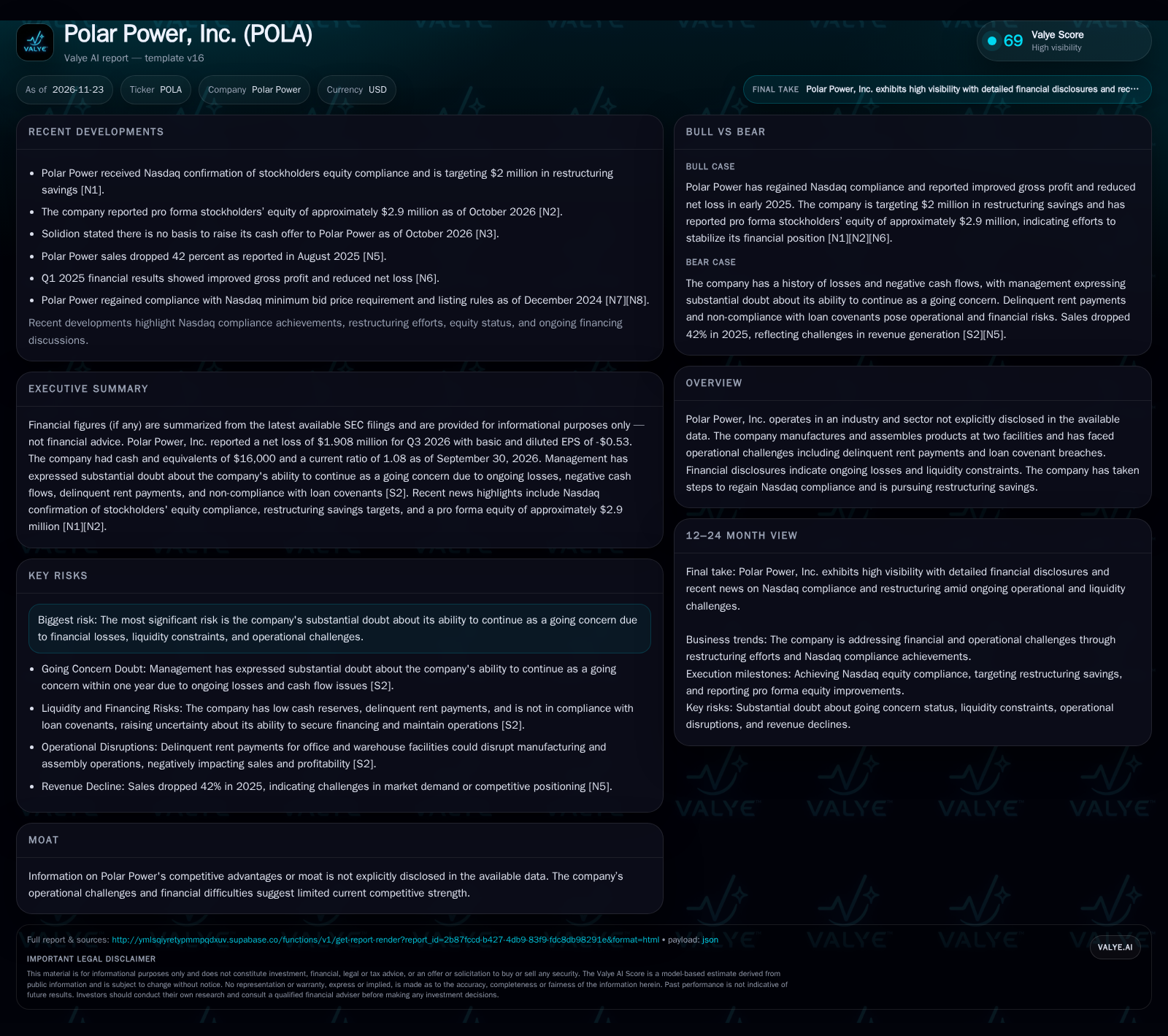
Polar Power, Inc. is contending with acute financial strain—reporting minimal cash, ongoing losses, and operational disruptions—despite recent Nasdaq compliance and a targeted $2 million in restructuring savings. Management’s stated doubts about the company’s ability to continue as a going concern underscore the urgency of its turnaround efforts. With sales plunging 42% in 2025 and persistent covenant breaches, the company’s path forward depends on successful cost reduction and any stabilization in revenue or financing options.
Polar Power, Inc. stands at a critical inflection point. Despite regaining compliance with Nasdaq’s listing requirements and announcing $2 million in restructuring savings, the company’s fundamentals remain deeply challenged—cash is nearly exhausted, management has flagged substantial doubt about its ability to continue as a going concern, and operational disruptions persist. The company’s recent 42% sales decline and ongoing covenant breaches illustrate the acute risks facing the business. As Polar Power pursues drastic cost reductions and seeks financial stabilization, the effectiveness of these measures—and any change in core demand—will determine whether it can survive or faces further contraction.
Acute Liquidity Strain and Operational Disruptions Define the Present
The company reported cash and liquidity metrics for the period; these figures do not by themselves establish operating runway, investment capacity, financial flexibility, or financing capacity. Management has formally expressed substantial doubt about the company’s ability to continue as a going concern, citing persistent losses, negative cash flows, and operational challenges such as delinquent rent payments and loan covenant breaches [S2]. The company experienced a 42% drop in sales in 2025, reflecting either sharp demand erosion or competitive displacement [N5]. Despite these headwinds, Polar Power has recently regained Nasdaq compliance and is targeting $2 million in restructuring savings, with pro forma stockholders’ equity reported at $2.9 million as of October 2026 [N1] [N2]. These moves offer temporary regulatory relief but do not resolve the underlying business fragility.
The interplay between liquidity constraints and operational disruptions creates a feedback loop that can exacerbate financial distress. For instance, delays in rent payments may lead to strained landlord relationships, risking eviction or unfavorable lease renegotiations that increase fixed costs or reduce operational flexibility. Similarly, breaches of loan covenants often restrict access to additional financing or trigger accelerated repayment demands, further tightening liquidity. This environment limits the company’s ability to invest in inventory or workforce stability, which in turn can impair production schedules and customer fulfillment, potentially accelerating revenue declines. Therefore, managing these interdependencies is critical; failure in one area can cascade into broader operational paralysis.
Cost Structure and Cash Burn: The Economics of Survival
Polar Power’s business model—manufacturing and assembling products at two facilities—suggests a high fixed-cost base, including facility rent, labor, and inventory requirements. With minimal cash on hand and a history of negative operating cash flow, the company’s economics are currently driven more by survival than by growth. The targeted $2 million in restructuring savings signals aggressive cost-cutting, possibly through headcount reduction, facility consolidation, or renegotiation of supply and lease terms [N1]. However, the magnitude of the recent 42% sales decline means that even a leaner operation may struggle to reach break-even without a revenue rebound [N5]. The company’s reported cash balance highlights an urgent need for either rapid operational turnaround, external financing, or asset sales. Polar Power’s operating leverage, once an advantage in periods of growth, now magnifies losses as volumes decline.
The company’s fixed-cost intensity implies that variable cost reductions alone will be insufficient to restore profitability without a meaningful increase in sales volume. Given the manufacturing footprint, certain overhead expenses—such as facility maintenance and core staffing—are unlikely to scale down proportionally with declining output, leading to a higher per-unit cost structure under reduced volumes. Moreover, restructuring savings often involve one-time charges or temporary measures, which may not translate into sustainable cost advantages if the underlying demand environment remains weak. Therefore, the company’s path to positive cash flow likely depends on a combination of structural cost realignment and a credible revenue recovery strategy that can leverage operating leverage effectively.
Market Pressure and the Challenge of Differentiation
While the specific end-markets for Polar Power’s products are not disclosed, the company’s sharp sales contraction suggests either intense price competition, technological substitution, or customer attrition. In industries such as distributed power, telecom backup, or specialized industrial generators—plausible categories given the company’s name and manufacturing footprint—competition can be fierce, with scale players able to out-invest in R&D and price aggressively. Polar Power’s operational instability, evidenced by covenant breaches and facility rent delinquencies, may raise customer and supplier concerns about reliability, further eroding competitive position. Without a clear product differentiation, sticky contracts, or proven recurring revenue, the company appears vulnerable to both demand shocks and aggressive competitors.
In markets characterized by rapid technological evolution and commoditization, differentiation becomes paramount to maintaining pricing power and customer loyalty. Without proprietary technology, patented designs, or embedded service contracts, companies like Polar Power risk commoditization that pressures margins and sales volumes. Additionally, customer perceptions of financial stability influence procurement decisions, particularly in capital-intensive or mission-critical applications where vendor reliability is essential. Thus, operational instability not only impacts internal costs but also external market positioning, potentially accelerating customer attrition. Strategic focus on niche segments with higher switching costs or specialized features could mitigate these risks, but execution requires investment and time that may be constrained under current conditions.
Turnaround Hinges on Execution: Cost Cuts and Revenue Stabilization
A favorable scenario would require Polar Power to execute its restructuring plan swiftly, realizing the targeted $2 million in cost savings without further operational disruption [N1]. If the company can stabilize or modestly grow sales—perhaps by regaining lost accounts, launching a differentiated offering, or expanding into a less contested niche—operating leverage could work in its favor, shrinking losses or restoring modest profitability. Confirmation would come from sequential revenue stabilization, consistent gross margin improvement, and progress in reducing net losses, as was briefly seen in early 2025 [N6]. Additional evidence would include the resolution of rent delinquencies, renewed loan covenant compliance, and the restoration of positive operating cash flow. If Polar Power can also secure bridge financing or favorable supplier terms, it could buy time for a more durable turnaround.
Ongoing Instability and Episodic Relief
The most plausible path is continued operational and financial instability, punctuated by sporadic cost-cutting and regulatory compliance milestones. While the company may achieve short-term relief through restructuring and pro forma equity improvements, persistent sales weakness and recurring covenant or rent issues would likely keep Polar Power in survival mode. Evidence supporting this scenario would include ongoing doubts about going concern status in future filings, recurring late payments or covenant breaches, and an inability to generate positive operating cash flow. Modest improvements in net loss or margin, as seen in Q1 2025 [N6], may be offset by further sales volatility or external shocks. The company could remain listed and operational, but with limited strategic flexibility and persistent existential risk.
Liquidity Exhaustion and Disrupted Operations Could Force Restructuring or Exit
If cost reduction measures fail to offset continued sales declines or if external funding proves unavailable, Polar Power could exhaust its liquidity, leading to severe operational disruptions or forced restructuring. Non-payment of facility rent could prompt eviction, halting production and sales. Persistent covenant breaches could trigger loan defaults, accelerating liabilities. In this scenario, the company may be compelled to pursue asset sales, bankruptcy protection, or an outright wind-down. Confirmation would come from further deterioration in working capital metrics, missed payroll or supplier payments, or explicit bankruptcy warnings from management. News of failed financing attempts or large customer defections would further validate this adverse trajectory.
What Will Determine Polar Power’s Survival or Decline?
Sequential quarterly sales trends—stabilization or continued decline would clarify demand dynamics and competitive pressure (if disclosed).
Gross margin progression, especially following restructuring efforts, to assess whether cost savings are sustainable and sufficient to offset revenue weakness (if disclosed).
Resolution of rent delinquencies and facility occupancy status, as further disruptions could halt production or sales.
Updates on loan covenant compliance and any new financing arrangements, which would indicate external confidence and operational runway.
Operating cash flow trends—persistent negative cash flow would signal heightened risk of insolvency (if disclosed).
Size and timing of any new customer contracts, channel partnerships, or product launches that could support revenue recovery (if disclosed).
Disclosure of asset sales, layoffs, or facility closures as indicators of deeper restructuring or distress.
Disclaimer: This is research-only, informational analysis and not investment advice. It may include AI-generated interpretation and general industry context. Always verify important details using primary sources.

Comments