
SOBR Safe: Shell Status, Compliance Ambitions, and the Structural Hurdles to Commercial Relevance
SOBR Safe, Inc. faces profound operational and regulatory headwinds after its Nasdaq delisting and shell-company classification, despite recent efforts to launch enterprise compliance software. The company’s ability to transition from cash-rich but revenue-poor status to sustainable operations depends on overcoming structural, financial, and market-access constraints.
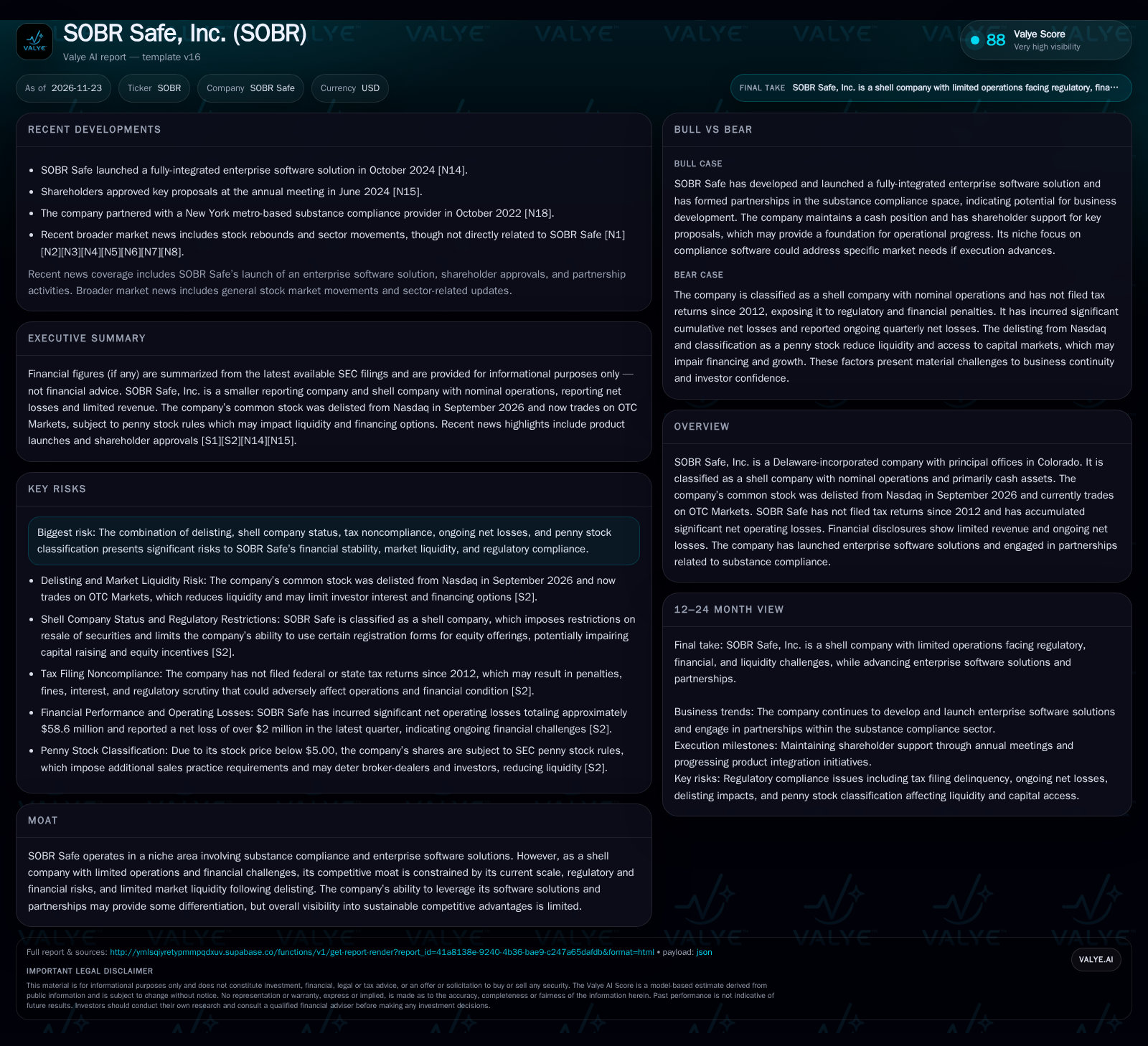
SOBR Safe, Inc. is currently a shell company with nominal operations, limited revenue, and ongoing net losses. Its delisting from Nasdaq and penny stock status restrict liquidity and financing options. While recent enterprise software launches and partnerships suggest a pivot toward substance compliance solutions, execution risk is high and financial/regulatory constraints are acute. The company’s future hinges on demonstrating commercial traction and resolving legacy compliance issues [S2].
SOBR Safe, Inc. stands at a crossroads defined by regulatory, financial, and operational uncertainty. After being delisted from Nasdaq and reclassified as a shell company, its primary assets are cash and a set of compliance-focused software initiatives. While recent product launches and partnerships signal intent to pivot toward active operations in the substance compliance space, the company’s persistent net losses, unresolved tax filings, and restricted market access pose formidable obstacles. Investors and industry observers must weigh the prospects for a commercial turnaround against the company’s entrenched structural challenges.
Material Developments: Delisting, Shell Status, and Nominal Operations
SOBR Safe, Inc. is currently classified as a shell company under SEC definitions, with only nominal operations and primarily cash assets [S2]. The company’s common stock was delisted from the Nasdaq Capital Market in September 2026, and now trades on the OTC Markets, subject to SEC penny stock rules due to its price being below $5.00 [S2]. As of September 30, 2026, SOBR Safe reported $29,075 in quarterly revenue against a net loss of $2,033,228, with cumulative net operating losses reaching approximately $58.6 million as of December 31, 2025 [S2]. The company also has not filed federal or state tax returns since 2012, exposing it to regulatory and financial penalties [S2]. These factors collectively constrain SOBR Safe’s ability to attract investors, raise capital, and engage in normal commercial activity.
Economic Model Constraints: Cash-Rich Shell, Minimal Revenue, and Uncertain Path to Scale
SOBR Safe’s current economics are defined by its shell company status: operations are nominal, revenue is negligible, and losses are persistent [S2]. The latest quarterly revenue of $29,075 is dwarfed by operating expenses, resulting in a net loss of over $2 million for the period [S2]. The company’s reported current assets of $1.4 million and current liabilities of $0.9 million yield a current ratio of 1.58, but these metrics reflect a static balance-sheet rather than an actively operating business [S2].
If SOBR Safe is to transition from a shell to an operating company, its economics would need to shift toward recurring software subscription or compliance-service revenue. Enterprise compliance software, if successfully commercialized, could offer high gross margins and favorable operating leverage, as fixed R&D and platform costs are spread across a growing customer base. However, with minimal revenue and no evidence of scaled customer adoption, the company’s economics remain speculative. Capital needs could increase if product development or go-to-market efforts accelerate, and the lack of tax compliance could further constrain cash utility or prompt regulatory action.
Competitive Landscape: Niche Compliance Ambitions Amid Structural Disadvantages
SOBR Safe operates in the substance compliance and enterprise software niche, where credible incumbents and emerging startups compete to address employer, institutional, and regulatory needs for substance use detection and monitoring. The market includes established compliance software vendors, device manufacturers, and integrated workplace safety solution providers. As a shell company, SOBR Safe lacks the operational scale, brand presence, and customer credibility typically required to win contracts or recurring business in this space.
Recent efforts to launch a fully-integrated enterprise software solution and partnerships with substance compliance providers indicate an attempt to build relevance. However, the company’s limited operational infrastructure, unresolved tax and regulatory issues, and penny stock status reduce its attractiveness as a partner or vendor. Customer switching costs in compliance software can be moderate if integration is deep, but SOBR Safe’s ability to create such stickiness is unproven. As a result, its competitive position is weak unless it can demonstrate rapid product-market fit and overcome operational handicaps.
From Shell to Substance: What a Successful Operational Pivot Would Require
A favorable scenario would see SOBR Safe resolve its regulatory and tax issues, leverage its cash assets to accelerate product development, and achieve meaningful commercial traction for its enterprise software in the substance compliance space. The company could secure pilot customers or small-scale contracts, using these as proof points to attract further partnerships or distribution agreements. If the software solution demonstrates clear ROI and ease of integration for employers or compliance providers, recurring revenue could begin to offset fixed costs, setting up operating leverage.
Confirmation of this scenario would require evidence of material contract wins, disclosed customer adoption metrics, or recurring revenue growth tied to the new software platform. Additionally, regulatory remediation—such as bringing tax filings current—would be necessary to unlock full use of cash and restore business credibility. Falsification would occur if the company remains in shell status with persistent nominal revenue, or if regulatory penalties further erode its capital base.
Stasis and Survival: Persisting as a Shell with Episodic Product Initiatives
The most plausible trajectory is that SOBR Safe continues to operate as a shell company, making periodic attempts to launch or license software in the substance compliance market but failing to achieve sustained commercial momentum. Revenue remains minimal, while operating costs and regulatory burdens persist, eroding the cash position over time. The company may announce new partnerships or product enhancements, but without evidence of scaled customer adoption, these efforts do not translate into durable operating results.
This scenario is confirmed by continued classification as a shell, nominal revenue, and lack of major customer or contract disclosures. Falsification would require a clear and sustained uptick in recurring revenue, customer wins, or regulatory remediation that signals a transition to active operations.
Regulatory and Financial Drag: How Unresolved Liabilities Could Trigger Further Erosion
The company could face lawsuits or restrictions on its ability to issue equity or raise capital, especially if penny stock status and OTC trading persist. Operating losses continue, leading to potential insolvency or forced asset sales. In this environment, partnerships and product launches provide little relief, as counterparties may avoid engagement due to perceived instability.
Evidence supporting this scenario would include regulatory actions, new or escalating penalties, further declines in cash balances, or disclosures of legal proceedings. Conversely, successful resolution of tax and compliance issues, or a material improvement in financial performance, would challenge this downside outlook.
Milestones and External Triggers That Could Reshape SOBR Safe’s Outlook
Progress in resolving outstanding tax filings and regulatory compliance issues—such as the filing of overdue federal and state tax returns—would help test whether SOBR Safe can restore operational flexibility.
Disclosure of new, material commercial contracts or pilot programs tied to the enterprise software solution would indicate early customer traction and validate the pivot away from shell status.
Evidence of recurring revenue growth, if disclosed, would be a direct signal of commercial momentum and product-market fit in the substance compliance space.
Announcements of meaningful partnerships with established compliance solution providers or enterprise customers would help assess the company’s ability to penetrate the market.
Quarterly operating expense trends and cash burn rates, if disclosed, would clarify the sustainability of current operations and the urgency of achieving revenue growth.
Any regulatory actions, penalties, or lawsuits related to tax noncompliance or penny stock status would increase downside risk and should be monitored closely.
Shareholder meeting outcomes and approvals for strategic proposals may signal ongoing investor support or changes in strategic direction.
Disclaimer: This is research-only, informational analysis and not investment advice. It may include AI-generated interpretation and general industry context. Always verify important details using primary sources.

Comments