
Caro Holdings: Micro-Scale Operations, Liquidity Strength, and the Limits of Transparency
Caro Holdings Inc. presents an unusual combination of extremely low revenue and net losses offset by a strikingly reported current ratio, yet with scant disclosure about its business model or sector, raising fundamental questions about its economic viability and future direction.
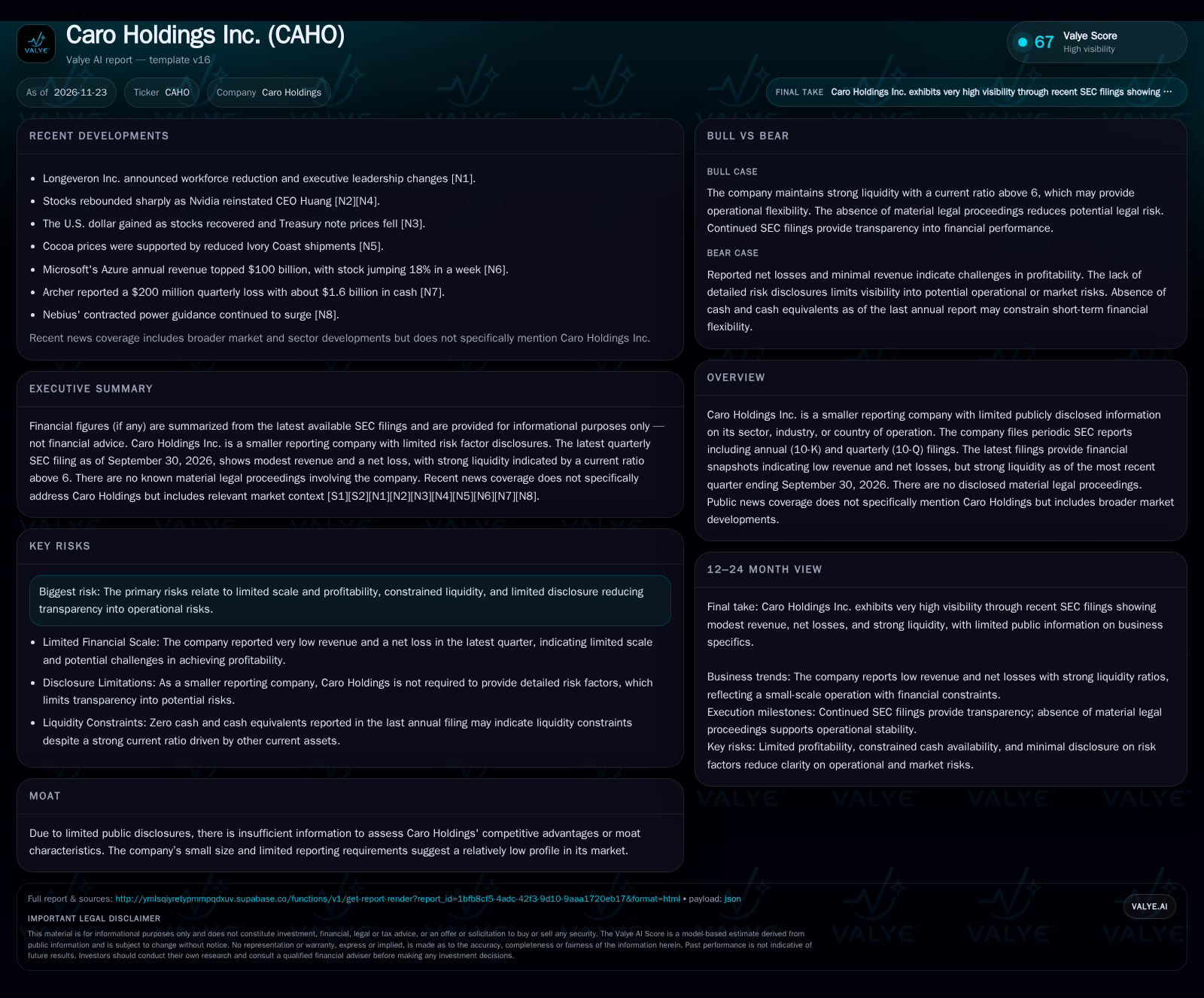
Caro Holdings Inc. reported just $69 in quarterly revenue and a net loss of $90,918, but holds a current ratio of 6.04 as of September 30, 2026. The absence of material legal proceedings reduces downside legal risk, but the company’s micro-scale operations and persistent losses highlight the need for a clearer path to sustainable business activity. [S2]
Caro Holdings Inc. stands out for its paradoxical financial profile: the company reported negligible quarterly revenue and a sizeable net loss, yet reported liquidity-ratio trends above 6, a rare level of short-term liquidity for an entity of its scale. Despite these headline numbers, the company’s lack of detailed disclosures about its business activities, sector, or competitive context leaves investors with little insight into how or if the business can transition from micro-scale operations to a viable enterprise. The absence of legal or regulatory overhang is a positive, but the core question remains: what, if anything, underpins Caro Holdings’ asset base and potential future earnings?
Why Caro Holdings’ Liquidity and Revenue Profile Demands Scrutiny
The most material current facts about Caro Holdings are its extraordinarily low revenue—just $69 for the quarter ending September 30, 2026—and a reported net loss of $90,918 for the same period [S2]. At the same time, the company reported $8,298,599 in current assets against $1,374,659 in current liabilities, producing a current ratio of 6.04 [S2]. This suggests reported liquidity position on paper. However, the last reported annual figure for cash and cash equivalents was zero as of March 31, 2022 [S1], raising questions about the composition and direct usability of these assets. With no material legal proceedings disclosed [S1], the company faces no immediate legal or regulatory headwinds, but the combination of micro-scale revenue and substantial current assets is highly unusual and central to understanding its potential and risks.
Decoding Caro Holdings’ Economic Model: Where Does Value Come From?
The business economics of Caro Holdings are opaque due to the lack of sector or product disclosure, but the available facts point to a company operating on a micro scale. With only $69 in quarterly revenue, it is not currently generating meaningful income from operations [S2]. The net loss of nearly $91,000 for the same period suggests that fixed costs—such as compliance, basic administration, and reporting—substantially outstrip any incoming cash flow. The current asset base, while large relative to revenue, may consist of non-cash items such as receivables, prepaid expenses, or other short-term assets that do not directly support operations or growth. Without cash flow from operations or clear evidence of an income-generating asset, Caro Holdings’ economic viability appears to depend on its ability to either monetize its asset base, attract additional capital, or pivot into a viable business model. There is no evidence of operating leverage or scalable margin structure at present.
Further examination of Caro Holdings’ asset composition is critical to understanding its economic model. If a significant portion of current assets consists of non-cash items such as advances, deposits, or intangible assets classified as current, the liquidity implied by the current ratio may be overstated. This distinction matters because non-cash current assets do not directly support operational cash flow or debt servicing. Additionally, if the company’s liabilities are primarily short-term and fixed, the mismatch between asset liquidity and liability maturity could create refinancing risk or cash flow timing challenges. Understanding whether these assets can be converted to cash without material loss is essential to assessing the company’s runway and potential financial flexibility.
Assessing Competitive Standing in the Absence of Market Visibility
Caro Holdings’ competitive position is virtually impossible to assess with confidence due to the lack of disclosed sector, product, or customer information. As a smaller reporting company, it is not required to furnish detailed business descriptions or risk factors [S1] [S2]. Without knowledge of its industry, it is not possible to benchmark its performance against peers or to identify direct competitors, substitutes, or structural advantages. The company’s low public profile and minimal reporting requirements suggest it is not a dominant or disruptive player in any known market. If Caro Holdings is a holding entity for illiquid or non-operating assets, its competitive position would be tied more to asset monetization opportunities than to market share or product differentiation. In any scenario, the lack of commercial traction and business transparency is a competitive disadvantage in attracting capital or strategic partners.
In the absence of clear market positioning, it is useful to consider Caro Holdings’ potential strategic roles beyond direct competition. For example, the company might function as a passive holding vehicle for assets awaiting monetization or restructuring. In such a scenario, competitive pressures would be less about market share and more about asset management efficiency, cost control, and timing of disposals. Alternatively, if the company is in the early stages of developing a new business line, its current opacity might reflect a deliberate strategic choice to limit disclosure until a viable model emerges. However, this approach carries risks, as limited transparency can hinder investor confidence and access to capital, which are often crucial for scaling operations or executing pivots.
Unlocking Hidden Value: What Would a Favorable Turn Look Like?
The most optimistic scenario for Caro Holdings would involve the company leveraging its current asset base to launch, acquire, or scale an operating business that generates sustainable revenue and positive cash flow. This could happen if the current assets represent monetizable holdings—such as marketable securities, sellable inventory, or receivables that convert to cash—or if the company is positioned to make a strategic acquisition or business pivot. Evidence that would confirm this scenario includes a sharp increase in reported revenue, disclosures of new business lines or acquisitions, or filings indicating a shift in asset composition toward cash or productive assets. Falsifying this scenario would be continued negligible revenue, persistent losses, and no change in the composition or deployment of current assets.
The Most Plausible Trajectory: Administrative Survival Without Business Progress
The most likely outcome, based on current evidence, is that Caro Holdings continues to operate in a low-activity, administrative mode. The company may persist as a shell or holding entity, maintaining compliance and periodic reporting but generating minimal revenue and incurring ongoing net losses.Its reported current ratio may be sustained by non-cash current assets, but without clear monetization or operational progress, the business is unlikely to scale or become profitable. Confirmation of this scenario would be ongoing filings with little change in revenue, persistent net losses, and static asset composition. Evidence of business development, new commercial contracts, or a material change in cash position would challenge this baseline.
When Asset Quality or Burn Rate Triggers a Strategic Inflection
The primary downside risk is that Caro Holdings’ current assets prove illiquid or impaired, forcing the company to either raise capital, sell assets at a discount, or wind down operations. If the burn rate persists while revenue remains negligible, the company’s ability to fund basic operations could be threatened despite a superficially reported current ratio. Evidence supporting this scenario would include a sharp drop in current assets, new disclosures about asset impairment, or filings indicating a need for external financing. Conversely, if the company maintains its current asset level and burn rate without material change, this scenario would be less likely in the short term but remains a risk over time.
Another dimension of downside risk involves the potential for asset impairment triggered by external market conditions or internal valuation reassessments. If Caro Holdings holds assets whose fair value is sensitive to economic cycles, regulatory changes, or technological obsolescence, a decline in asset value could materially weaken the balance sheet and necessitate write-downs. Such impairments would not only reduce reported current assets but could also trigger covenant breaches or accelerate liquidity stress. Moreover, if the company’s operational burn rate remains steady or increases without corresponding revenue growth or asset monetization, the cumulative cash drain could force distress-driven decisions, including asset fire sales or restructuring, further eroding shareholder value.
Milestones and Metrics That Will Define Caro Holdings’ Next Chapter
Any material change in quarterly revenue—especially if accompanied by new business line disclosures—would provide insight into whether Caro Holdings is evolving beyond its current micro-scale operations.
A detailed breakdown of current assets in future filings would help clarify the liquidity and usability of the company’s asset base.
Disclosure of new business activities, acquisitions, or strategic pivots would indicate a move toward operational viability.
Sustained or increasing net losses with no change in revenue would reinforce the thesis of administrative persistence without business progress.
A sudden reduction in current assets or new financing activity would signal potential liquidity stress or a shift in strategic direction.
If disclosed, information on customer relationships, contract terms, or revenue recognition mechanics would help assess the company’s business model and recurring revenue potential.
Any emergence of legal or regulatory proceedings could alter the company’s risk profile and operational flexibility.
Disclaimer: This is research-only, informational analysis and not investment advice. It may include AI-generated interpretation and general industry context. Always verify important details using primary sources.

Comments