
Local Bounti’s Controlled Environment Agriculture: Proprietary Yield, Capital Pressures, and the Urgency of Strategic Adaptation
Its survival and potential hinge on rapidly securing additional funding and translating technological yield into sustainable, profitable scale.
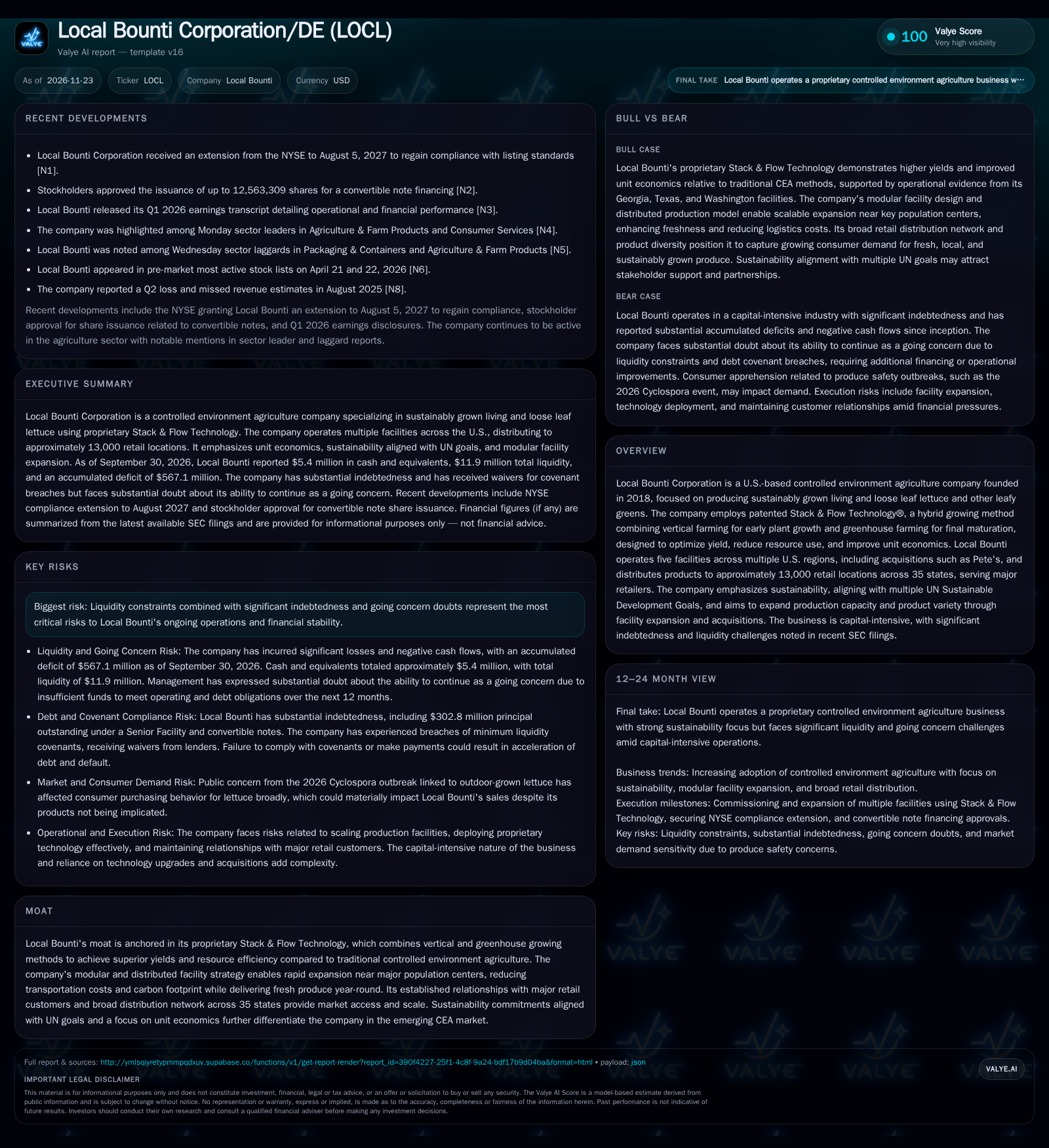
Local Bounti’s proprietary hybrid CEA technology and distribution to 13,000 retail locations underscore its operational ambition, but severe liquidity shortfalls and ongoing losses have forced debt covenant waivers and raised substantial doubt about its ability to continue as a going concern. The company’s future now depends on its ability to obtain new financing or execute drastic operational improvements, even as it demonstrates superior yield potential in select facilities. Strategic execution and capital access will determine whether Local Bounti’s model can scale before financial constraints force retrenchment or restructuring. [S2]
Local Bounti Corporation’s bold vision—a proprietary hybrid approach to controlled environment agriculture (CEA), broad distribution footprint, and sustainability commitments—contrasts sharply with its current financial reality. Despite operational advances and a retail network spanning 13,000 locations, the company faces a severe cash crunch, mounting debt, and explicit going concern warnings. The crux of the Local Bounti story is no longer just about technology or market access, but about whether the company can bridge the funding gap in time to realize its operational promise. This analysis explores the core economics, competitive structure, and the critical scenarios now shaping Local Bounti’s future.
Acute Liquidity Strain, Debt Burden, and Technology Yield: The Current State of Play
Local Bounti’s latest financials spotlight a business at a crossroads: as of September 30, 2026, the company reported $5.4 million in cash, $6.5 million in restricted cash, and a current ratio of 1.2—metrics that are overshadowed by a $567.1 million accumulated deficit and $340.3 million in outstanding debt ($302.8 million senior facility, $37.5 million convertible notes). Management has formally expressed substantial doubt about the company’s ability to continue as a going concern, citing insufficient funds to meet operating needs and debt obligations in the coming year. The company has received covenant waivers and shifted to payment-in-kind interest for certain periods, underscoring the fragility of its debt situation. [S2]
Operationally, Local Bounti continues to demonstrate its proprietary Stack & Flow Technology’s potential, reporting doubled run-rate production at the Georgia facility and improved yields at Texas and Washington sites. The company’s products are distributed to approximately 13,000 retail locations across 35 states, including major chains like Kroger, Walmart, and Whole Foods. However, the capital intensity of facility expansion and the need for ongoing investment threaten to outpace available resources, placing the business model under acute stress. [S2]
Hybrid CEA Economics: Yield, Scale, and the Capital Cost Dilemma
Local Bounti’s business is built on the premise that its patented Stack & Flow Technology—a hybrid of vertical farming for seedling growth and greenhouse production for maturation—can materially improve unit economics in the leafy greens sector. The company targets higher yields (1.5–2.0x traditional CEA greenhouse output) and lower resource intensity (90% less water and land than conventional agriculture), with the potential for lower per-unit labor and logistics costs through modular, distributed facility deployment.
However, the economics are heavily dictated by upfront capital requirements: facility construction, technology integration, and ongoing operational costs are substantial. The modular build strategy is intended to reduce construction lead times and allow for local proximity to major population centers, theoretically lowering transportation costs and spoilage. Yet, the fixed cost burden is high, and the company’s ability to ramp utilization fast enough to absorb overhead is, in practice, highly sensitive to demand, execution, and financing availability.
On the revenue side, access to major retail partners provides volume potential, but the CEA produce market is characterized by thin gross margins and intense price competition from both traditional and other CEA producers. While Local Bounti’s product diversity—living lettuce, packaged greens, salad kits—offers some mix benefits, overall profitability depends on achieving high facility utilization and supply chain efficiency, neither of which is guaranteed in the current capital-constrained environment.
Defensible Edge or Technology Arms Race? Competitive Dynamics in CEA
Local Bounti’s competitive proposition rests on three pillars: proprietary Stack & Flow Technology, a modular and distributed facility network, and established retail relationships. The technology offers demonstrable yield and resource efficiency gains over traditional CEA greenhouses, and the distributed footprint is designed to ensure freshness and reduce last-mile logistics costs.
However, the CEA sector is marked by rapid technological evolution and aggressive entrants, including both well-capitalized vertical farming startups and established greenhouse operators expanding into automated, data-driven production. Many competitors are also pursuing proprietary growing systems, automation, and sustainability branding, eroding any static technological moat.
Switching costs for retailers are relatively low—most large grocers source from multiple suppliers and are sensitive to price, reliability, and food safety. Local Bounti’s brand and product breadth offer some insulation, but long-term retention hinges on consistent supply, competitive pricing, and the ability to scale alongside customer growth. The modular facility strategy, if adequately funded, could enable market share capture in new geographies, but only if operational excellence is maintained and capital is available.
From Distress to Differentiation: How Rapid Capital Infusion and Execution Could Unlock Value
A favorable outcome for Local Bounti would require securing near-term external financing—whether through equity, debt restructuring, or strategic partnerships—providing the runway to bring additional facilities to full utilization. If the company is able to translate its demonstrated yield gains into sustained, profitable operations at scale, it could leverage its retail network and sustainability credentials to outcompete less efficient rivals.
Confirmation of this scenario would come from announcements of new capital raises, successful refinancing or conversion of debt, and evidence of improving gross margins and positive cash flow from operations. Additional signs would include further expansion of retail contracts, improved facility utilization rates, and stabilization or reduction of per-unit logistics and production costs.
Falsification would be signaled by continued delays or failures to secure financing, further deterioration in liquidity, or loss of key retail relationships due to supply disruptions or pricing pressure.
Stretched Operations and Tactical Survival: The Most Probable Near-Term Trajectory
Given the severity of liquidity constraints and the capital-intensive nature of the CEA business, the most plausible scenario is one of tactical survival: Local Bounti continues to seek waiver extensions, incremental financing, and operational efficiencies while restricting growth initiatives and deferring major investments. Facility expansion slows or pauses, with management focused on maximizing utilization and cash generation from existing operations.
This path would likely involve ongoing negotiations with creditors, possible asset sales, and efforts to renegotiate commercial terms with suppliers and customers. The company may seek to monetize non-core assets (such as the currently non-operating Montana facility) or structure joint ventures to share risk and capital burden.
Evidence confirming this scenario would include further disclosures of debt amendments, incremental capital infusions, and flat or modestly improving operational metrics without major expansion announcements. Conversely, an abrupt loss of lender support, further covenant breaches without waivers, or rapid cash depletion would indicate a shift toward downside scenarios.
Liquidity Exhaustion, Debt Acceleration, and the Prospect of Restructuring
The most adverse scenario for Local Bounti is a failure to secure new financing or covenant waivers, triggering acceleration of debt obligations and potentially forcing the company into restructuring or asset liquidation. In this scenario, the company’s operational advances and technology assets may not be enough to offset the overwhelming cash burn and debt burden.
This could result in loss of NYSE listing if continued compliance is not achieved, disruption of customer relationships due to supply interruptions, and possible fire-sale of assets to satisfy creditors. The value of proprietary technology and retail contracts could be impaired if distressed sale conditions prevail.
Evidence supporting this scenario would include public notice of default, withdrawal of lender waivers, missed interest payments, rapid cash drawdown, or announcements of strategic alternatives such as sale, bankruptcy filing, or management turnover.
Milestones and External Shocks That Could Reshape Local Bounti’s Outlook
Announcements of new equity or debt financing, or strategic investments/partnerships that materially increase available liquidity.
Updates on facility utilization rates, yield improvements, or cost-per-unit trends at core production sites—if disclosed, these would clarify progress toward profitable scale.
Additional disclosures on debt covenant compliance, waivers, or amendments, indicating the company’s ongoing relationship with lenders.
Material changes in major retail contracts—new wins, renewals, or losses—that would affect revenue visibility and bargaining power.
Evidence of supply chain disruptions, logistics cost spikes, or quality/safety issues that could impact customer retention.
Progress or setbacks related to NYSE listing compliance, including meeting minimum price or market cap requirements.
Regulatory or market developments (e.g., further produce safety scares, new sustainability regulations) that could shift demand or cost structure for CEA products.
Management turnover or board changes, which could signal strategic realignment or distress.
Disclaimer: This is research-only, informational analysis and not investment advice. It may include AI-generated interpretation and general industry context. Always verify important details using primary sources.

Comments