
I-ON Digital Corp.: Blockchain-Backed Gold Assets Confront Capital Constraints and Compliance Hurdles
I-ON Digital Corp. aims to digitize gold and mineral ownership for institutional finance using a proprietary blockchain platform, but persistent losses, going concern warnings, and internal control weaknesses raise questions about its ability to capitalize on a growing market for real-world asset tokenization.
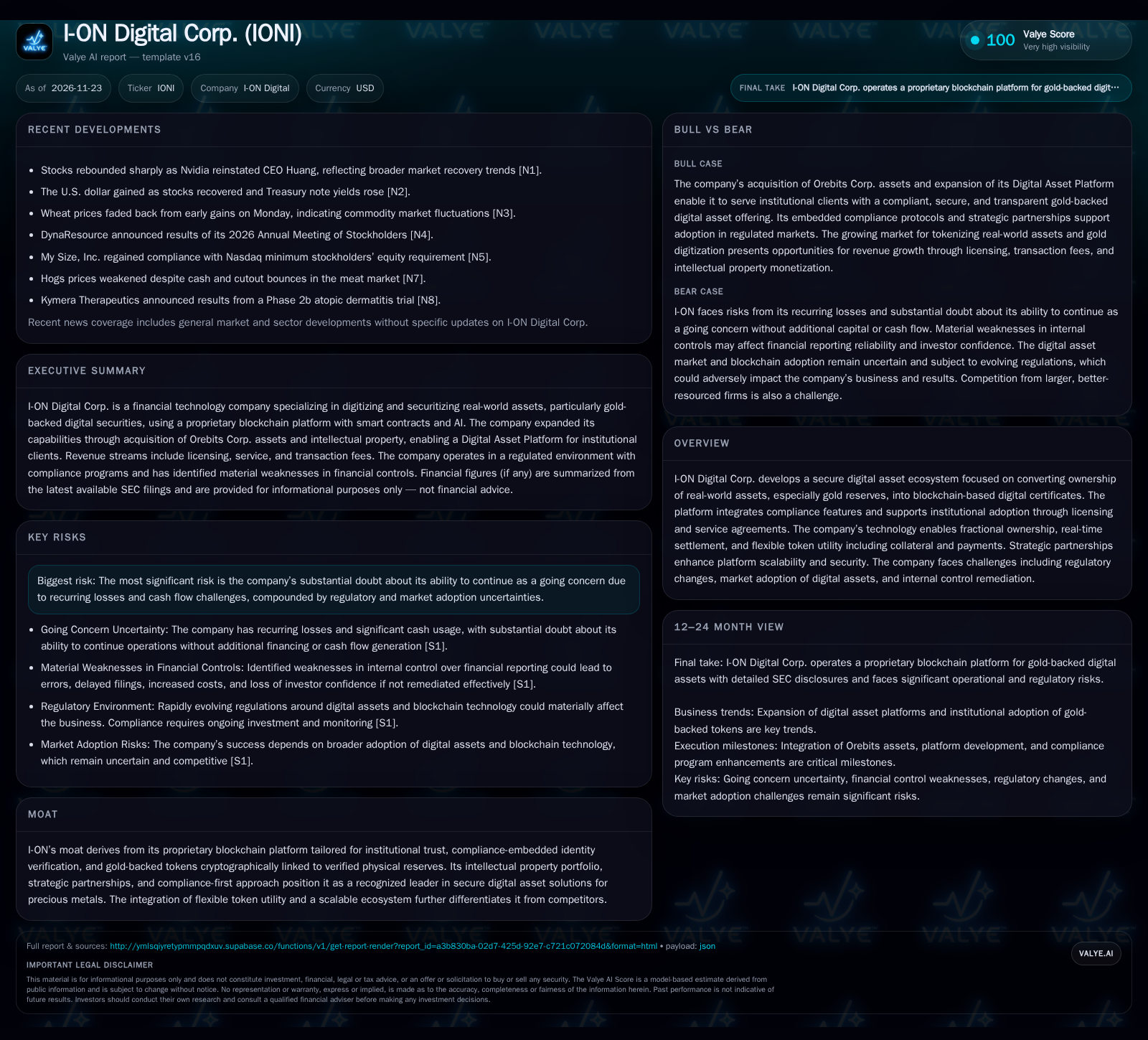
I-ON Digital Corp. develops a blockchain-based platform for digitizing and securitizing gold and mineral reserves, targeting institutional clients with secure, compliant digital asset solutions.While the company recently reported positive net income, its balance sheet reveals a reported cash ratio and a current ratio under 1, with recurring losses and a going concern warning. Success depends on adoption of digital asset platforms, regulatory clarity, and remediation of financial controls, but limited capital and operational resources present substantial risks to sustainable growth. [S1] [S2]
I-ON Digital Corp. positions itself at the intersection of blockchain innovation and institutional finance, offering a platform that digitizes gold and mineral reserves into secure, compliant digital assets. As the market for real-world asset tokenization evolves amid regulatory scrutiny and competitive pressure, I-ON Digital must demonstrate both technical reliability and financial resilience to secure a lasting foothold.
Recent Expansion and Financial Stress Define Current State
I-ON Digital Corp. recently broadened its capabilities by acquiring Orebits Corp.'s gold-backed assets, patents, and intellectual property, enabling an expanded Digital Asset Platform (DAP) aimed at institutional clients such as banks and broker-dealers. This strategic move positions the company to offer asset-backed digital financial instruments with embedded compliance protocols, serving a growing interest in gold digitization. However, as of September 30, 2026, I-ON reported a cash balance of $207,022, current assets of $4.6 million, and current liabilities of $5.7 million, yielding a current ratio of 0.8 and a cash ratio of just 0.04. Despite net income of $1.56 million for the first nine months of 2026, recurring losses and significant cash burn led management to express substantial doubt about the company’s ability to continue as a going concern without additional capital or improved cash flow. Material weaknesses in internal controls over financial reporting further complicate the outlook. [S1] [S2]
Monetizing Digital Gold: Licensing, Transactions, and the Economics of Trust
I-ON Digital’s business model is built around converting proof-of-ownership in gold and mineral reserves into blockchain-based digital certificates, which can be traded, used as collateral, or integrated into payments and settlements. The company generates revenue through a mix of licensing fees for platform access, service charges for digitization and custody, and transaction fees on asset transfers. This structure theoretically enables high-margin, recurring revenue streams if transaction volumes and institutional adoption scale. However, the economics are heavily volume-dependent: fixed costs for platform development, compliance, and ongoing audits are significant, while variable costs are relatively low once assets are onboarded. The model’s success hinges on attracting claim holders with validated gold reserves and institutional buyers seeking secure, compliant tokenized assets—an audience with long sales cycles and high due diligence demands.
Capital needs are pronounced: maintaining regulatory compliance, continuous platform upgrades, and robust audit trails require sustained investment. The company’s reliance on a small core team (five employees) and strategic partners for operational support helps contain costs but may limit agility and capacity to scale. Without a broader customer base or recurring contract lock-ins, cash flow remains sensitive to adoption rates, and operating leverage may not materialize until substantial transaction volumes are achieved. [S1]
Barriers and Counterforces in Digital Asset Tokenization
I-ON Digital’s proposition—blockchain-based gold-backed tokens with embedded compliance and transparency—addresses key institutional concerns around trust, auditability, and regulatory adherence. The company’s proprietary technology, compliance-first approach (including KYC/AML), and cryptographic linkage to physical reserves provide some points of differentiation. Strategic partnerships with custodians and technology providers also enhance interoperability and credibility.
However, the competitive landscape for real-world asset tokenization is intensifying. Larger fintechs, established custodians, and blockchain-native platforms with deeper resources are targeting similar institutional clients. These peers may offer broader asset coverage, more robust integrations, and stronger brand trust, raising switching frictions for prospective clients. Additionally, regulatory uncertainty and the need for jurisdiction-specific compliance create barriers to rapid scaling and favor firms with established legal and compliance infrastructure. The company’s limited operational scale and ongoing internal control issues may further weaken its competitive stance if not resolved. [S1]
If Institutional Adoption Accelerates, Platform Economics Could Inflect
The favorable scenario for I-ON Digital involves a confluence of institutional adoption, regulatory clarity, and successful remediation of internal controls. If banks, broker-dealers, and high-net-worth investors embrace gold-backed digital assets as compliant, auditable instruments, I-ON could see a surge in asset onboarding, transaction volume, and recurring fee income. The company’s partnerships with technology providers and custodians would support scaling, while a compliance-first reputation could attract risk-averse institutions seeking secure tokenization solutions.
Evidence supporting this scenario would include: a significant uptick in platform onboarding by institutional clients, growth in assets digitized (especially gold reserves), and expansion of transaction volumes. Announcements of multi-year licensing agreements, successful completion of external audits, and closure of additional capital rounds would further validate the company’s ability to scale and monetize its platform. Conversely, if institutional clients remain hesitant, regulatory hurdles persist, or control weaknesses remain unresolved, the upside scenario would be undermined. [S1]
Sustained Uncertainty: Incremental Progress Amid Financial and Regulatory Headwinds
The most plausible near-term trajectory for I-ON Digital is one of incremental platform development and selective client wins, offset by persistent financial and operational constraints. While the company’s technology may attract some institutional pilots or smaller-scale deployments, the bulk of revenue is likely to remain modest unless the broader market for gold-backed digital assets matures. Ongoing remediation of internal controls could gradually restore some investor confidence, but recurring losses and a reported cash balance may necessitate further capital raises or cost containment.
Confirmation of this scenario would come from steady, if unspectacular, increases in platform transaction activity, periodic licensing deals, and incremental progress on compliance milestones. Falsification would involve a sudden inflection in client adoption or, conversely, a material deterioration in financial condition leading to restructuring or asset sales. [S1] [S2]
Failure to Secure Capital or Adoption Could Trigger Restructuring
The adverse scenario is defined by the company’s inability to secure additional funding or achieve meaningful platform adoption. Persistent material weaknesses in internal controls could erode stakeholder confidence and delay or derail potential client contracts, while regulatory changes or enforcement actions in the digital asset space could restrict business activity or increase compliance costs.
Confirmation of this scenario would include further going concern warnings, delayed filings, inability to meet payroll or contractual obligations, or announcements of restructuring, asset divestitures, or bankruptcy proceedings. A lack of new client wins, stalled platform development, or regulatory setbacks would also signal increasing downside risk. [S1] [S2]
Milestones That Will Reveal I-ON Digital’s Real-World Asset Tokenization Trajectory
Progress on remediating material weaknesses in internal controls, as evidenced by external audit reports or management disclosures, would help test whether the company can build institutional trust.
The number and size of institutional clients onboarded to the Digital Asset Platform—if disclosed—would indicate traction in the target market.
Growth in the volume and value of gold and mineral reserves digitized on the platform would signal expanding adoption and revenue potential.
Recurring revenue and transaction fee trends, if reported, would clarify whether platform economics are improving and if the business is scaling.
Details on new licensing agreements, intellectual property monetization, or multi-year commercial contracts would provide evidence of commercial momentum.
Updates on regulatory compliance status, such as completion of third-party audits or absence of enforcement actions, would reduce perceived operational risk.
Management commentary or disclosures regarding cash burn rate, cost containment efforts, or plans for operational scale-up would clarify near-term financial resilience.
Disclaimer: This is research-only, informational analysis and not investment advice. It may include AI-generated interpretation and general industry context. Always verify important details using primary sources.

Comments