
Zoomcar: Asset-Light Car Sharing at Scale Faces Liquidity and Structural Headwinds in India
Zoomcar’s peer-to-peer car sharing marketplace has achieved a leading position in India with over 33,000 Host vehicles and 2.5 million active Guests.
Zoomcar has scaled its peer-to-peer car sharing marketplace in India, leveraging a technology-driven, asset-light model and a large user base.
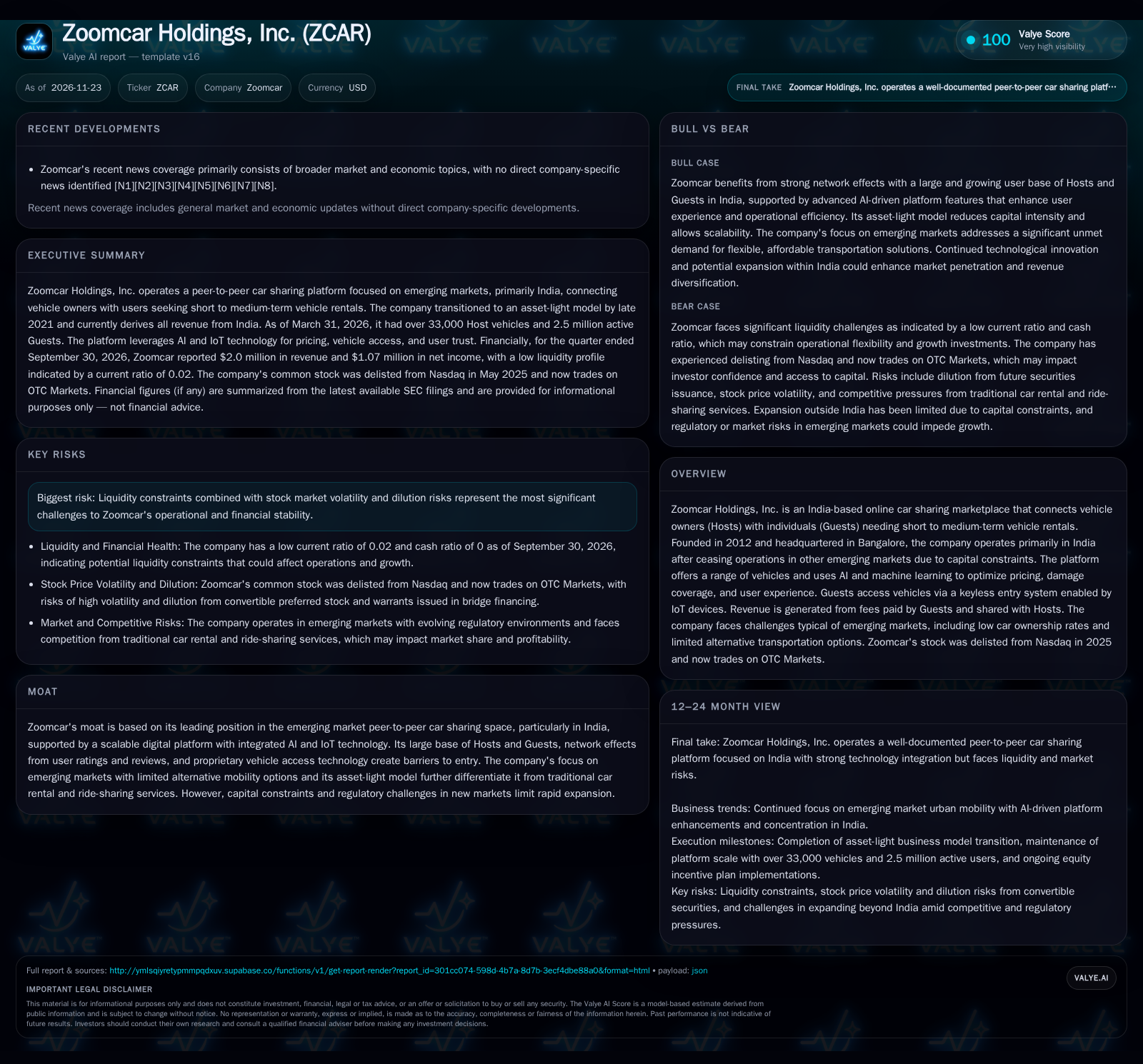
Zoomcar Holdings, Inc. has carved out a distinctive presence in India’s urban mobility ecosystem by operating an online peer-to-peer car sharing marketplace. With more than 33,000 Host vehicles and a user base of 2.5 million active Guests, Zoomcar leverages AI and IoT to drive efficiency and user trust on its asset-light platform.
Liquidity Crunch and Delisting Define Current Reality
As of September 30, 2026, Zoomcar reported cash and equivalents of $85.75 million against current liabilities of $35.41 billion, resulting in a current ratio of 0.02 and a cash ratio of 0 [S2]. The company reported cash and liquidity metrics for the period; these figures do not by themselves establish operating runway, investment capacity, financial flexibility, or financing capacity. Despite reporting $2.0 million in revenue and $1.07 million in net income for the quarter, these figures reflect a thin operating buffer relative to the scale of its obligations [S2].
Zoomcar’s common stock was delisted from Nasdaq in May 2025 and now trades on the OTC Markets, reflecting both operational headwinds and reduced access to institutional capital [S1]. In response to these constraints, the company has issued convertible preferred stock and warrants as part of bridge financing in 2026, creating further dilution risk for existing shareholders [S2].
Operationally, Zoomcar continues to command a large presence in India’s car sharing market, with 33,383 registered Host vehicles and 2.5 million active Guests as of March 31, 2026 [S1]. However, all revenue is now generated solely from India after exits from other emerging markets due to capital constraints [S1].
How the Asset-Light Model Shapes Cost Structure and Value Capture
Zoomcar’s economics hinge on its peer-to-peer, asset-light platform: the company does not own or lease vehicles but instead connects Hosts (vehicle owners) with Guests (renters) through a digital marketplace [S1]. This model reduces capital intensity and fixed asset risk, shifting the business toward a variable cost structure where the primary expenses are platform development, customer acquisition, and support.
Revenue is generated from a mix of upfront booking fees, trip protection fees, and convenience fees paid by Guests, with approximately 40% retained by Zoomcar and 60% passed to Hosts [S1]. This revenue-sharing structure incentivizes Hosts to supply vehicles, but also limits Zoomcar’s take-rate and constrains gross margin expansion.
AI and machine learning drive dynamic pricing, fraud prevention, and user experience optimization, potentially supporting higher utilization and improved margins if market depth is sufficient. However, the platform’s dependency on scale means that fixed costs—technology, regulatory compliance, and customer service—must be absorbed across a large transaction base, making sustained volume growth critical for operating leverage.
Reliance on bridge financing and convertible securities introduces ongoing dilution and uncertainty regarding long-term capital structure.
Defending Share in a Fragmented, Fast-Evolving Mobility Market
Zoomcar’s core competitive advantage lies in its first-mover scale, digital platform integration, and deep local market knowledge. Its AI-powered pricing, IoT-enabled vehicle access, and trust-building features (such as ratings and real-time tracking) are designed to overcome the challenges of low car ownership and limited public transport in Indian cities [S1].
The company benefits from network effects: as the number of Hosts and Guests grows, transaction liquidity and platform reliability improve, making it harder for new entrants to match breadth or trust. However, switching costs for Guests remain relatively low, as alternative mobility options—such as ride-hailing (e.g., Ola, Uber), traditional car rentals, and emerging micro-mobility platforms—compete for urban travel demand.
Zoomcar’s asset-light model differentiates it from fleet-heavy rental companies, but this approach is increasingly replicable by domestic and international competitors, especially as digital and fintech infrastructure matures in India. Regulatory risk, local trust dynamics, and the ability to maintain a high-quality, well-maintained vehicle pool are ongoing challenges. The company’s withdrawal from other emerging markets also signals the difficulty of exporting this model without substantial capital and local adaptation.
Leveraging Platform Scale and Technology for Margin Expansion
A favorable outcome for Zoomcar would see the company harness its large Host and Guest base to drive higher transaction volumes and platform utilization.
As urban mobility demand in India continues to rise and digital payments proliferate, Zoomcar could deepen its penetration among both Hosts (increasing vehicle supply) and Guests (broadening use cases beyond traditional rentals). Margin expansion could follow if improved utilization and value-added services (such as insurance, loyalty programs, or premium listings) increase the take-rate without eroding Host incentives.
Confirmation would come from sustained growth in active users, rising transaction frequency, improved take-rate, and evidence of positive operating cash flow. Additional validating signals would include successful execution of non-dilutive financing or strategic alliances that enhance capital flexibility.
Sustaining Operations Amid Capital Constraints and Incremental Growth
The most plausible near-term trajectory for Zoomcar is one of cautious operational maintenance, constrained by persistent liquidity shortfalls and limited access to growth capital. The company is likely to focus on defending its installed base in India, seeking incremental improvements in platform efficiency and user experience rather than aggressive expansion.
Revenue may grow modestly if urban mobility demand in India continues to rise and the company can successfully retain Hosts and Guests with its technology offerings. However, expansion into new markets or major product investments will likely remain on hold unless capital constraints ease.
This scenario would be confirmed by continued concentration of revenue in India, stable or slightly rising Host and Guest counts, and a lack of significant new market launches or major capital expenditures.
Liquidity Erosion Triggers Contraction and Platform Instability
In a negative scenario, Zoomcar’s acute liquidity deficit could force dramatic downsizing, service interruptions, or even insolvency if the company is unable to secure additional funding. Further dilution from emergency financing may erode shareholder value, while declining trust among Hosts and Guests could trigger defections to competing platforms.
Platform reliability and customer support may deteriorate if resources become too constrained, leading to negative network effects and a downward spiral in transaction volumes. Regulatory penalties or disputes over user claims could further accelerate platform instability.
Evidence for this scenario would include further deterioration in current ratio or cash position, missed payments to Hosts, increased customer complaints, or regulatory actions. A sharp drop in active user counts or Host vehicle supply would be a clear sign of platform distress.
What Could Shift Zoomcar’s Trajectory in the Indian Mobility Market?
Growth or decline in active Host vehicle count and Guest user base, as these drive platform liquidity and network effects.
Trends in transaction volume and take-rate (Zoomcar’s share of booking fees); a useful metric would be average revenue per Host or per trip, if disclosed.
Incidence of Host and Guest churn, or shifts in user retention rates, would help test platform stickiness against competitors.
Any new non-dilutive funding rounds, strategic partnerships, or capital infusions that materially alter the balance sheet.
Evidence of expansion into new Indian cities or re-entry into other emerging markets, signaling renewed growth ambition.
Operational disruptions, regulatory challenges, or customer service breakdowns that could undermine trust and trigger negative network effects.
Dilution from further convertible securities issuance or warrant exercises, and the pace at which such securities are converted into common shares.
Disclaimer: This is research-only, informational analysis and not investment advice. It may include AI-generated interpretation and general industry context. Always verify important details using primary sources.

Comments