
T3 Defense: Aerospace and Defense Growth Through Targeted Acquisitions Under Financial Pressure
Emerging from a fintech past, T3 Defense Inc. has rapidly assembled a portfolio of specialized defense suppliers and dual-use technology assets.
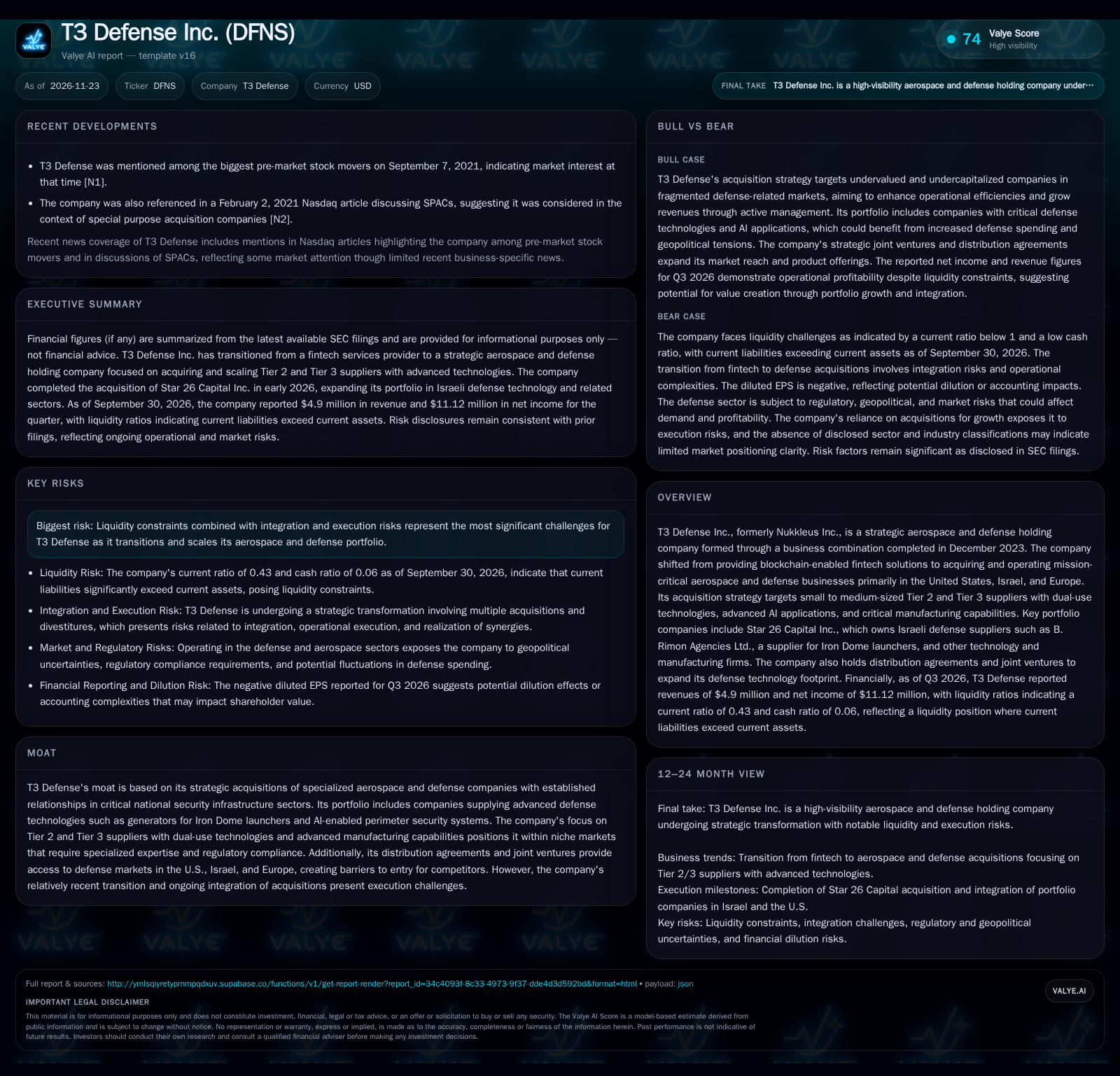
T3 Defense Inc., having pivoted from fintech to a defense-sector holding model, now owns a portfolio including Israeli defense suppliers and advanced AI technologies. The company’s Q3 2026 results show positive net income but also reveal a substantial liquidity shortfall, with current liabilities far exceeding current assets. The core thesis hinges on whether T3 Defense can integrate its acquisitions, realize operational synergies, and navigate funding constraints before execution or market shocks undermine its strategy. [S1] [S2]
T3 Defense Inc. represents a high-profile attempt to create value by consolidating specialized, dual-use defense suppliers and technology platforms across the U.S., Israel, and Europe. Having exited its fintech roots in late 2023, the company has moved aggressively to acquire assets with existing ties to critical defense programs—including suppliers to Israel’s Iron Dome and developers of AI-enabled defense solutions. Despite reporting positive net income for Q3 2026, T3 Defense faces a glaring liquidity shortfall, with current liabilities more than double its current assets. [S1] [S2]
Current Financial Challenges and Acquisition Strategy
T3 Defense’s most recent quarter (ended September 30, 2026) reveals a company at a strategic crossroads. On one hand, the firm reported $4.9 million in revenue and $11.12 million in net income, suggesting early signs of operational profitability. On the other, its balance sheet is under acute pressure: current assets of $18.28 million are dwarfed by current liabilities of $42.43 million, producing a current ratio of just 0.43 and a cash ratio of 0.06. This imbalance signals that T3 Defense cannot meet its short-term obligations with its existing liquid assets. [S2]
The company’s business model has undergone a radical transformation since late 2023, when it shifted from fintech to a strategic holding company focused on aerospace and defense. Its acquisition of Star 26 Capital in January 2026 brought in Israeli defense suppliers, including B. Rimon Agencies Ltd., which supplies generators for the Iron Dome system. T3 Defense has also secured exclusive U.S. distribution rights for advanced drone payload systems and entered joint ventures targeting Baltic and Israeli defense infrastructure. These moves position the company within critical national security supply chains but also introduce integration and execution complexity. [S1]
Creating Value Through Synergies, Dual-Use Technologies, and Operational Efficiency
T3 Defense’s business model is predicated on acquiring and scaling small-to-medium Tier 2 and Tier 3 defense suppliers—often those developing dual-use (military and civilian) technologies or operating in niche manufacturing verticals. The logic is that these smaller companies, frequently undervalued or undercapitalized, can be integrated into a larger platform to achieve economies of scale, cross-selling, and procurement efficiencies.
Revenue generation is inherently project-based and lumpy in the defense sector, with contract timing, regulatory approval, and geopolitical events all impacting sales cycles. The company’s exposure to Israeli and U.S. defense supply chains—particularly through subsidiaries involved in Iron Dome and drone payloads—could provide differentiated, high-barrier revenue streams if contract wins are recurring or multi-year in nature. However, unless commercial mechanics are disclosed, it is unclear whether these are one-off sales or long-term supply contracts.
On the cost side, the defense industry tends to have high fixed costs (regulatory compliance, R&D, certification) and moderate-to-high variable costs (materials, labor), but successful integration could allow T3 Defense to extract margin leverage through shared services, consolidated procurement, and technology transfer across its subsidiaries. The capital intensity of defense manufacturing suggests ongoing funding needs, especially if the company aims to scale production or pursue further acquisitions. The company reported cash and liquidity metrics for the period; these figures do not by themselves establish operating runway, investment capacity, financial flexibility, or financing capacity.
T3 Defense’s Role: Navigating Between Niche Supplier Consolidation and Industry Leaders
T3 Defense is staking out a position in the fragmented middle of the defense value chain. Rather than competing head-on with prime contractors or major original equipment manufacturers (OEMs), the company is consolidating specialized Tier 2 and Tier 3 suppliers—firms with unique manufacturing capabilities or proprietary dual-use technologies. This segment can be attractive due to higher technical differentiation, entrenched relationships with national defense programs, and regulatory barriers that deter new entrants.
However, this strategy comes with counterforces. First, large defense primes may choose to bring critical suppliers in-house or vertically integrate, squeezing independent players. Second, defense procurement cycles can be unpredictable, and government budgetary shifts may impact contract renewals. Third, the very fragmentation T3 Defense seeks to exploit also makes integration challenging—systems, cultures, and compliance regimes vary widely across acquired entities.
Relevant competitor categories include private equity-backed roll-ups of defense suppliers, other holding companies targeting dual-use technology, and established local players in each geography. The company’s exclusive distribution rights and joint ventures may provide near-term differentiation, but sustainable advantage will depend on its ability to integrate acquisitions, maintain regulatory compliance, and deliver on critical defense projects.
Potential Benefits from Successful Integration and Recurring Revenue Development
The most favorable scenario for T3 Defense would see it effectively integrating its portfolio of acquired defense suppliers, achieving operational synergies, and turning one-off project wins into recurring or multi-year contracts. If management can standardize systems, drive procurement efficiencies, and cross-sell advanced technologies (such as AI-enabled perimeter security or smart hydration solutions) across its subsidiaries, margins could improve and revenue visibility could increase.
A critical catalyst would be the conversion of its exclusive U.S. distribution rights for advanced drone payloads into substantial, repeat orders from major defense customers or OEMs. Similarly, successful joint ventures in the Baltics and Israel could open up new markets and infrastructure projects, providing a pipeline of high-value contracts.
Announcements of successful cross-selling, technology transfer, or margin expansion at the portfolio level would further bolster the case.
Growth Outlook Tempered by Funding Limits and Integration Complexities
The most plausible trajectory for T3 Defense is a period of constrained growth as the company works to integrate its acquisitions and stabilize its balance sheet. While the portfolio includes differentiated assets—such as suppliers to the Iron Dome and AI-driven defense technologies—the company’s acute liquidity shortfall and high current liabilities will likely force management to prioritize cash flow preservation, cost control, and selective investment over aggressive expansion.
In this scenario, revenue may grow modestly as acquired businesses are stabilized and some operational synergies are realized, but working capital pressures could limit the pace of new business development or additional M&A. Integration risks remain elevated, and the company could face challenges harmonizing processes, retaining key technical staff, and navigating regulatory complexity across multiple jurisdictions.
Confirmation of this scenario would include incremental revenue growth, limited margin improvement, and continued liquidity constraints without a near-term resolution. Falsification would come from evidence of a successful refinancing, a dramatic uptick in recurring contract wins, or a step-change in operational cash flow that materially improves the company’s liquidity position.
Risks of Financial Strain Leading to Asset Divestitures or Increased Dilution
The adverse scenario for T3 Defense centers on its acute liquidity stress and the risk of failed integration. If portfolio companies underperform, anticipated synergies fail to materialize, or working capital needs escalate faster than cash inflows, the company could be forced into reactive asset sales, distressed financings, or dilutive equity raises.
A persistent current ratio well below 1 and negative operating cash flow would be warning signs that the company cannot bridge its funding gap internally. Integration missteps—such as loss of key contracts, regulatory penalties, or major cost overruns—could further erode value and undermine the credibility of the acquisition-driven strategy.
Evidence confirming this downside would include material asset dispositions, emergency financings, further deterioration in liquidity ratios, or disclosures of missed regulatory or contractual milestones. Falsification would require clear signs of stable or improving cash balances, successful refinancing, or major new contract awards that offset near-term liabilities.
Key Developments Shaping the Outcome of T3 Defense’s Strategic Shift
Quarterly operating cash flow: Consistent positive cash flow from operations would demonstrate that integration is yielding real economic benefit and reducing reliance on external funding.
Disclosure of new recurring or multi-year contracts: If disclosed, such agreements would provide revenue visibility and reduce dependence on lumpy project work.
Integration milestones: Announcements regarding harmonization of systems, procurement efficiencies, or successful technology transfer between subsidiaries would help test the thesis.
Retention of key technical and managerial staff: Evidence of stable or improving headcount in critical portfolio companies would reduce execution risk.
Refinancing or new credit facilities: Securing additional liquidity on favorable terms would help bridge the working capital gap and enable further investment.
Asset sales or distressed financings: Any indication of forced divestitures or highly dilutive capital raises would signal that liquidity stress is constraining strategic flexibility.
Backlog or order pipeline disclosures: If disclosed, these metrics would provide insight into near-term revenue prospects and the stickiness of customer relationships.
Disclaimer: This is research-only, informational analysis and not investment advice. It may include AI-generated interpretation and general industry context. Always verify important details using primary sources.

Comments