
Farmhouse, Inc.: Platform Aspirations Meet Execution Risk in Digital Asset Transition
Farmhouse, Inc. is repositioning as a public company platform with ambitions in digital asset treasury management and opportunistic acquisitions.
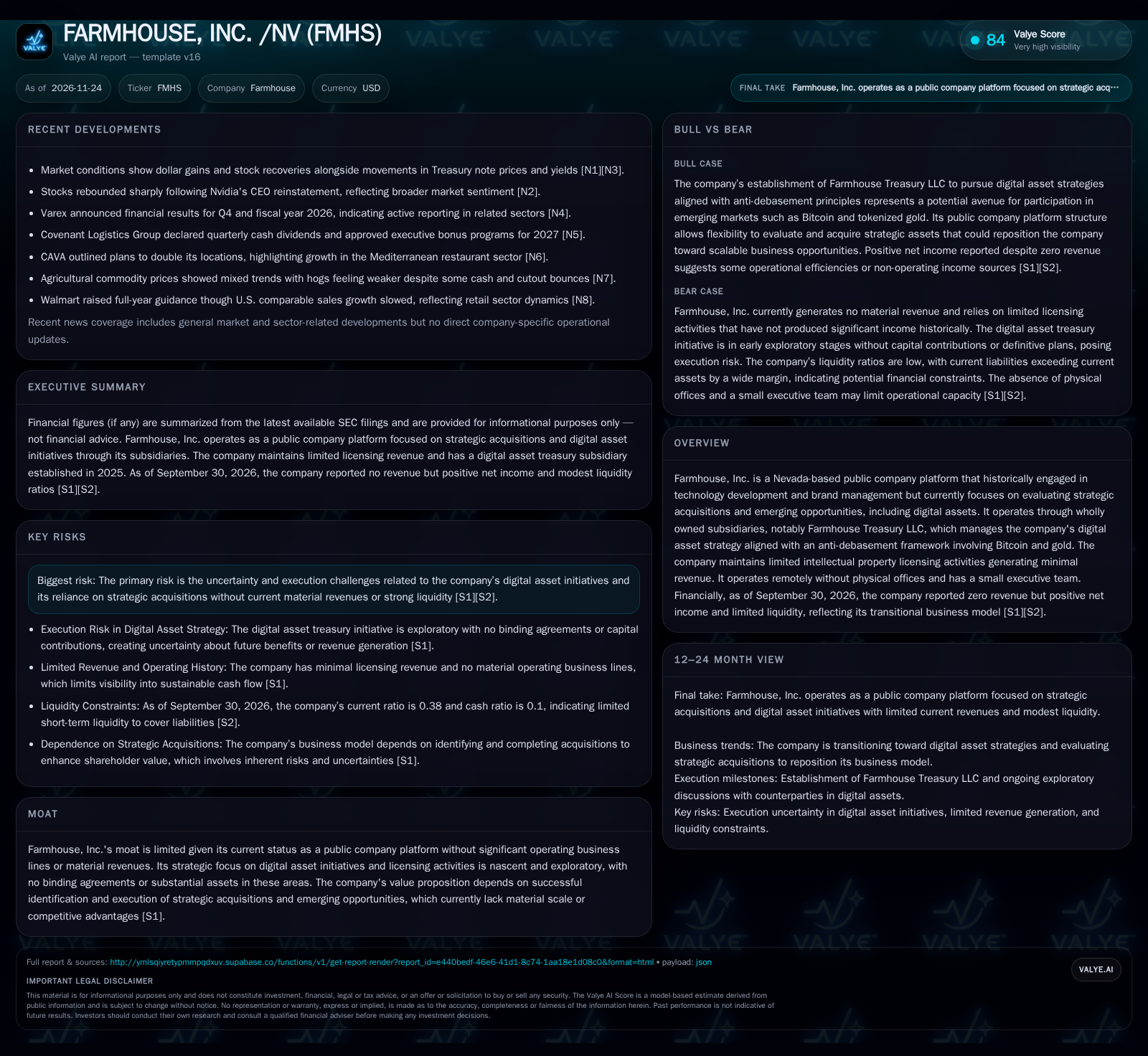
Farmhouse, Inc. has pivoted toward digital asset initiatives and strategic acquisitions, operating through subsidiaries with a recently established treasury arm focused on Bitcoin and tokenized gold. Its future hinges on successfully executing new business models and securing meaningful operating scale [S1] [S2].
Farmhouse, Inc. stands at a strategic crossroads, aiming to reinvent itself as a public company platform targeting digital asset treasury management and opportunistic acquisitions. With the recent formation of Farmhouse Treasury LLC and a declared focus on anti-debasement assets like Bitcoin and tokenized gold, the company signals intent to capture value in emerging markets. The central question is whether Farmhouse can translate its platform ambitions into scalable, sustainable business lines before financial constraints become a limiting factor [S1] [S2].
Farmhouse’s Transitional State: Net Income Amid Zero Revenue and Digital Asset Ambitions
Farmhouse, Inc. reported zero revenue for the period ending September 30, 2026, yet posted positive net income of $2,246,294 and basic EPS of $0.12 [S2]. This divergence suggests the presence of non-operating or one-time items rather than ongoing business activity. [S2] Operationally, Farmhouse remains in a transitional phase, having formed Farmhouse Treasury LLC in late 2025 to pursue a digital asset strategy focused on Bitcoin and tokenized gold, but with no capital contributions or digital assets acquired as of the latest reporting [S1]. The company has minimal ongoing licensing revenue and operates with a lean executive team and no physical offices [S1].
Evaluating Platform Economics: From Shell to Scalable Operation?
Farmhouse’s economics currently resemble those of a public shell or holding company, with negligible recurring revenue and limited operating expenses. The reported net income in the absence of revenue points to possible non-operating gains—such as asset sales, fair value adjustments, or other non-core activities—rather than sustainable business operations [S2]. The company’s stated model is to leverage the flexibility of a public platform to pursue acquisitions and digital asset opportunities. If successful, the economics could shift toward fee-based or asset-management income (in the case of digital asset custody/treasury operations), or toward consolidated operating profit if it acquires revenue-generating subsidiaries. However, absent a core operating business, Farmhouse’s fixed costs are kept low (remote operations, small team), but variable costs could rise sharply if acquisitions or asset strategies are pursued. Capital needs would likely grow rapidly in any scenario involving material asset acquisition, digital asset custody, or integration of new businesses. Until then, the company’s economics are exposed to dilution risk if additional capital is required to fund growth or sustain operations.
The scalability of Farmhouse’s platform model fundamentally depends on its ability to transition from a capital-light shell to an entity capable of managing or acquiring assets that generate meaningful cash flow. This transition requires careful calibration of capital allocation between digital asset purchases, acquisition costs, and operational investments. If Farmhouse opts to prioritize digital asset treasury management, it must develop robust risk management frameworks to navigate volatility and regulatory uncertainty inherent in cryptocurrencies and tokenized assets. Conversely, pursuing acquisitions demands due diligence capabilities and integration expertise to avoid value destruction. The interplay between these strategic paths will dictate the company’s cost structure evolution, capital intensity, and ultimately, its path to sustainable profitability.
Competing for Relevance: Where Farmhouse Fits in a Crowded Ecosystem
Farmhouse’s current position is that of a public company platform with ambitions but little operating scale. In digital asset treasury management and custody, it would face competition from established crypto custodians, fintechs, and asset managers with deep technical and compliance infrastructure. In the realm of strategic acquisitions, Farmhouse competes with other public shells, SPACs, and investment holding companies seeking to provide a path to public markets or facilitate roll-ups. The lack of a differentiated asset base, proprietary technology, or recurring revenue model limits Farmhouse’s immediate moat. Its value proposition would depend on the management team’s ability to source and execute accretive deals or establish a defensible niche in digital asset management—both of which are highly competitive and require capital, credibility, and execution track record. Switching frictions are low for counterparties, especially in digital assets, making customer acquisition and retention an uphill battle unless Farmhouse can offer unique terms, expertise, or regulatory clarity.
Farmhouse’s competitive positioning is further challenged by the rapid pace of innovation and regulatory shifts in the digital asset space. Established players benefit from network effects, regulatory licenses, and customer trust built over years, which create high barriers to entry. Farmhouse’s potential differentiation might derive from agility in structuring unique treasury solutions or targeting niche asset classes less penetrated by incumbents. However, success in these areas requires not only technical and compliance capabilities but also strategic partnerships that can provide access to liquidity and market infrastructure. The company’s ability to demonstrate a credible compliance posture and operational resilience will be critical in gaining counterparty confidence and overcoming the low switching costs prevalent in digital asset services.
Unlocking Value Through Strategic Acquisitions and Digital Asset Execution
The most favorable outcome for Farmhouse would involve the successful identification and execution of a high-potential acquisition or the rapid deployment of its digital asset treasury strategy. If Farmhouse Treasury LLC is able to secure meaningful capital commitments, establish partnerships, and launch a credible custody or anti-debasement product, the company could attract assets under management and related fee income. Alternatively, acquisition of a revenue-generating operating business could provide immediate scale and cash flow, transforming Farmhouse from a shell into an integrated platform. Confirmation of this scenario would require announcements of binding agreements, capital infusions, or the onboarding of significant digital assets. Evidence to watch for: completed acquisitions with disclosed operating metrics, new product launches in digital assets with early customer adoption, and a shift from non-operating to recurring operating income.
Transitional Limbo: Prolonged Exploration and Limited Operating Progress
The most plausible near-term trajectory for Farmhouse is continued exploration of digital asset strategies and opportunistic acquisition targets, but with slow progress toward tangible operating scale. The company may announce further exploratory partnerships or non-binding letters of intent, but without committed capital or executed deals, revenue is likely to remain negligible. Operating expenses may stay low given the remote structure, but liquidity constraints will persist absent new funding. This scenario would be confirmed by ongoing disclosures of discussions and initiatives without the closure of revenue-generating transactions, and by continued reliance on non-operating items for net income. Falsification would require clear evidence of a completed acquisition, capital raise, or significant revenue-generating activity.
Liquidity Pressures Force Strategic Retrenchment or Dilutive Actions
With current liabilities far exceeding current assets and no material revenue, the company may be forced to seek dilutive equity financing, dispose of any remaining assets, or reduce operations further. The risk of non-compliance with reporting or listing requirements could rise if financial stress persists. Confirmation of this scenario would include announcements of emergency financing, asset sales at unfavorable terms, or warnings regarding going-concern status. Falsification would require a marked improvement in liquidity or the rapid development of a viable operating business.
Milestones That Will Determine Farmhouse’s Transition Beyond a Shell
Announcements of completed acquisitions or the closing of binding agreements in either digital assets or operating businesses.
Evidence of initial capital contributions or digital asset purchases by Farmhouse Treasury LLC, with details on custody/management structure if disclosed.
Disclosures of new recurring revenue streams—whether from digital asset management, licensing, or acquired businesses.
Changes in liquidity position, including successful capital raises, debt arrangements, or material improvements in current ratio if disclosed.
Shifts in executive team composition, particularly hires with digital asset or acquisition integration expertise.
Progress updates on exploratory discussions converting to definitive agreements or product launches.
Any regulatory or compliance developments that impact Farmhouse’s ability to operate as a digital asset platform or acquisition vehicle.
Disclosures clarifying the nature of non-operating income contributing to reported net income, to assess sustainability.
Disclaimer: This is research-only, informational analysis and not investment advice. It may include AI-generated interpretation and general industry context. Always verify important details using primary sources.

Comments