
Abpro Holdings After Delisting: Capital Constraints and the Roadblocks to Biopharma Progress
The company’s ability to advance product candidates and maintain market relevance now hinges on securing substantial new capital—an increasingly difficult task given its current market status and balance sheet.
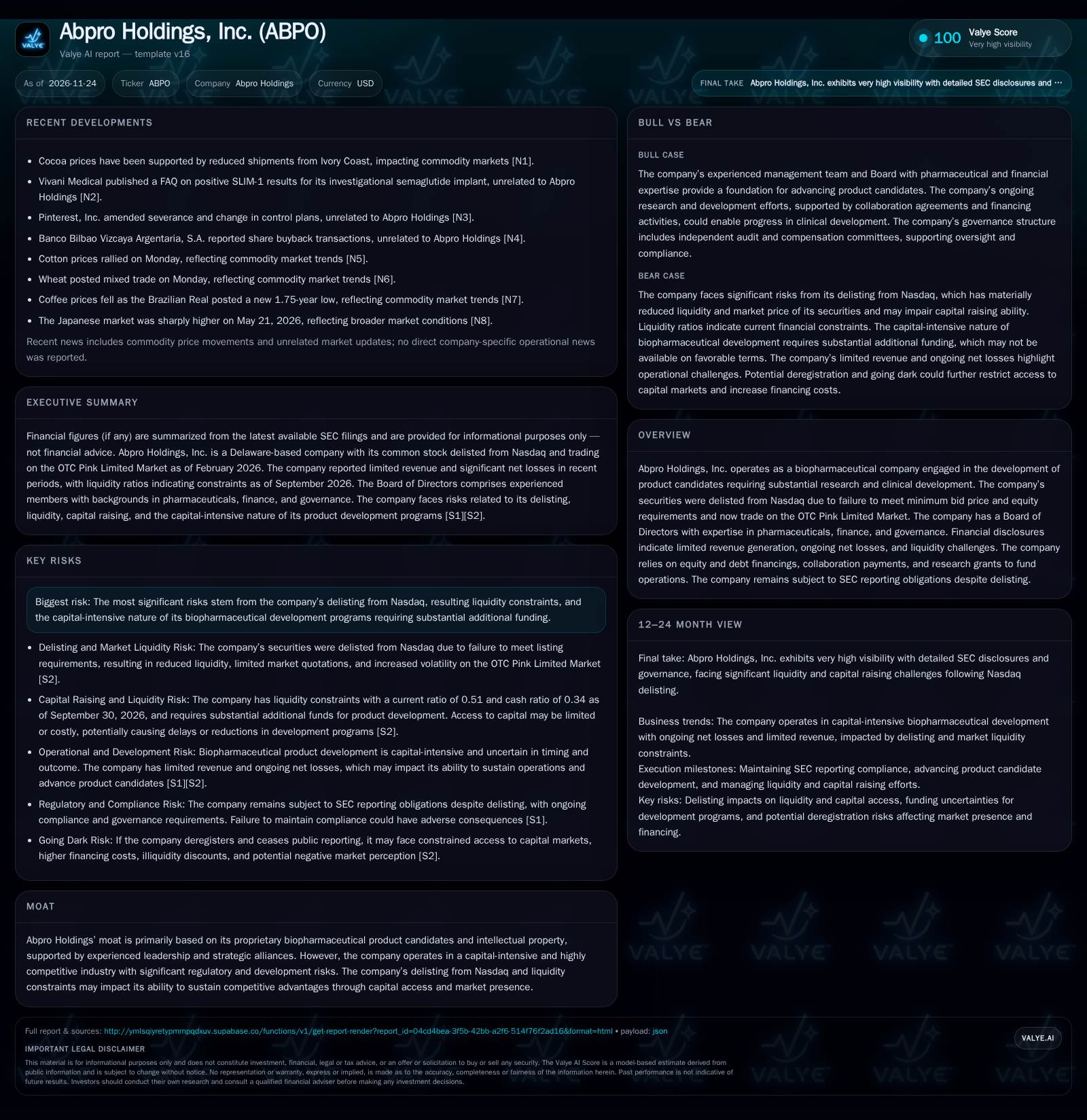
Abpro Holdings, Inc. (ABPO) is a biopharma developer now trading on the OTC Pink Limited Market after its Nasdaq delisting in February 2026. Its ability to progress product candidates is highly contingent on raising new capital, which is complicated by reduced share liquidity and market visibility post-delisting. Without a clear path to substantial funding, Abpro’s position in the capital-intensive biopharma sector is precarious. [S2]
Abpro Holdings, Inc. stands at a critical juncture following its delisting from Nasdaq and subsequent move to the OTC Pink Limited Market. As market visibility and share liquidity diminish post-delisting, Abpro’s ability to raise the capital required for clinical progress and operational continuity is highly uncertain. The company’s near-term future will likely be dictated by its access to new funding and its capacity to navigate the risks associated with capital scarcity in a highly competitive, capital-intensive sector.
Delisting, Liquidity Crunch, and the Immediate Impact on Abpro’s Operations
Abpro Holdings’ shares were delisted from Nasdaq on February 23, 2026, following a failure to meet minimum bid price and equity requirements. The shift to the OTC Pink Limited Market has led to materially reduced liquidity and market price for its securities, with management cautioning that this may adversely affect the company’s ability to raise capital on favorable terms. The company’s revenue for FY2024 was just $183,000, while net losses remain substantial ($3.887 million in Q1 2025). In the wake of delisting, Abpro’s access to capital is more restricted, its market visibility has diminished, and its ability to fund ongoing research and development is under acute pressure. [S1] [S2]
Funding the Pipeline: Abpro’s Capital-Intensive Model and Economic Leverage
Abpro operates within the biopharmaceutical sector, where the core business model relies on discovering, developing, and potentially commercializing novel therapeutics. This model is characterized by long development cycles, high upfront R&D expenses, and the need for substantial capital outlays before any meaningful revenue materializes. With just $183,000 in annual revenue and persistent net losses, Abpro’s negative operating leverage is acute—each dollar spent on development and overhead is not offset by corresponding revenue, magnifying the impact of fixed costs.
The company’s disclosures indicate that funding to date has come from equity and debt financings, collaboration payments, and research grants. However, with the move to the OTC Pink Limited Market, the cost of capital is likely to rise due to illiquidity discounts and investor risk aversion. In this context, the economics of Abpro’s business are highly sensitive to capital availability, dilution risk, and the timing of any potential licensing or collaboration deals—none of which are assured.
The capital-intensive nature of biopharmaceutical development means that Abpro’s financial strategy must carefully balance the timing and scale of funding rounds against clinical milestones to optimize value retention. If disclosed, a useful metric would be the company’s burn rate relative to its cash runway, as this ratio directly affects the urgency and terms of capital raises. Additionally, the company’s ability to stagger development programs or out-license earlier-stage assets could modulate capital requirements, but such strategic decisions often come with trade-offs in long-term value capture. The interplay between fixed costs, milestone-driven expenditures, and revenue recognition timing underscores the fragility of Abpro’s operating economics in the absence of robust capital sources.
Competitive Landscape: Intellectual Property vs. Capital Disadvantage
Abpro’s theoretical competitive edge would stem from proprietary biopharma candidates and intellectual property, supported by a Board with deep sector experience. However, in the biopharma industry, competitive advantage is not solely determined by scientific differentiation—it is just as dependent on access to capital, speed of execution, and the ability to sustain multi-year clinical programs.
The company now contends with a structurally weaker position: OTC Pink trading reduces its visibility to institutional investors and potential strategic partners, potentially limiting both licensing opportunities and the ability to attract non-dilutive funding. Meanwhile, well-capitalized peers and larger incumbents are better positioned to advance candidates through expensive clinical milestones, negotiate with regulators, and withstand inevitable setbacks. In this environment, Abpro’s product pipeline—while potentially innovative—may struggle to compete unless it can secure partnerships or alternative financing to offset its capital disadvantage.
In the context of competitive positioning, the value of Abpro’s intellectual property portfolio is contingent not only on its scientific merit but also on the company’s capacity to defend and extend patent life through sustained R&D investment. If capital constraints force program delays or deprioritization, there is a risk that key patents may lapse or that competitors could advance similar technologies unchallenged. Moreover, the reduced visibility from OTC Pink trading limits Abpro’s ability to attract high-caliber talent and external collaborators, which are critical for maintaining innovation momentum. Thus, the company’s competitive disadvantage is compounded by both financial and operational factors that could erode its long-term strategic positioning.
What a Turnaround Would Require: Strategic Partnerships and Non-Dilutive Capital
A constructive scenario for Abpro would involve the company leveraging its scientific assets and leadership network to secure a strategic partnership or substantial non-dilutive funding—such as research grants or upfront licensing payments. This could enable continued development of its product candidates without excessive shareholder dilution or restrictive debt covenants. A successful partnership could also lend external validation, improving investor sentiment and potentially supporting a relisting or up-tiering effort.
Confirmation of this upside would come from announced collaborations with established pharmaceutical firms, grant awards, or the signing of licensing deals that include upfront payments. Evidence would include a material increase in R&D funding, pipeline milestones achieved, or a narrowing of quarterly net losses as development advances. Conversely, the absence of such deals or further balance sheet deterioration would falsify this scenario.
Sustained Capital Scarcity and Slow Progress Characterize the Likely Path Forward
Given current facts, the most probable path for Abpro is one of ongoing capital scarcity, limited pipeline progress, and continued reliance on dilutive or high-cost financing. The company may be forced to slow or halt certain development programs, prioritize only the most promising candidates, and seek opportunistic funding even at punitive terms. Trading on the OTC Pink Limited Market will likely perpetuate low trading volumes and reduce the appeal for new institutional investors.
This scenario would be confirmed by continued low or declining R&D expenditure, persistent net losses, further increases in share count due to equity raises, or announcements about program delays. Any material improvement in financial ratios or a significant licensing agreement would challenge this base case.
Under sustained capital scarcity, Abpro’s strategic flexibility is likely to be severely constrained, forcing difficult prioritization decisions that may affect the breadth and depth of its pipeline. The company might need to focus exclusively on candidates with the shortest path to clinical proof-of-concept or those with the highest potential for out-licensing, potentially sacrificing longer-term innovation opportunities. Additionally, reliance on dilutive financing in a low-liquidity market could accelerate shareholder dilution, further depressing investor confidence and complicating future capital raises. This feedback loop illustrates how capital scarcity can create a self-reinforcing cycle of operational and financial challenges, limiting the company’s ability to execute its development strategy effectively.
Potential for Going Dark or Restructuring if Capital Access Remains Closed
In a more adverse scenario, Abpro’s inability to secure material new funding could force it to consider going dark—deregistering its securities and ceasing public reporting—or entering a formal restructuring process. This could be triggered by failed financing attempts, worsening net losses, or loss of operational viability for its development programs.
Indicators confirming this downside would include an explicit warning about cash runway exhaustion, announcements of workforce reductions, program discontinuations, or notice of SEC deregistration. If Abpro moves toward restructuring or asset sales, it could further erode any remaining shareholder value and effectively end its ambitions as an independent drug developer.
Milestones and External Factors That Will Shape Abpro’s Trajectory
Any disclosure of new strategic partnerships, licensing agreements, or non-dilutive financing would be a critical signal of improved capital access.
Updates on the company’s cash and current ratios in future filings would help gauge ongoing liquidity constraints.
Announcements regarding the advancement, delay, or termination of product candidates would clarify operational momentum.
Changes in share count or the terms of new equity or debt financings, if disclosed, would signal the degree of dilution or financial stress.
Explicit statements about potential deregistration or going dark would indicate heightened risk to market presence and capital access.
Progress or setbacks in regulatory filings or clinical milestones, if reported, would provide insight into value creation potential.
Any shift in Board or management composition—particularly the addition of executives with business development experience—could suggest a focus on external partnering.
Disclaimer: This is research-only, informational analysis and not investment advice. It may include AI-generated interpretation and general industry context. Always verify important details using primary sources.

Comments