
Premier Air Charter: Fleet Expansion, Revenue Growth, and the Imperative of Financial Discipline
Premier Air Charter has expanded its fleet with high-performance jets and delivered strong year-over-year revenue growth, particularly in new markets like Mexico and Hawaii.
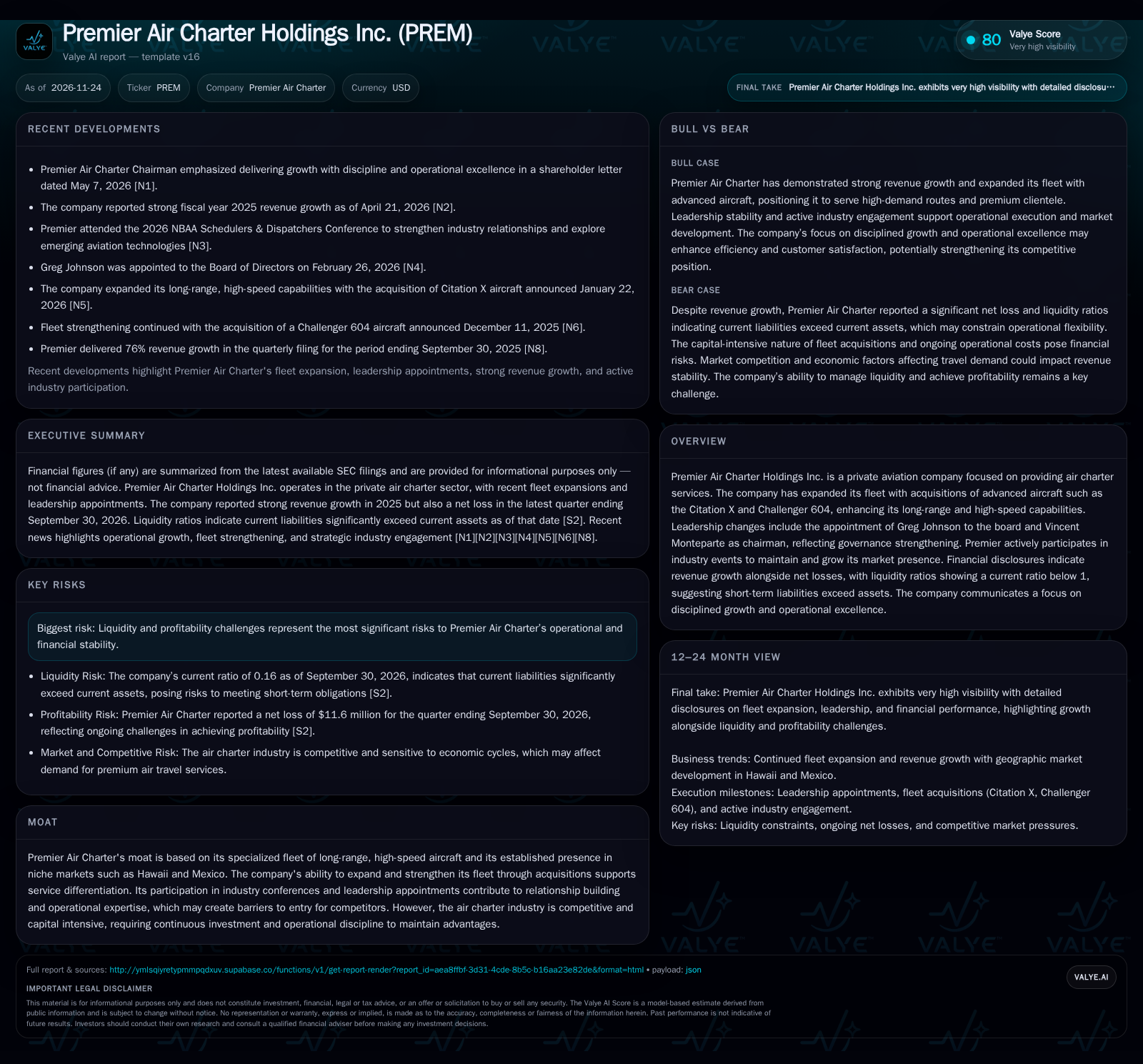
Premier Air Charter has expanded its fleet with high-performance jets and delivered strong year-over-year revenue growth, particularly in new markets like Mexico and Hawaii. Despite these advances, the company reported a substantial net loss and faces acute liquidity pressures, with current liabilities vastly exceeding current assets. The core challenge is whether operational excellence and market expansion can offset the capital intensity and competitive dynamics of the private aviation sector. [S2] [N8]
Premier Air Charter Holdings Inc. operates in the highly competitive private aviation sector, where capital intensity, customer expectations, and operational reliability define success. In the past year, the company has aggressively expanded its fleet with high-performance aircraft and reported robust revenue growth, especially in key leisure markets. The company’s ability to balance growth ambitions with financial discipline will determine whether it can translate its recent momentum into durable market leadership. [S2] [N8]
Fleet Expansion and Financial Results: A Double-Edged Sword
Premier Air Charter’s most recent SEC filing reveals a company at a crossroads: while revenue for the quarter ending September 30, 2026 reached $6,119,368, the net loss for the period was $11,604,154, with basic and diluted EPS of -$0.04 [S2]. This follows a period of strong reported revenue growth, including a 76% increase in the comparable prior-year quarter [N8]. The company’s current assets of $4,533,084 are dwarfed by current liabilities of $28,632,376, resulting in a current ratio of 0.16 and a cash ratio of 0 as of the reporting date [S2].
Strategically, Premier has invested in fleet upgrades, acquiring the Citation X and Challenger 604—jets known for their long range and high speed—aiming to capture premium clientele and serve lucrative markets like Mexico and Hawaii [N5] [N6] [N8]. Leadership changes, including the appointment of Greg Johnson to the Board and Vincent Monteparte as Chairman, signal a focus on governance and operational execution [N4] [N1].
The operational and financial data together paint a picture of a company with momentum in market development and customer acquisition, but facing acute short-term liquidity and persistent losses that could limit its ability to sustain growth and service obligations.
How Premier Air Charter’s Economics Are Shaped by Scale, Mix, and Cost Pressures
Premier Air Charter’s business model is fundamentally shaped by the economics of private aviation: high fixed costs (aircraft acquisition, maintenance, regulatory compliance, crew salaries, insurance) and variable costs (fuel, catering, repositioning) that scale with utilization. Revenue is primarily driven by flight hours booked, aircraft type (with long-range jets commanding premium rates), and ancillary services. The addition of Citation X and Challenger 604 aircraft enables the company to serve longer-haul and time-sensitive routes, potentially increasing average revenue per booking and customer lifetime value [N5] [N6].
However, the capital intensity of fleet expansion requires either robust cash flow or access to external financing. The reported net loss and liquidity shortfall suggest that current operating margins are insufficient to cover both fixed and variable costs at present utilization rates [S2]. In this context, operating leverage is a double-edged sword: higher utilization of the expanded fleet could drive margin improvement, but under-utilization or pricing pressure would quickly magnify losses.
In private aviation, pricing power is typically strongest in peak-demand corridors (e.g., New York–Los Angeles, trans-border leisure routes) and for last-minute bookings or bespoke services. To improve economics, Premier must optimize fleet utilization, minimize downtime, and manage cost volatility—particularly for fuel and insurance, which are subject to external shocks. Without improved operating efficiency or structural cost reductions, the current financial trajectory is unsustainable absent new capital infusions.
Differentiation, Barriers, and the Challenge of Standing Out in Private Aviation
Premier Air Charter’s competitive position is built around its specialized fleet—especially the recent additions of high-performance jets—and its ability to serve niche premium markets such as Mexico and Hawaii [N5] [N6] [N8]. In an industry where client trust, aircraft availability, and service reliability are paramount, fleet quality and operational track record can create tangible differentiation. Active participation in industry events and ongoing leadership renewal may also help build relationships with brokers, corporate travel managers, and high-net-worth clients [N3] [N4].
Nevertheless, the private air charter industry is fragmented, with barriers to entry that are high in capital requirements but modest in customer switching costs. Clients—often corporations or ultra-high-net-worth individuals—can and do shop around for price, availability, and service level. Large, well-capitalized operators and membership-based platforms (e.g., NetJets, Wheels Up, VistaJet) compete aggressively on both price and experience, while smaller regional players often undercut on cost.
The risk for Premier is that, despite its fleet investments, it may lack the scale or brand recognition to secure repeat, high-margin business in the face of industry consolidation and price competition. Its ability to create recurring demand, secure longer-term customer relationships, and manage cost structure will dictate whether its differentiation is durable or merely fleeting.
Pathway to Profitability: When Market Expansion Meets Operational Discipline
The most favorable scenario for Premier Air Charter is one where recent fleet investments and geographic expansion translate into sustained increases in high-value bookings, driving up utilization rates and average revenue per flight. If the company succeeds in capturing and retaining premium clientele in growth markets like Mexico and Hawaii, it could achieve operating leverage, with incremental revenue outpacing incremental costs.
Confirmation of this scenario would come from sequential improvements in fleet utilization rates, positive trends in revenue per available flight hour, and a narrowing of net losses or a shift to operating profits. Evidence of successful cost containment—particularly in fuel, maintenance, and overhead—would further support the thesis. Additional confirmation could include new recurring contracts, strategic partnerships, or alliance agreements with corporate travel departments or luxury travel brokers.
A move towards positive operating cash flow, even before net profitability, would suggest that the business model is reaching a sustainable scale. If Premier can demonstrate resilience to fuel cost volatility (e.g., through effective hedging or fuel surcharges) and maintain high customer satisfaction, its position in the premium charter segment could become defensible.
Sustained Growth Meets Structural Financial Strain
The most plausible scenario, given current facts, is that Premier Air Charter continues to grow revenue through fleet expansion and targeted market development, but struggles to translate this into profitability due to persistent cost pressures and high capital requirements. Utilization rates may improve, but not enough to offset the drag from under-utilized assets, rising insurance and regulatory costs, and the need to service or refinance short-term obligations.
Confirmation of this scenario would be continued year-over-year revenue growth, but with operating losses remaining significant or only modestly narrowing. The company could be forced to seek additional external financing or equity infusions to bridge liquidity gaps—potentially on unfavorable terms if financial performance does not improve. Absence of material improvement in current ratio or cash flow from operations would reinforce this view.
A scenario in which Premier maintains market relevance but cannot break out of the cycle of capital-raising and operating losses is common in capital-intensive, competitive service businesses. The company’s ability to improve its capital structure, secure longer-term customer commitments, and optimize cost structure will determine whether it can move beyond this equilibrium.
Liquidity Squeeze and the Risks of Overextension
In this scenario, even strong underlying demand or a robust order pipeline may not be enough to avoid a cash crunch.
Confirmation would include missed payments to suppliers or lenders, asset sales at distressed prices, or adverse changes in fleet composition due to repossessions or forced divestitures. Early warning signs could be a sudden drop in available aircraft, negative customer reviews due to service disruptions, or regulatory warnings for non-compliance on insurance or safety standards.
Failure to secure new capital or restructure liabilities could lead to insolvency or a distressed sale, especially if market conditions worsen or if a competitor exploits Premier’s weakened position. In this scenario, customer and partner confidence could erode quickly, compounding the operational and financial challenges.
Milestones and Metrics That Will Define Premier Air Charter’s Trajectory
Quarterly trends in fleet utilization rates and revenue per available flight hour—if disclosed—would offer insight into whether new aircraft are being effectively deployed.
Changes in net loss trajectory and progress toward positive operating cash flow will be critical to assessing the sustainability of recent growth.
The current ratio and cash ratio in upcoming filings: any improvement would signal progress in liquidity management, while further deterioration would raise alarm.
Evidence of longer-term customer contracts or repeat business, as opposed to transactional bookings, would help test the durability of demand and revenue visibility.
New equity or debt financing events, including terms and dilution impact, will indicate both market confidence and the company’s reliance on external capital.
Disclosures regarding cost control initiatives—such as fuel hedging, insurance renegotiations, or operational automation—would clarify management’s ability to manage variable and fixed costs.
Market share or competitive win disclosures in targeted geographies (Mexico, Hawaii) would validate the company’s expansion strategy.
Any negative regulatory, insurance, or operational events—such as safety incidents or loss of key certifications—would threaten both reputation and financial viability.
Disclaimer: This is research-only, informational analysis and not investment advice. It may include AI-generated interpretation and general industry context. Always verify important details using primary sources.

Comments