
Mitesco’s Reinvention: Can a Lean Holding Model Overcome No Revenue and Severe Liquidity Constraints?
After abandoning healthcare clinics, Mitesco, Inc. is repositioning as a data center and AI applications holding company. With zero revenue, a net loss, and a nearly nonexistent liquidity buffer, the company’s future now hinges on converting consulting-driven operations and early-stage technology bets into a viable business.
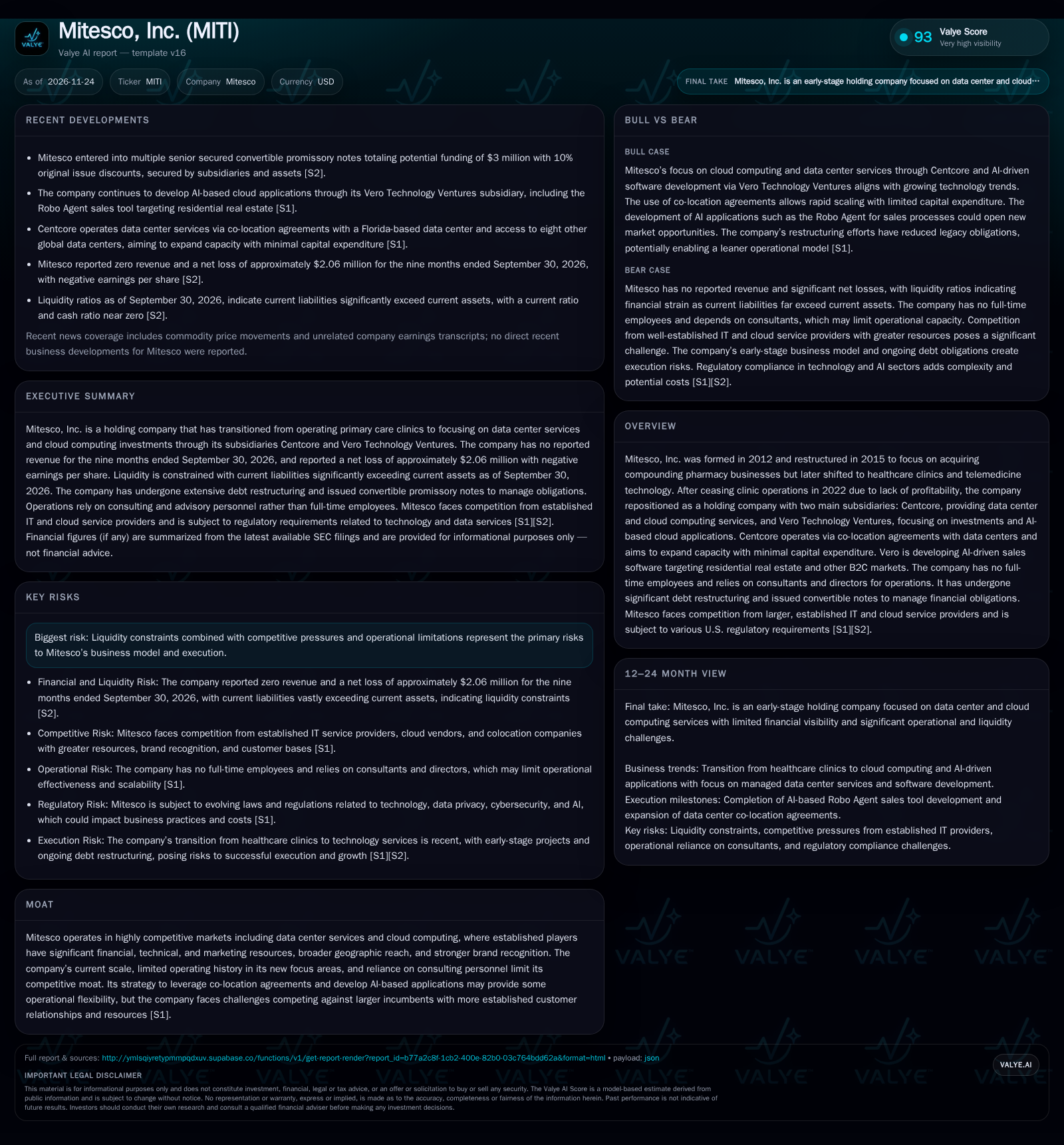
Mitesco, Inc. has exited healthcare clinics and now bets on data center services (Centcore) and AI-based cloud applications (Vero Technology Ventures). Despite aggressive debt restructuring, the company reported zero revenue and a net loss for the recent period, with current liabilities vastly exceeding assets. Execution risk, operational capacity, and the ability to compete against entrenched IT and cloud players remain critical open questions as Mitesco attempts to commercialize its AI software and scale its co-location business model.
Mitesco, Inc. is attempting a high-wire transformation: after shuttering its unprofitable healthcare clinic business, it now positions itself as a holding company targeting the data center and AI-driven cloud computing space. The company’s go-forward strategy leans on capital-light expansion (via co-location agreements) and consulting-based execution, but its severe liquidity crunch and lack of operating revenue set a daunting backdrop. With a net loss, no full-time staff, and a crowded competitive landscape, the company’s next phase depends on the successful launch of new AI-based products and the ability to attract customers before cash runs out.
Zero Revenue, Heavy Liabilities, and a Pivot to Cloud and AI: Where Mitesco Stands
As of September 30, 2026, Mitesco reported zero revenue and a net loss of approximately $2.06 million for the prior nine months. The company’s liquidity is critically low: current assets stood at $66,941 against current liabilities of $22.8 million, resulting in a current ratio and cash ratio near zero [S2]. This follows a major strategic pivot—after discontinuing its primary care clinic operations in 2022, Mitesco now focuses on two subsidiaries: Centcore, which offers data center services through co-location agreements, and Vero Technology Ventures, which develops AI-based cloud applications such as the Robo Agent sales tool for residential real estate [S1]. To manage its obligations, Mitesco has converted $26 million of debt into equity and preferred stock and issued convertible promissory notes with potential funding of $3 million [S1] [S2]. The company operates with no full-time employees, relying instead on consultants and directors [S1].
The Financial Logic and Constraints of a Consulting-Led, Asset-Light Platform
Mitesco’s current business model is designed for capital efficiency but faces acute economic limitations. Centcore’s use of co-location agreements allows the company to offer managed data center services without the heavy up-front capital expenditure typical of building or owning physical infrastructure. In theory, this lowers fixed costs and speeds capacity expansion, but it also exposes Mitesco to variable costs tied to third-party agreements and limits its ability to capture full-margin economics. Pricing power is likely limited, as customers in the data center and cloud services space can often negotiate aggressively and have many alternatives.
Vero Technology Ventures’ AI-based cloud applications—such as the planned Robo Agent for real estate—could, if successful, provide higher-margin, recurring software revenue. However, the go-to-market approach is not yet established, and it is unclear whether the software will be sold as a subscription, per-use, or via another model. Importantly, with zero revenue reported and product launches still pending, the economics remain hypothetical. The company’s reliance on consultants rather than full-time staff helps control fixed payroll costs, but may constrain execution speed and institutional knowledge. Meanwhile, debt restructuring and convertible notes have provided some relief, but ongoing interest, dilution risk, and limited cash mean the company operates under severe funding constraints [S1] [S2].
Competing Against Scale: Mitesco’s Place in the Cloud and Data Center Value Chain
Mitesco’s subsidiaries operate in sectors dominated by large, well-capitalized incumbents. The data center and cloud services market features hyperscale providers, established colocation vendors, and managed IT service companies with deep customer relationships, robust sales channels, and substantial marketing budgets. Mitesco’s lack of brand recognition, limited operational track record in these sectors, and absence of full-time staff make it difficult to win new business or command premium pricing.
In AI-based software, particularly for real estate sales enablement, the competitive set includes both vertical SaaS providers and large platform companies with deep AI and data science teams. Without a differentiated product or bundled ecosystem, Mitesco may find customer acquisition costly and retention challenging. The company’s strategy to use consulting expertise and co-location may allow for rapid pivoting or opportunistic market entry, but these are not substitutes for scale, brand, or network effects. Regulatory complexity in data privacy and AI adds an additional barrier, favoring larger players with compliance infrastructure [S1].
If the Robo Agent Launches and Data Center Partnerships Deliver Early Wins
A favorable outcome for Mitesco would require the successful launch and adoption of Vero’s Robo Agent AI tool, beginning with the residential real estate market. If the product is released on schedule (Q3 FY2026) and demonstrates clear ROI for users—such as improving sales conversion rates or reducing agent workload—it could secure pilot customers and generate initial revenue. Early adoption could validate the company’s technology and attract further interest in adjacent B2C verticals.
Simultaneously, if Centcore can sign initial managed service or co-location contracts with anchor tenants leveraging its Florida data center and global access points, revenue could begin to flow with minimal capex. Demonstrable traction—such as customer logos, bookings, or pilot contracts—would help unlock further funding or strategic partnerships. Evidence for this scenario would include announced customer wins, revenue recognition, and early renewals or expansions. Falsification would come from missed product launch dates, lack of customer uptake, or continued zero revenue after pilot periods.
Reality Check: Slow Commercialization, Ongoing Losses, and Uncertain Funding
The most plausible near-term scenario is that Mitesco continues to develop its AI software and pursues co-location agreements, but commercialization is slow. Product development may consume more time and resources than anticipated, with initial pilots or trials yielding little revenue. Customer acquisition in both data center services and AI software could be hampered by limited brand presence, lack of a salesforce, and the company’s reliance on consulting staff.
Meanwhile, ongoing operating expenses and consulting fees prolong net losses, and the company’s cash position remains precarious. Without significant revenue or external capital injections, Mitesco may need to renegotiate debt, seek bridge financing, or consider asset sales or strategic alternatives. Confirming evidence for this scenario would be continued negative cash flow, limited customer announcements, and updates referencing ongoing 'development' rather than commercial traction. Falsification would require a clear inflection in revenue, customer wins, or new funding that materially improves the balance sheet.
When Liquidity Runs Out: Potential for Insolvency or Forced Asset Sales
The absence of full-time operational staff and reliance on consultants may limit the company’s ability to respond quickly to crisis or execute a turnaround. In this scenario, creditors could pursue claims on the company’s remaining assets—including its interests in Centcore and Vero—or force asset sales at distressed prices.
Additionally, if product development stalls or regulatory/compliance hurdles consume time and capital, the company could lose whatever early-mover or niche advantage it hopes to develop. Evidence for this scenario would include missed payroll or vendor payments (if disclosed), default notices, announcements of asset sales, or formal restructuring filings.
Milestones That Will Reveal Whether Mitesco’s New Model Can Gain Traction
Announcement and timing of the Robo Agent product launch; actual user availability and onboarding rates would help test whether Vero Technology Ventures can convert development into market adoption.
Signed customer contracts or pilot programs for Centcore’s data center services, particularly with recognizable anchor clients or multi-location agreements.
Any disclosed revenue from either subsidiary—especially recurring or contracted revenue—would mark a break from the current zero-revenue status.
Updates on funding—such as new debt, equity raises, or strategic investments—that increase near-term liquidity and extend operational runway.
Disclosed product retention, renewal rates, or customer satisfaction data for Vero’s AI applications, if available, to gauge stickiness and market fit.
Evidence of cost discipline or shifts in the consulting model, such as hiring full-time staff or reducing SG&A relative to development milestones.
Regulatory or compliance developments, especially those that could affect the timeline or cost structure for AI or cloud services.
Disclaimer: This is research-only, informational analysis and not investment advice. It may include AI-generated interpretation and general industry context. Always verify important details using primary sources.

Comments