
Liminatus Pharma: Oncology Pipeline Ambitions Confront Severe Financial Strain and Strategic Uncertainty
Liminatus Pharma’s recent Nasdaq compliance moves and oncology pipeline expansion through merger amendments highlight its efforts to remain viable, but severe net losses, a distressed liquidity position, and an absence of commercial-stage products raise pressing questions about sustainability and near-term strategic options.
Liminatus Pharma has taken urgent steps to maintain its Nasdaq listing and expand its oncology pipeline, including a major reverse stock split and a merger amendment. However, the company faces severe financial distress, with current assets far below liabilities, no disclosed revenue, and a substantial net loss. Recent capital raises have not alleviated its liquidity crunch, and its unconventional review of digital asset strategies underscores management's search for alternatives. Without a near-term breakthrough in clinical progress or funding, Liminatus’s ability to continue as a going concern is in doubt.
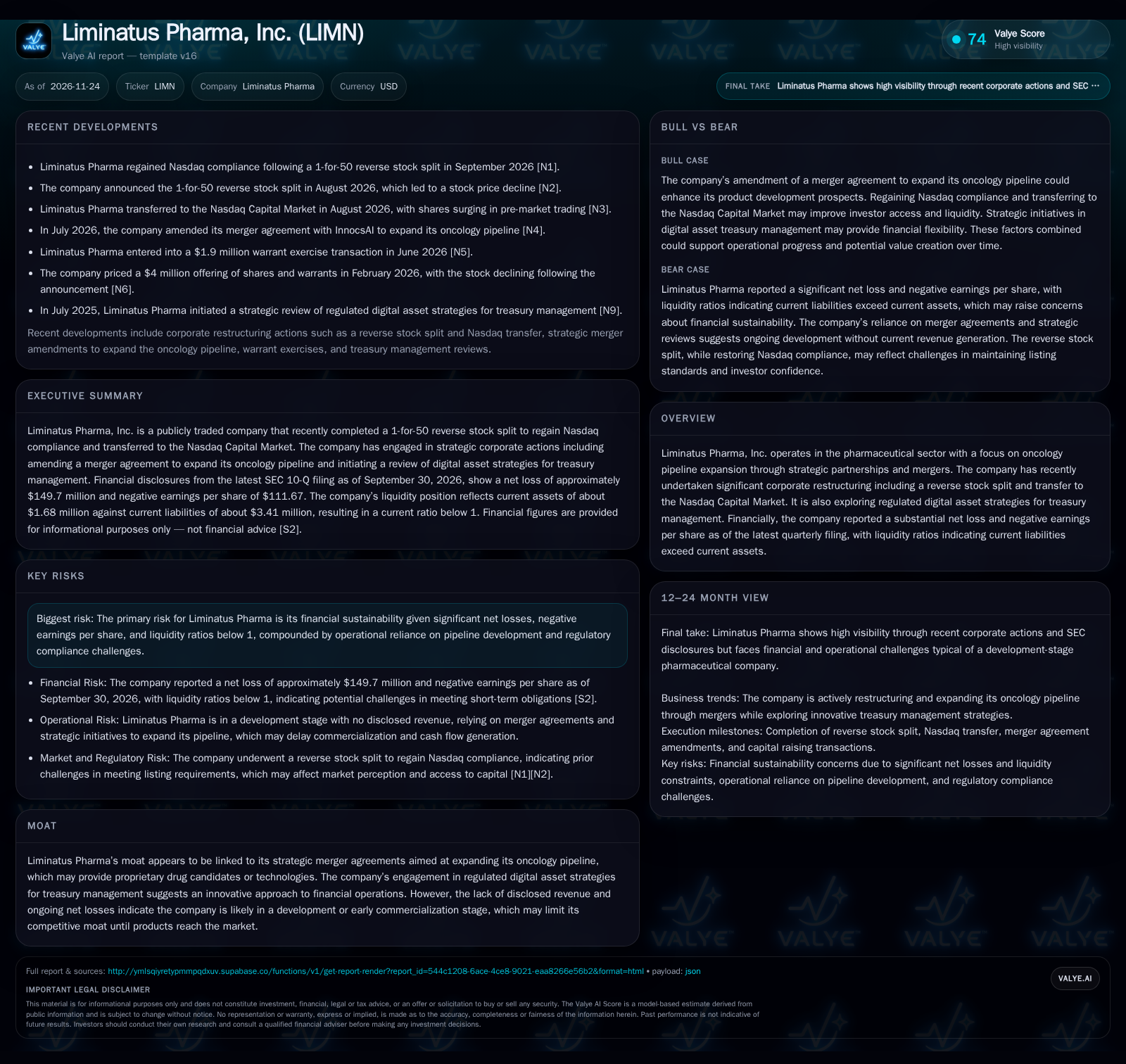
Liminatus Pharma’s recent history is defined by urgent restructuring, including a dramatic 1-for-50 reverse split and a transfer to the Nasdaq Capital Market, all in the face of mounting net losses and a liquidity crunch. With current assets less than half of current liabilities and no disclosed revenue, the company’s bet on oncology pipeline expansion via a merger amendment with InnocsAI represents a high-stakes gamble. Absent a near-term commercial breakthrough or substantial new funding, Liminatus may face existential threats to its ability to operate as a going concern [S2] [N4].
Recent Restructuring and Pipeline Moves Define Liminatus’s Present
Liminatus Pharma’s operational reality is shaped by several critical recent events. In August 2026, the company completed a 1-for-50 reverse stock split, restoring compliance with Nasdaq listing requirements after a period of stock price weakness that threatened delisting [N1] [N2]. Shortly thereafter, Liminatus transferred to the Nasdaq Capital Market—an important step to maintain public market access, though it does not in itself resolve underlying business challenges [N3].
Strategically, Liminatus amended its merger agreement with InnocsAI in July 2026, aiming to expand its oncology drug development pipeline [N4]. This move signals ongoing commitment to pipeline growth, but the lack of disclosed late-stage assets or commercial products means the value and timing of this expansion are uncertain.
Financially, the Q3 2026 SEC filing presents a stark picture: current assets of $1.68 million versus current liabilities of $3.41 million (current ratio 0.49), a net loss of $149.7 million, and negative earnings per share of $111.67 [S2]. The company executed a $4 million offering in February 2026 and a $1.9 million warrant exercise in June, but these have not reversed the acute liquidity deficit or stemmed ongoing losses [N5] [N6] [S2].
Unproven Commercial Model and High Fixed Costs Undermine Economic Viability
Liminatus’s business model is characteristic of early-stage biotech: substantial upfront R&D and administrative costs, periodic capital raises, and no current revenue. The company’s oncology pipeline expansion via merger suggests reliance on external innovation rather than internally developed assets, which can bring both speed and integration risk. Without commercialized products, cash burn is dictated by clinical development pace, regulatory milestones, and ongoing G&A.
The fixed cost base is likely significant, driven by research, regulatory, and public company expenses. Variable costs remain low until clinical trial activity ramps up, but the lack of revenue means operating leverage is negative—losses scale with activity until a product reaches market. Capital needs are persistent and unpredictable, as evidenced by multiple equity and warrant financings in 2026 [N5] [N6].
An added layer of complexity is the company’s review of regulated digital asset strategies for treasury management. While this could theoretically unlock non-traditional sources of liquidity or yield, it introduces execution and compliance risks that may distract management from core drug development, especially given the company’s precarious financial position.
Pipeline Expansion as a Strategic Bet in a Crowded Oncology Landscape
Liminatus faces the classic biotech dilemma: it must compete for investor attention, capital, and eventual commercial partners in an oncology sector crowded with both large pharma and nimble early-stage rivals. The amended merger with InnocsAI may bring novel assets or platforms, but without disclosed late-stage candidates, it is unclear whether Liminatus has a credible path to differentiation.
Potential sources of competitive advantage could include first-in-class or best-in-class drug candidates, proprietary technology platforms, or unique clinical data—none of which have been substantiated in the current disclosures. The company’s willingness to experiment with digital asset treasury management is unusual and may signal a differentiated risk appetite, but does not directly contribute to a scientific moat.
Switching costs for prescribers and patients in oncology are generally high only once a drug achieves approval and reimbursement; until then, pipeline companies compete primarily on science, speed to milestones, and the ability to access capital. Liminatus’s current financial distress may limit its ability to recruit top talent, advance programs rapidly, or partner with established biopharma companies.
Breakthrough Clinical Progress or Strategic Partnership Could Transform Trajectory
The most optimistic scenario for Liminatus would involve rapid clinical progress from its expanded oncology pipeline—either a successful proof-of-concept trial or compelling preclinical data that attracts a larger partner or acquirer. This could unlock milestone payments, non-dilutive funding, or a premium buyout, dramatically improving the balance sheet and validating the pipeline-centric strategy.
Confirmation of this scenario would require disclosure of late-stage assets, positive clinical data, or a major partnership agreement. A secondary upside would be successful monetization or yield generation from digital asset treasury strategies, though this is less likely to be transformative absent core business progress.
Falsification would take the form of continued absence of clinical milestones, inability to secure partnerships, or further dilutive equity raises that fail to improve liquidity or market perception.
Development-Stage Stasis: Funding Gaps and Incremental Pipeline Steps
The most plausible path for Liminatus is a continuation of its current trajectory: incremental progress on pipeline integration post-merger, periodic capital raises to fund operations, and ongoing net losses. Without late-stage assets or near-term revenue, the company remains exposed to capital markets volatility and may need to accept increasingly dilutive terms to raise funds.
Evidence for this scenario would include further small-scale equity or warrant financings, a lack of new clinical or partnership announcements, and continued delays in moving pipeline candidates into pivotal trials. The company may also pursue additional strategic reviews or unconventional treasury maneuvers as its liquidity position remains strained.
A deviation from this path would be signaled by either a dramatic improvement in funding (e.g., a large non-dilutive grant or partnership) or a forced asset sale or restructuring event.
Liquidity Exhaustion Forces Restructuring or Delisting
The adverse scenario is one in which Liminatus fails to secure new funding before exhausting its limited cash resources. With a current ratio of just 0.49 and no reported cash balance as of Q3 2026, the company is acutely vulnerable to missed payroll, delayed vendor payments, or technical default on obligations [S2].
If capital markets remain inaccessible or investor appetite wanes, Liminatus could face forced asset sales, layoffs, or voluntary delisting. Regulatory non-compliance due to financial distress could further erode investor confidence and undermine any residual strategic value in the pipeline.
Confirmation of this downside would include disclosure of going-concern warnings, missed debt or payment obligations, or a failed attempt to raise capital. Falsification would require a rapid and material improvement in the company’s liquidity position or a strategic transaction that alleviates short-term cash needs.
Milestones That Will Determine Liminatus Pharma’s Survival and Strategic Value
Updates on the clinical and regulatory status of newly acquired or merged oncology pipeline assets—timing of IND filings, trial initiations, or readouts would help test the commercial thesis.
Disclosure of any partnership, out-licensing, or non-dilutive funding agreements that could materially improve the company’s liquidity or validate its scientific platform.
Announcement of additional equity, warrant, or alternative financing transactions, and the terms attached—would signal ongoing capital dependence or, if on improved terms, potential recovery in investor confidence.
Progress or setbacks in the company’s regulated digital asset treasury management strategy, including any realized gains, losses, or compliance events.
Any going-concern language or auditor warnings in future SEC filings, which would indicate acute financial distress.
Changes in the composition or tenure of the executive team and board, especially if tied to restructuring or strategic review outcomes.
Public disclosure of revenue from licensing, milestone payments, or product sales—if achieved, this would mark a turning point in business model validation.
Disclaimer: This is research-only, informational analysis and not investment advice. It may include AI-generated interpretation and general industry context. Always verify important details using primary sources.

Comments