
Specificity, Inc.: Behavior-Based Marketing Ambitions Confront Financial Fragility
Specificity, Inc.
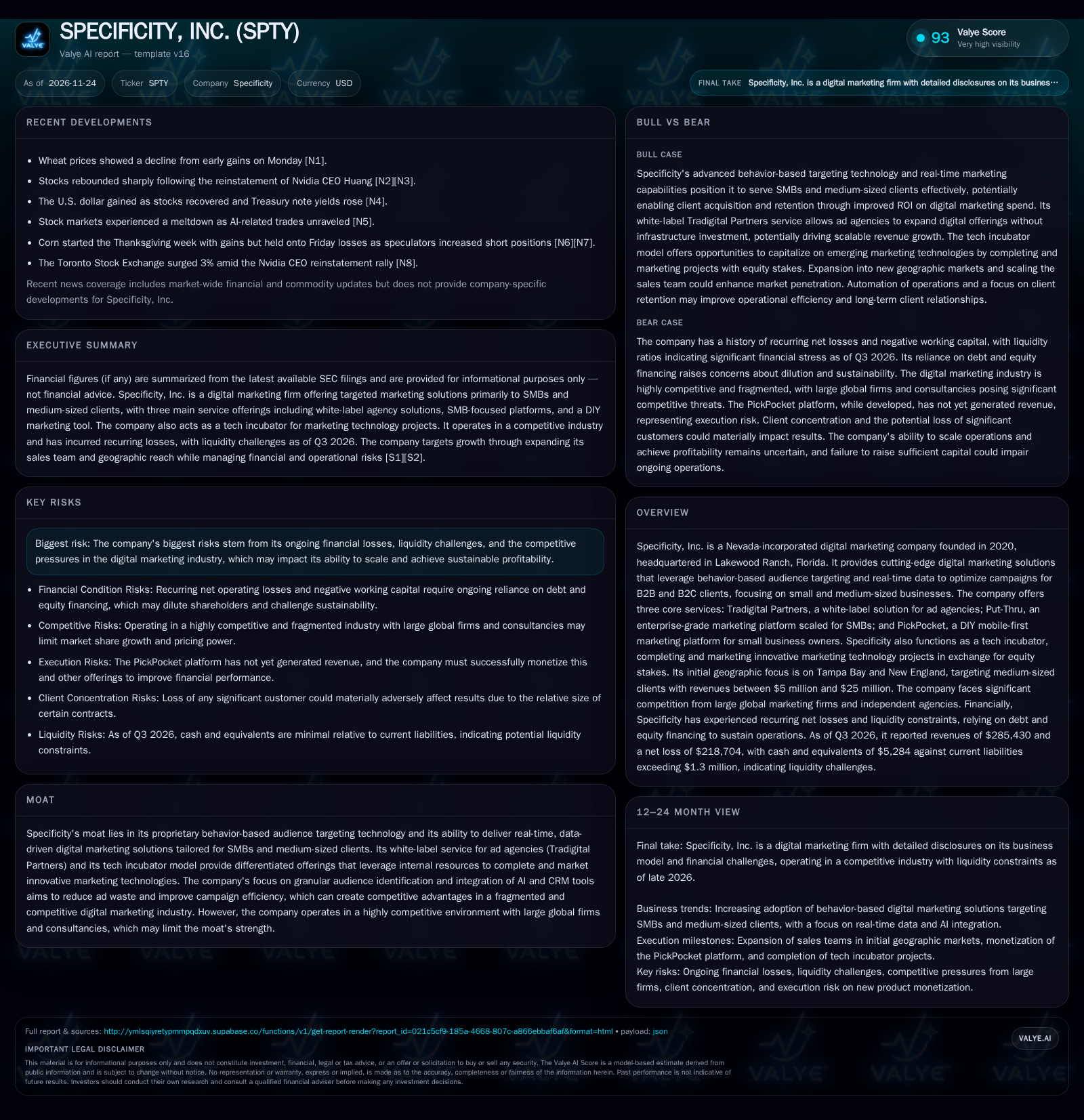
Specificity, Inc. delivers real-time, behavior-based digital marketing solutions for SMBs and medium-sized clients, with three main offerings and a tech incubator model. The firm's ability to convert technology differentiation into profitable, recurring revenue is unproven, and its financial position constrains execution options. Competitive intensity from large agencies and consultancies remains high, making client acquisition, retention, and product monetization critical hurdles going forward. [S1] [S2]
Specificity, Inc. has carved out a strategy centered on behavior-based, real-time digital marketing for small and medium-sized businesses, offering a suite of solutions for agencies, SMBs, and self-serve marketers. Despite a differentiated technology proposition and an incubator model for marketing innovation, the company enters late 2026 with minimal cash, substantial current liabilities, and a history of recurring losses. The central question for investors and clients alike is whether Specificity’s technology and service breadth can deliver sustainable, profitable growth before its financial constraints force a strategic reset or capital raise.
Liquidity Crisis and Monetization Delays Define the Current State
Specificity, Inc. reported revenue of $285,430 and a net loss of $218,704 for the quarter ended September 30, 2026. As of that date, the company’s cash position was just $5,284, with current liabilities totaling $1,372,607—placing its current and cash ratios effectively at zero and highlighting acute liquidity pressure [S2]. This financial fragility is compounded by the fact that its PickPocket DIY platform, though fully developed, has not yet generated revenue, signaling significant execution risk and delayed monetization [S1]. The company’s ongoing reliance on debt and equity financing to sustain operations further underscores its precarious position. In this environment, even routine business continuity is at risk without near-term capital infusion or a rapid improvement in cash flow generation.
Unit Economics and the Challenge of Scaling Behavior-Based Marketing
Specificity’s business model is predicated on delivering premium digital marketing services using proprietary, behavior-based audience targeting. The firm monetizes its offerings through three main channels: Tradigital Partners (white-label services for agencies), Put-Thru (an SMB-focused, enterprise-grade marketing platform), and PickPocket (a DIY platform for small businesses) [S1]. With target clients typically spending $5,100 per month on digital marketing, the company’s revenue potential per client is meaningful if acquisition and retention are successful. However, the firm’s low full-time staff count (9 employees as of December 2025) and reliance on consultants suggests a variable cost structure, but also limits scalability without further investment.
Operating leverage could emerge if the company successfully onboards clients to its platforms, especially PickPocket, which—if adopted at scale—could drive higher gross margins via automation and self-service. However, absent current PickPocket revenue, fixed development costs and ongoing support expenses weigh on margins. The tech incubator model, involving equity stakes in new marketing technologies, has the potential for non-linear upside if any project achieves commercial success, but near-term cash flows from this activity are unpredictable and likely back-end loaded.
Persistent net losses and negative working capital indicate that the firm’s current cost structure exceeds its revenue generation, and any attempt to scale will require either external capital or rapid improvement in client onboarding and retention. The lack of recurring revenue evidence or disclosed contract terms for its core offerings adds uncertainty to the sustainability and predictability of its cash flows.
Differentiation Faces Headwinds in a Crowded Digital Marketing Arena
Specificity operates in a highly competitive and fragmented digital marketing industry, contending with large global holding companies and a multitude of independent agencies [S1]. Its stated differentiation is rooted in proprietary, behavior-based targeting technology and real-time campaign optimization. The Tradigital Partners white-label model provides agencies with turnkey digital offerings, potentially lowering their own barriers to entry and expanding Specificity’s reach without direct sales to end clients.
However, barriers to entry in digital marketing technology are relatively low, and larger incumbents have greater resources to deploy similar or superior targeting solutions, integrate AI at scale, and absorb client churn. The company’s geographic focus on Tampa Bay and New England may provide short-term relief from national competition, but such protection is thin as digital marketing buyers can source services globally.
The PickPocket platform could, in theory, address a gap for small businesses seeking affordable, behavior-based digital marketing. Yet, the absence of revenue from this product underscores the difficulty of breaking through in a market where self-serve ad tools from major platforms (Google, Meta, etc.) already dominate. Client retention and the ability to demonstrate clear ROI will be essential to fend off both large and niche competitors.
Unlocking Platform Monetization and Incubator Value
A favorable outcome for Specificity would involve rapid adoption and monetization of its PickPocket platform, enabling the company to onboard a large volume of small business customers at attractive unit economics. If the Tradigital Partners model succeeds in attracting agency clients with minimal churn, and Put-Thru demonstrates measurable ROI for SMBs, Specificity could build a base of recurring, high-margin revenue. In this scenario, the tech incubator arm might yield additional equity gains from successful marketing technology projects, providing both cash inflows and validation of the firm’s innovation model.
Evidence supporting this scenario would include: a sharp acceleration in PickPocket customer acquisition and revenue; rising retention rates and average revenue per client; improved gross margins from automation; and the closing of one or more lucrative incubator exits. Disclosure of multi-year contracts, revenue visibility, or strategic partnerships with agencies would further validate the sustainability of growth. Falsification would come from continued platform underperformance, high client churn, or minimal incubator outcomes.
Survival Mode: Incremental Progress Amid Tight Constraints
The most plausible near-term path is one of incremental progress, where Specificity manages to retain core clients, slowly grows its SMB and agency base, but struggles to achieve scale or profitability due to capital limitations and competitive pressures.
Under this scenario, the company may secure short-term financing or equity infusions to maintain operations, but dilution risk remains high. Continued net losses and negative working capital persist, and any progress toward positive cash flow is gradual. Confirmation would come from modest but steady revenue growth, cost containment, and disclosed bridge financing. Falsification would be evidenced by further contraction in the client base, inability to raise capital, or a material deterioration in liquidity.
Liquidity Shortfall Forces Strategic Reset or Exit
In a negative scenario, Specificity is unable to generate sufficient new business or monetize PickPocket, while existing clients churn due to competitive offers or perceived lack of differentiation. The company’s acute liquidity squeeze—cash of just $5,284 against $1.37 million in current liabilities as of Q3 2026 [S2]—means that any delay in raising capital or generating cash flow could force a restructuring, asset sale, or bankruptcy filing.
Loss of a significant client or a failed fundraising attempt could trigger an immediate crisis. In this scenario, the technology incubator assets may be sold at distressed valuations, and the company’s ability to operate as a going concern comes into question. Evidence would include missed payroll, default on obligations, or regulatory filings indicating financial distress. Falsification of this scenario would be a successful capital raise or a sudden, material improvement in operating cash flow.
Milestones That Will Determine Whether Specificity’s Differentiation Delivers
PickPocket platform user growth and the timing and magnitude of its first revenue contributions—if disclosed—will be crucial to validating the DIY model.
Monthly and quarterly client churn rates across all service lines would help test the stickiness and perceived value of Specificity’s offerings.
Gross margin trends as the business scales—particularly if automation and self-service adoption reduce delivery costs.
Incubator project pipeline disclosures, including project completions, equity stakes, and any monetization events.
Any disclosed multi-year contracts, revenue commitments, or renewal rates, which would indicate improved revenue visibility and client confidence.
Evidence of successful capital raises, bridge financing, or strategic investment to address immediate liquidity needs.
Average revenue per client and client concentration metrics, to assess both revenue diversity and vulnerability to the loss of key accounts.
Sales team expansion and geographic reach progress, particularly in new markets beyond Tampa Bay and New England, as a sign of scalable growth potential.
Disclaimer: This is research-only, informational analysis and not investment advice. It may include AI-generated interpretation and general industry context. Always verify important details using primary sources.

Comments