
M2i Global’s Integrated Critical Minerals Ambition Confronts Severe Liquidity and Execution Hurdles
M2i Global seeks to build a diversified, U.S.-aligned critical minerals platform spanning mining, recycling, and strategic reserves, but its ultra-thin liquidity and minimal revenue highlight the daunting gap between vision and operational reality.
M2i Global, Inc. (MTWO) is pursuing a vertically integrated model for critical minerals supply, targeting U.S. defense and industrial demand through mining, recycling, and policy-aligned reserves. Strategic partnerships—most notably with Reforme Group—are intended to offset scale and technology disadvantages relative to established global competitors. [S1] [S2]
M2i Global, Inc. is positioning itself as a linchpin in the U.S. push for critical mineral independence, aiming to secure and process rare earths and specialty metals vital to defense and advanced manufacturing supply chains. Its business spans mining, recycling, and the creation of a strategic mineral reserve, backed by a technology partnership with Reforme Group. However, the company’s current financial position—characterized by minimal cash, outsized liabilities, and negligible revenue—raises urgent questions about its ability to bridge the gap between strategic intent and commercial execution. The next phase will test whether its integrated approach and government alignment can attract the necessary capital and overcome formidable competitive and operational barriers.
Liquidity and Revenue Realities Shape M2i Global’s Near-Term Outlook
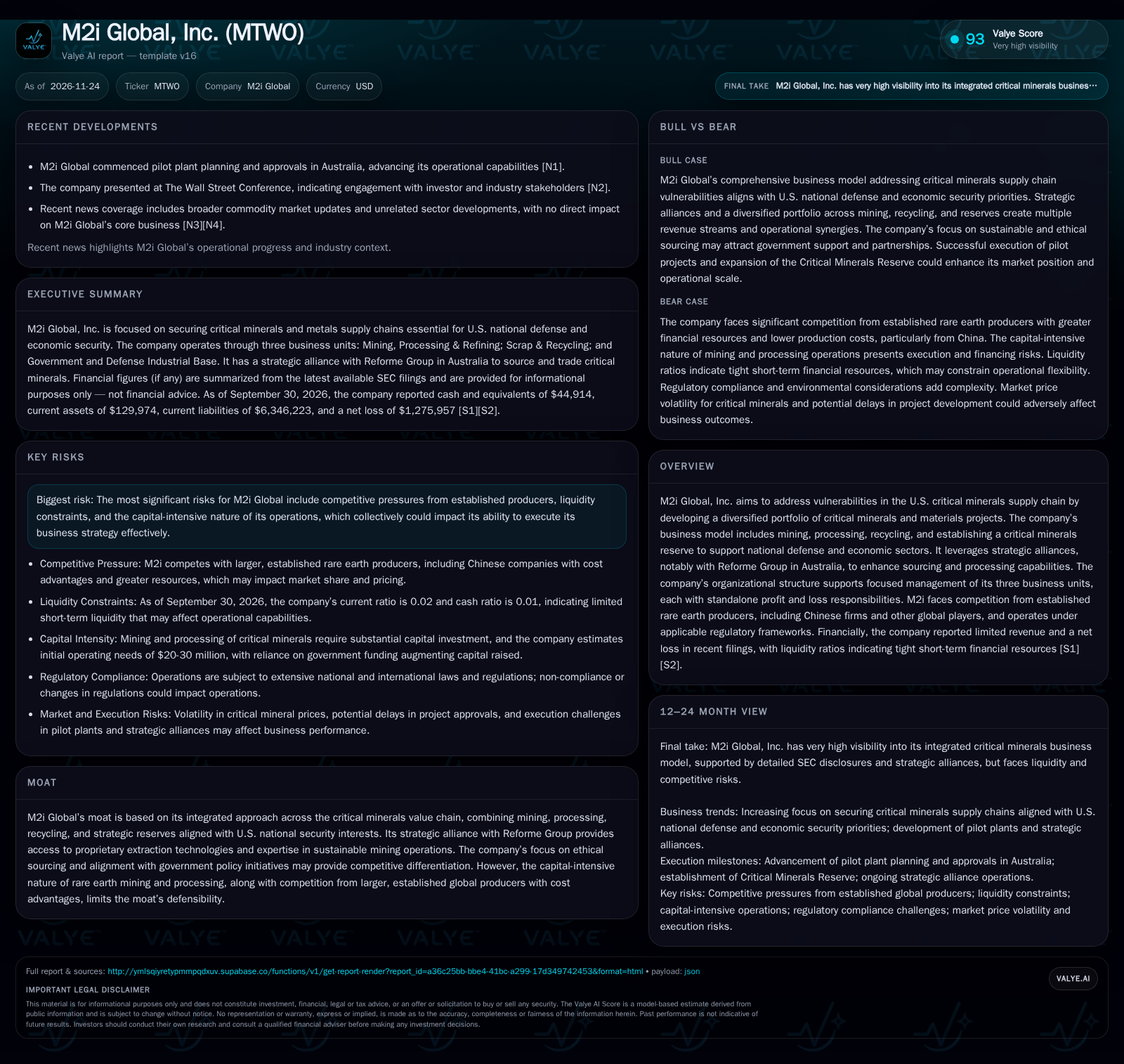
M2i Global’s most recent financial filings reveal a precarious liquidity position: as of September 30, 2026, the company reported cash and equivalents of $44,914, current assets of $129,974, and current liabilities of $6,346,223, resulting in a current ratio of just 0.02 and a cash ratio of 0.01 [S2]. The company reported cash and liquidity metrics for the period; these figures do not by themselves establish operating runway, investment capacity, financial flexibility, or financing capacity. Meanwhile, revenue generation remains at an embryonic stage, with only $3,400 reported for the fiscal year ending November 2023 [S2], and the company posted a quarterly net loss of $1,275,957 [S2]. These figures underscore the gap between M2i’s strategic ambitions and its current commercial footprint, making near-term funding and execution milestones critical for viability.
How M2i’s Integrated Model Might Unlock Value—If Funding Arrives
M2i Global’s business model is designed to capture value across the critical minerals supply chain: extracting and processing raw materials (Mining, Processing & Refining), recovering metals from end-of-life products (Scrap & Recycling), and managing a government-aligned strategic reserve (Defense Industrial Base) [S1]. In theory, this vertical integration could provide margin stability, operational synergies, and diversified revenue streams—especially if government demand for secure supply chains continues to rise.
However, the economics of mining and refining are highly capital-intensive, with significant fixed costs for exploration, development, and processing infrastructure. The company estimates it needs $20–30 million in initial operating capital, with a stated intention to augment private capital with government funding [S1]. Until these funds are secured, operating leverage remains largely theoretical. The Scrap & Recycling unit targets lower-risk, cash-positive acquisitions, which could provide earlier returns, but the scale and profitability of these activities remain undisclosed. Government contracts or reserve management could offer recurring revenue and better margin visibility, but commercial mechanics and contract structures are not detailed in the current disclosures.
Without meaningful revenue and with a heavy reliance on external funding, M2i’s business economics are currently dominated by fixed cost absorption and working capital strain, rather than economies of scale or positive operating leverage.
Facing Global Giants: M2i’s Position in a Crowded and Geopolitically Charged Market
M2i Global operates in a sector dominated by established global competitors, including Chinese rare earth producers and Western incumbents such as MP Materials and Lynas [S1]. These players benefit from scale, entrenched customer relationships, and in many cases, lower production costs and more developed technology stacks. M2i’s main differentiator is its integrated, U.S.-aligned approach—leveraging ethical sourcing, recycling, and government reserve management to appeal to national security priorities.
The strategic alliance with Reforme Group is designed to bridge technology and sourcing gaps, providing access to proprietary extraction methods and Australian supply streams [S1]. This could help offset some disadvantages in scale or technical know-how, but execution risk remains high until pilot projects and commercial contracts are proven.
Potential substitutes include direct customer sourcing from larger players, as well as ongoing advancements in recycling technology and materials science that could reduce demand for primary mining. The question is whether M2i can carve out a defensible niche through policy alignment, sustainability, and supply chain reliability before incumbents adapt or crowd out new entrants.
How Strategic Partnerships and U.S. Policy Tailwinds Could Catalyze a Breakout
The most favorable scenario for M2i Global hinges on successfully leveraging its Reforme Group alliance and U.S. policy alignment to secure both project funding and early customer contracts. If the company can rapidly advance its Australian pilot plant, demonstrate reliable and ethical supply, and win government-backed procurement or reserve management mandates, it could transition from pre-revenue to recurring revenue status and achieve early proof of concept.
In this scenario, the Scrap & Recycling unit could provide near-term cash flow, helping to de-risk the broader mining and refining operations. Government incentives, grants, or direct purchases—potentially catalyzed by ongoing geopolitical tensions and supply chain vulnerabilities—could further accelerate scale-up.
Confirmation would come from announced government contracts, successful pilot plant commissioning, and a marked improvement in liquidity through equity raises, grants, or customer prepayments. Evidence of recurring revenue streams and positive operating cash flow would further validate the model.
Incremental Progress Amid Funding and Execution Headwinds
The most plausible near-term trajectory is one of incremental progress punctuated by funding constraints. M2i Global may secure enough bridge financing—potentially through a mix of private placements and small-scale government grants—to advance pilot plant development and pursue targeted recycling acquisitions. However, absent a major contract or infusion of capital, operations are likely to remain sub-scale, with ongoing net losses and limited ability to ramp mining or refining output.
Evidence for this scenario would include slow but steady progress on pilot plant approvals, modest revenue increases from recycling or consulting, and periodic dilution or debt to maintain liquidity. Failure to secure transformative contracts or capital would leave the company exposed to continued competitive and execution risk. This scenario would be falsified by either a material government contract win (moving toward the upside) or inability to secure even minimal funding (moving toward the downside).
Liquidity Crunch and Execution Delays Threaten Continuity
In a negative scenario, M2i Global’s acute liquidity constraints prevent it from advancing pilot projects or acquiring revenue-generating recycling assets. Persistent net losses, lack of operational cash flow, and inability to raise new capital could force the company to curtail or suspend operations, cede valuable project rights, or pursue distressed asset sales.
Confirmation would come from further deterioration in liquidity metrics, missed payroll or supplier payments, regulatory filings indicating going concern uncertainty, or public disclosure of failed capital raises. Delays in pilot plant development or the loss of strategic partners would further compound downside risk. In this scenario, M2i would likely lose competitive relevance before demonstrating commercial viability.
What Will Determine Whether M2i Global Closes the Gap Between Vision and Viability?
Announcement of successful capital raises—whether from private equity, public markets, or government grants—sufficient to fund pilot plant and initial operations.
Execution milestones on the Australian pilot plant: regulatory approvals, construction start, and first production.
Disclosure of government contracts, reserve management mandates, or long-term offtake agreements with U.S. defense or industrial customers.
Material increase in recycling division revenue or evidence of successful, cash-positive acquisitions in the Scrap & Recycling unit (if disclosed).
Improvement in liquidity metrics—such as a current ratio above 1.0 or a cash balance sufficient for at least 6–12 months of operations (if disclosed).
Evidence of positive operating cash flow or meaningful gross margin in any business unit (if disclosed).
Retention or expansion of the Reforme Group partnership, and disclosure of technology transfer or sourcing outcomes.
Regulatory or policy developments that increase U.S. government funding or procurement for domestic critical mineral supply chains.
Disclaimer: This is research-only, informational analysis and not investment advice. It may include AI-generated interpretation and general industry context. Always verify important details using primary sources.

Comments