
Addentax Group: Navigating Diversification, Capital Actions, and Persistent Profitability Hurdles
Despite reported liquidity position and strategic expansion attempts, Addentax Group’s diversified China-based operations face ongoing losses and segment volatility. Recent deal terminations, capital raises, and a pivot toward consulting and AI-enhanced logistics highlight both opportunity and execution risk.
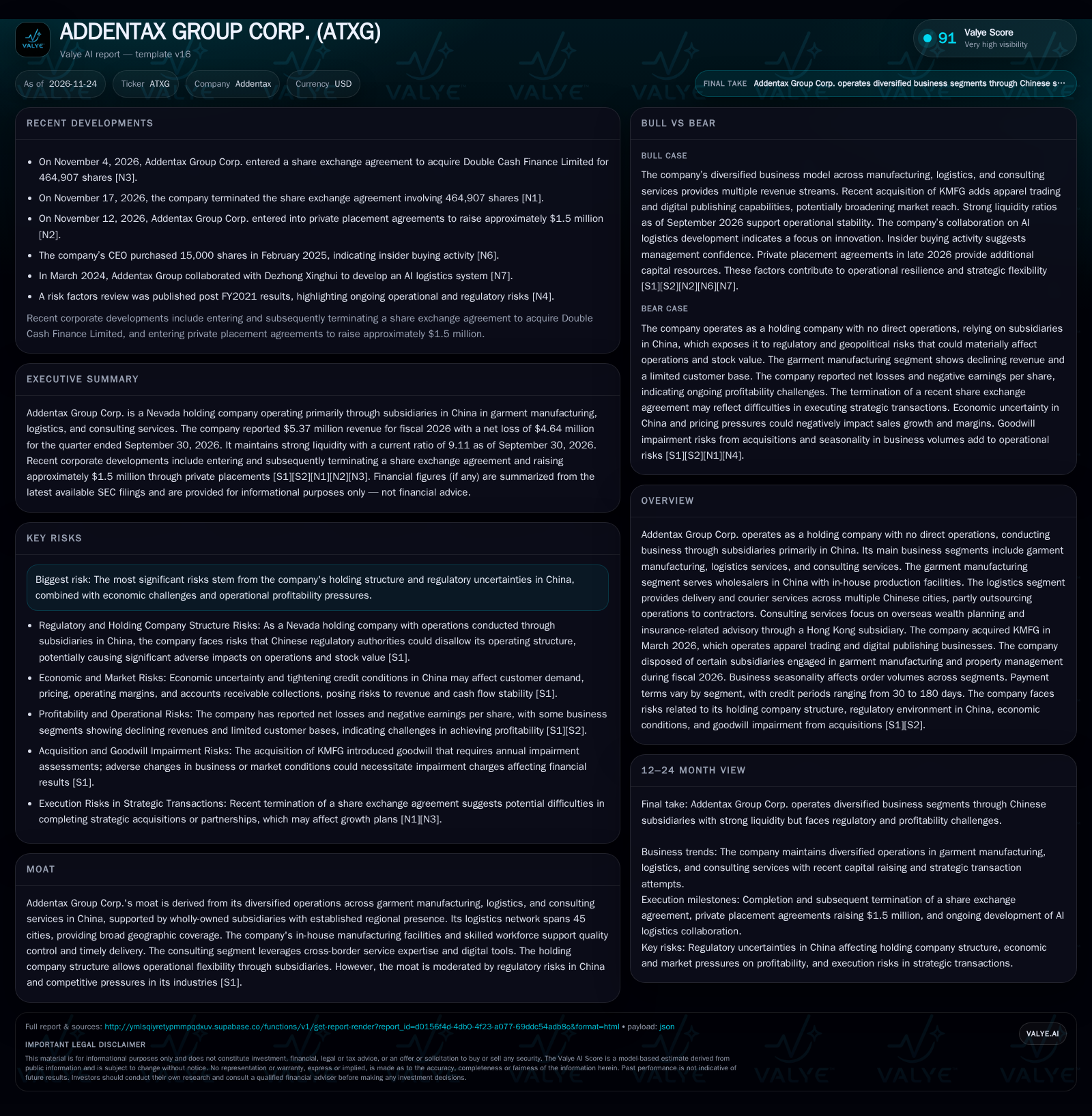
Addentax Group operates through Chinese subsidiaries in garment manufacturing, logistics, and consulting. Revenue rose 28.5% in fiscal 2026, mainly from consulting, but the company reported a significant net loss last quarter. Liquidity remains high, with over $13 million in cash and equivalents as of September 2026. Recent moves include a terminated acquisition, a successful $1.5 million private placement, and ongoing development of AI logistics. Execution risk, regulatory exposure, and segment-specific headwinds remain central challenges.
Addentax Group Corp. stands at a strategic crossroads: while its diversified operations in China have delivered top-line growth—driven by consulting and logistics—core profitability remains elusive. Addentax’s future will likely hinge on its ability to scale higher-margin segments, realize returns from AI and digital initiatives, and navigate regulatory and economic headwinds in the Chinese market.
Recent Developments Signal Strategic Uncertainty and Portfolio Shifts
Addentax Group reported $5.37 million in revenue for fiscal 2026, a 28.5% year-over-year increase, with consulting services now contributing over 40% of the total. However, the company posted a net loss of $4.64 million for the quarter ended September 2026, indicating that top-line growth has not translated into profitability [S1] [S2]. Garment manufacturing revenue has collapsed—from $283,042 in 2025 to just $40,911 in 2026—reflecting a shrinking customer base and lower order volumes [S1].
Liquidity remains a relative strength, with $1.15 million in cash and $12 million in short-term investments as of September 30, 2026, yielding a current ratio of 9.11 and a cash ratio of 3.49 [S2]. The company entered and then quickly terminated a share exchange agreement to acquire Double Cash Finance Limited in November 2026, while raising $1.5 million via private placements [N1] [N2] [N3]. These moves highlight both the search for growth and the challenges in executing strategic transactions.
Segment Economics: Consulting Ascends, Manufacturing Contracts, Logistics Seeks Efficiency
Addentax’s business model is defined by three segments—consulting, logistics, and garment manufacturing—each with distinct economics and risk profiles. Consulting, now the fastest-growing and highest-contributing segment, benefits from relatively short payment cycles (30–60 days), lighter capital requirements, and the potential for higher margins compared to asset-heavy manufacturing and logistics [S1]. This segment’s growth reflects demand for cross-border wealth planning and insurance-related advisory services, especially as Chinese and Hong Kong clients seek overseas options.
Logistics, generating $3.18 million in fiscal 2026 (up 5.2%), operates across 45 cities but relies on both in-house resources and outsourced contractors [S1]. This hybrid model can provide flexibility and scalability but may limit margin expansion if contractor costs rise or if competition intensifies. Payment terms of 30–90 days suggest some working capital risk but are manageable given current liquidity.
Garment manufacturing, once a core business, is now marginal—its shrinking revenue base signals a lack of scale, customer concentration risk, and possible margin compression from price competition. The company’s disposal of certain subsidiaries in this segment and the acquisition of KMFG (with digital publishing and apparel trading) suggest a pivot toward less capital-intensive, potentially higher-return activities [S1].
Operating leverage is limited by the company’s mix: logistics and consulting may offer incremental margin upside with scale, but manufacturing losses and overheads currently offset these gains. The net loss and negative EPS underscore that revenue growth alone cannot overcome structural cost issues without deeper segment realignment or efficiency gains.
Diversification and Digital Moves: Competitive Edge or Structural Drag?
Addentax’s multi-segment approach provides a hedge against volatility in any one business line, but it also creates complexity and dilutes focus. In garment manufacturing, the company faces intense competition from both domestic and regional players with larger scale, more automated facilities, and stronger customer relationships. The segment’s declining revenue suggests it is losing share or failing to keep pace with evolving market demands.
In logistics, geographic breadth across 45 cities is an asset, but the partial outsourcing model means Addentax competes not only with traditional logistics firms but also with tech-enabled upstarts and established express delivery giants in China. The company’s collaboration with Dezhong Xinghui to develop an AI logistics system is a bid to enhance efficiency and differentiate its offering, but it remains to be seen whether this will deliver cost advantages or stickiness with enterprise customers [N7].
Consulting services, focused on cross-border wealth planning and insurance-related advisory, occupy a niche where regulatory knowledge and trusted relationships can increase switching costs. However, barriers to entry are moderate, and sustained growth will require maintaining regulatory compliance, building brand trust, and potentially scaling via digital tools.
Overall, Addentax’s competitive position is defined by breadth rather than depth. Its key advantage may rest in its ability to coordinate among segments and leverage digital innovation, but this must be balanced against execution risk and the challenges of maintaining operational discipline across disparate business lines.
Strategic Pivots and Digital Initiatives Unlock Profitable Growth
A favorable trajectory for Addentax would involve successfully scaling its consulting and logistics segments while extracting value from AI-driven logistics innovation and the digital publishing assets acquired with KMFG. Consulting could deliver margin expansion if cross-border wealth planning demand accelerates and Addentax leverages its Hong Kong base to attract high-value clients.
In logistics, the AI collaboration—if it results in automation, route optimization, or improved service offerings—could reduce costs and enhance competitiveness, allowing for share gains in select provinces.
The upside case would be confirmed by sustained revenue growth in consulting and logistics, narrowing net losses or a pivot to profitability, and evidence that new digital services are gaining traction. Announcements of new enterprise contracts, improved segment margins, or recurring revenue streams from digital offerings would further support this scenario.
Incremental Progress Amid Ongoing Losses and Execution Volatility
The most plausible pathway is one of modest revenue growth driven by consulting and logistics, offset by continued weakness or further contraction in garment manufacturing.
Strategic transactions, such as the recently terminated share exchange, may continue to face hurdles, reflecting either due diligence findings, valuation gaps, or regulatory constraints. The company will likely remain in a holding pattern—experimenting with digital and AI initiatives, seeking operational efficiencies, and occasionally pursuing bolt-on acquisitions.
Confirmation of this scenario would include continued revenue growth in consulting and logistics, but with limited improvement in operating margin or EPS. Repeated deal terminations or lack of progress in digital initiatives would further entrench this base case.
Regulatory, Execution, and Segment Risk Drive Deeper Losses
In a negative scenario, macroeconomic weakness or regulatory intervention in China could sharply reduce demand for consulting and logistics services, while exacerbating collections risk and compressing margins. Garment manufacturing could become a further drag or be wound down entirely, incurring restructuring or impairment costs.
Execution risk is high: further failed acquisitions, goodwill impairments from the KMFG deal, or poor returns on AI investments could erode capital and undermine confidence. The company’s holding structure and reliance on Chinese subsidiaries expose it to policy changes that could limit capital flows or even force divestitures [S1] [N4].
Confirmation would come from declining segment revenues, ballooning net losses, asset write-downs, or disclosures of regulatory actions impacting subsidiary operations. A failure of the AI logistics initiative to deliver tangible cost or revenue benefits would also support this downside outcome.
Milestones That Will Determine Whether Addentax’s Diversification Pays Off
Growth rate and margin trends in consulting services—sustained expansion and margin improvement would signal successful repositioning.
Revenue and cost structure developments in logistics, including evidence of operational leverage and impact from AI system deployment (if disclosed).
Updates on the performance and integration of KMFG’s digital publishing and apparel trading businesses, including revenue contribution and margin profile.
Evidence of recurring revenue streams or higher-value client acquisition in consulting and digital offerings.
Announcements of new strategic partnerships, acquisitions, or terminations—frequency and rationale would clarify execution capability.
Any disclosures of impairment charges, especially related to goodwill from the KMFG acquisition.
Regulatory developments affecting holding company structures or cross-border service businesses in China—any adverse changes would be critical.
Working capital and receivables trends, especially in logistics and consulting, as indicators of customer health and credit risk.
Disclaimer: This is research-only, informational analysis and not investment advice. It may include AI-generated interpretation and general industry context. Always verify important details using primary sources.

Comments