
CrowdStrike’s Strategic Bet: Zscaler Acquisition and the Mechanics of AI Security Leadership
CrowdStrike’s definitive move to acquire Zscaler signals a bold consolidation in cybersecurity, but integration challenges, evolving AI-driven threats, and market competition could reshape the firm’s economics and trajectory. Examining the interplay of recurring subscription revenue, operational leverage, and the risks of scale reveals what could drive or hinder outperformance.
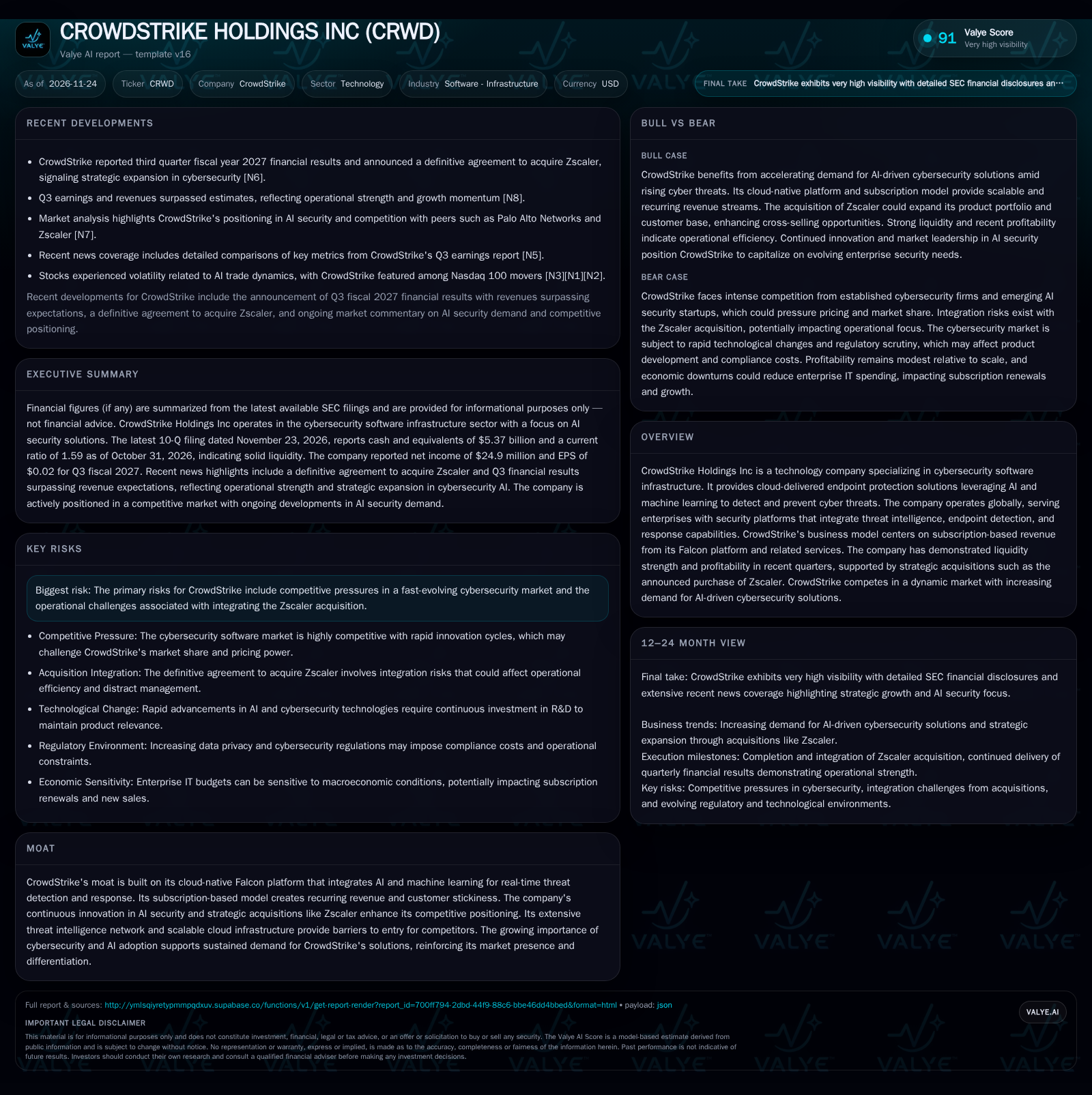
CrowdStrike’s acquisition of Zscaler marks a major step in expanding its AI-driven cybersecurity capabilities. While the company reports reported liquidity position and a return to profitability, its long-term advantage depends on successful integration, continued innovation, and navigating competitive and regulatory pressures. The potential for operational leverage and cross-sell is high, but execution risks remain material. [S2] [N6]
CrowdStrike’s latest move to acquire Zscaler marks an inflection point in the cybersecurity landscape, blending two of the sector’s most recognized cloud-native platforms. As enterprises demand more comprehensive and intelligent threat protection, CrowdStrike must deliver both technological innovation and commercial discipline to justify its expanding footprint and valuation.
Acquisition of Zscaler and Financial Snapshot Define the New Starting Line
CrowdStrike has signed a definitive agreement to acquire Zscaler, representing one of the most significant consolidations in the cybersecurity sector in recent years [N6]. This move could reshape the competitive landscape by combining two leaders in cloud-native security and zero trust, potentially unlocking new cross-sell opportunities and platform synergies. [S2] The company posted a net income of $24.9 million for the quarter, indicating a shift toward consistent profitability even as it pursues aggressive expansion [S2]. These facts set the stage for a high-stakes period of integration, innovation, and market repositioning.
Subscription Recurrence, Operating Leverage, and the Economics of Platform Expansion
CrowdStrike’s core business model is built around recurring subscription revenue from its Falcon platform, delivering endpoint protection and threat intelligence as a cloud-based service. This structure allows for scalable top-line growth with relatively low marginal costs, provided customer retention and upsell rates remain high. The economics of cybersecurity SaaS favor high gross margins, but significant ongoing investment in R&D and sales is required to maintain product leadership and customer acquisition momentum.
The Zscaler acquisition, if completed, could create a more comprehensive security suite spanning endpoint, identity, and network security. This breadth may enhance wallet share and stickiness, but also introduces integration complexity—especially around product unification and salesforce coordination. Operating leverage could accelerate if CrowdStrike successfully cross-sells between its and Zscaler’s installed bases, but this depends on minimizing customer friction and realizing cost synergies without disrupting innovation cycles.
Efficient integration and realization of anticipated revenue and cost synergies will be critical to justifying the acquisition premium and supporting ongoing margin expansion.
A critical factor influencing the economics of CrowdStrike's expanded platform post-acquisition is the degree of overlap and differentiation between the Falcon and Zscaler product suites. If the combined offerings can be modularly integrated to allow customers to adopt components incrementally, this could reduce friction and accelerate adoption. Conversely, if integration requires wholesale platform migration or significant changes to customer workflows, adoption risks slowing, potentially increasing churn or lengthening sales cycles. Moreover, the success of cross-selling initiatives will depend on the salesforce's ability to effectively position the combined value proposition without diluting focus or creating internal competition between legacy product teams.
Consolidation and Platform Wars: Navigating Intensifying Cybersecurity Competition
CrowdStrike operates in a cybersecurity market characterized by rapid innovation, intense competition, and the rising importance of AI-driven threat detection. Its main competitors include platform players in endpoint, cloud, and network security—categories that increasingly overlap as customers seek unified solutions. The acquisition of Zscaler could position CrowdStrike as one of the few vendors capable of offering an end-to-end cloud-native security stack, rivaling the breadth of established firms and challenging both legacy and next-gen competitors.
However, this consolidation also brings challenges. Larger platform players may face slower innovation cycles, internal complexity, and the risk that customers prefer best-of-breed solutions over integrated suites. Emerging AI-first security startups could exploit these gaps, especially if they deliver superior threat detection, user experience, or cost efficiency. Additionally, competitors with deep enterprise relationships or broader product portfolios—such as diversified technology giants—retain significant pricing power and customer access. CrowdStrike’s future advantage will depend on its ability to maintain technical leadership, deliver tangible outcomes for customers, and execute on both product and go-to-market integration with Zscaler.
From a competitive standpoint, the integration of Zscaler positions CrowdStrike to address a broader attack surface, which is increasingly important as enterprises adopt hybrid and multi-cloud environments. However, the firm's ability to capitalize on this opportunity depends on its agility in responding to shifting threat vectors and regulatory requirements across different geographies. Additionally, competitors that specialize in niche segments or leverage open ecosystems may challenge CrowdStrike’s platform approach by offering more customizable or interoperable solutions. The trade-off between platform breadth and depth will be a key battleground in maintaining market share and customer loyalty.
Furthermore, the competitive landscape is influenced by the pace at which AI-first security startups innovate and the extent to which they can integrate with existing enterprise systems. CrowdStrike’s scale and data assets provide a formidable moat, but only if the company can rapidly incorporate cutting-edge AI techniques and maintain low false positive rates to avoid alert fatigue among security teams. The dynamic interplay between large integrated platforms and specialized AI-driven challengers will shape customer preferences and pricing dynamics, potentially impacting CrowdStrike’s long-term pricing power and margin profile.
If Integration Delivers: Synergy Realization and AI Leadership Catalyze Outperformance
The most favorable outcome for CrowdStrike would involve smooth integration of Zscaler, enabling the combined entity to offer a seamless, unified security platform that addresses endpoint, identity, and network threats. This could drive accelerated cross-sell, reduce customer churn, and increase average contract values, while leveraging shared threat intelligence to deliver superior AI-driven protection.
Confirmation of this scenario would include rapid growth in multi-product adoption, evidence of rising net retention rates, and expanding gross and operating margins as cost synergies are realized. Additionally, continued leadership in third-party security efficacy tests and high win rates in large enterprise deals would suggest that the platform approach is resonating with customers. Falsification would occur if integration issues led to customer defections, product delays, or a deceleration in revenue growth relative to peers.
Platform Expansion Brings Growth with Friction: A Realistic Trajectory
The most plausible trajectory is that CrowdStrike achieves incremental growth and modest margin expansion as it integrates Zscaler, but faces typical post-acquisition friction. Some cross-sell opportunities are realized, but not at full potential due to integration complexity, cultural differences, and customer migration challenges. The combined platform enhances competitive positioning, but the market remains fragmented with strong best-of-breed challengers.
Evidence confirming this scenario would be steady revenue growth, stable or slightly improving operating margins, and retention of key enterprise accounts. Signs of friction could include slower-than-expected progress on integration milestones, muted customer adoption of the unified platform, or ongoing reliance on aggressive sales incentives to drive cross-sell. If disclosed, net retention rates and customer churn would help validate whether synergy targets are realistic or require recalibration.
Integration Missteps and Competitive Gaps Could Erode Momentum
The adverse scenario would see CrowdStrike struggling to integrate Zscaler, resulting in customer confusion, product overlap, and operational distractions. This could lead to increased churn, slower sales cycles, and rising costs as the company attempts to reconcile divergent platforms and sales motions. Meanwhile, agile competitors—especially AI-focused upstarts—could capture market share by capitalizing on product gaps or delays.
Confirmation of this scenario would include declining net retention, negative customer feedback on integration, and margin compression due to elevated costs or lost scale efficiencies. Additionally, if revenue growth materially lags sector peers or if innovation cycles slow, it would suggest that the complexity of platform consolidation has outweighed the intended benefits. Major enterprise customer losses or higher-than-expected integration costs would further validate downside risks.
Milestones That Will Define CrowdStrike’s Strategic Payoff
Progress and timeline of Zscaler acquisition closing, including regulatory approvals and any revised deal terms.
Updates on integration milestones, such as unified platform launches, cross-product integrations, or salesforce alignment.
If disclosed, changes in net retention rates and churn—especially among large enterprise customers—following the acquisition.
Trends in gross and operating margins as cost synergies are pursued and integration expenses are absorbed.
Evidence of incremental revenue from cross-sell or upsell into the combined CrowdStrike-Zscaler customer base.
Updates on AI-driven product enhancements and third-party efficacy validation, supporting claims of technical leadership.
Competitive win rates against both platform incumbents and emerging AI-first security vendors.
If available, customer satisfaction or NPS scores post-integration, which would help test the thesis of enhanced platform value.
Disclaimer: This is research-only, informational analysis and not investment advice. It may include AI-generated interpretation and general industry context. Always verify important details using primary sources.

Comments