
Jacobs Solutions: Backlog Growth, Consulting Integration, and the Levers Behind Infrastructure Visibility
A surge in backlog, the full integration of PA Consulting, and a diversified project pipeline position Jacobs Solutions at a pivotal moment—yet execution on government contracts, debt management, and acquisition synergy remain decisive variables for future value realization.
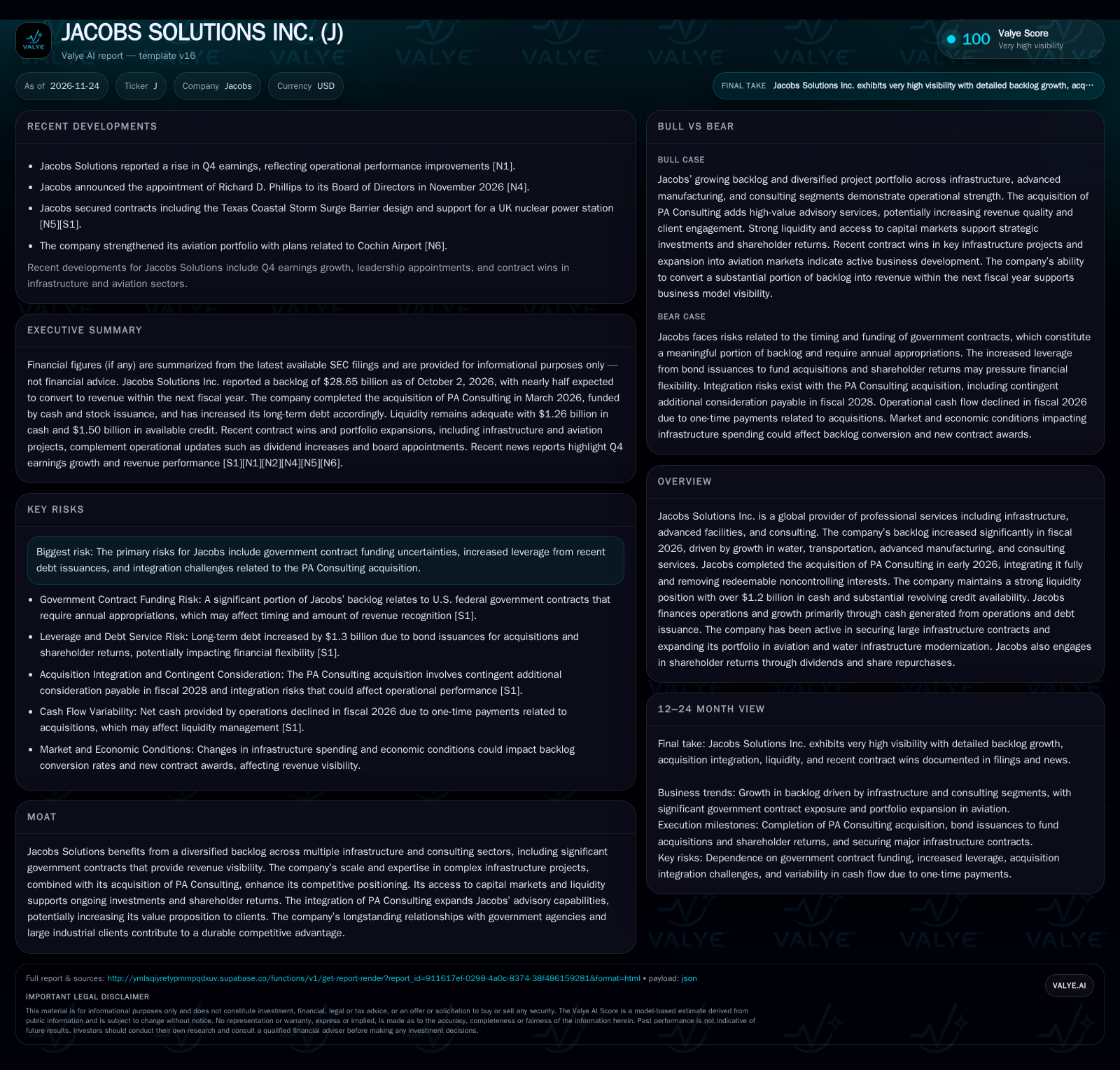
Jacobs Solutions has expanded its backlog to $28.65 billion, nearly half of which is expected to convert to revenue within a year. The full acquisition of PA Consulting deepens its advisory capabilities, but also increases leverage and integration risk. With active wins in infrastructure and aviation, Jacobs must navigate government contract timing, debt service, and consulting integration to translate its strong backlog into sustainable earnings and cash flow. [S1] [N1] [N6]
Jacobs Solutions stands at an inflection point, having expanded its backlog to a record $28.65 billion and completed the full acquisition of PA Consulting, deepening its consulting and advisory footprint. Nearly half of this backlog is expected to convert to revenue within the next fiscal year, signaling strong near-term visibility. However, this growth comes with heightened leverage, integration demands, and exposure to government contract timing. The company’s ability to turn backlog into profitable, recurring cash flow while managing debt and realizing consulting synergies will determine whether its recent strategic moves translate into durable shareholder value. [S1]
Backlog Expansion, Consulting Acquisition, and Government Exposure Define Today’s Landscape
As of October 2, 2026, Jacobs Solutions reported a record backlog of $28.65 billion—up sharply from $23.06 billion a year prior—driven by new contract wins in water, transportation, advanced manufacturing, and organic growth in the consulting segment. Approximately $12.7 billion, or 44.3% of this backlog, is targeted for revenue conversion in the next fiscal year, indicating high short-term visibility. The company completed its acquisition of the remaining interest in PA Consulting for approximately £1.21 billion on March 20, 2026, funded through a mix of cash and newly issued stock, with another £75 million in contingent consideration due in 2028. This deal increased Jacobs’ long-term debt by $1.3 billion. Notably, about 8.9% of backlog relates to U.S. federal government contracts, which are typically funded annually and thus subject to potential timing risk. [S1]
Revenue Recognition and Project Mix: The Economics Behind Jacobs’ Model
Jacobs’ revenue is primarily generated through a mix of cost-reimbursable and fixed-price contracts for technical, engineering, and consulting services, with clients spanning government, industrial, and commercial sectors. The company’s economics hinge on its ability to manage project mix, pricing discipline, and efficient delivery—cost-reimbursable contracts offer lower risk but limited margin upside, while fixed-price and advisory projects can drive higher margins but expose Jacobs to execution risk and cost overruns.
The acquisition of PA Consulting shifts the mix toward higher-value, knowledge-driven advisory services, which typically deliver better margins and less working capital intensity than construction-heavy segments. However, integration costs and the need to harmonize delivery models could create near-term margin friction. Jacobs’ capital needs are moderate relative to heavy industrial peers, but the recent transaction has increased leverage and introduced contingent liabilities. Operating leverage is present but limited by the project-based, people-intensive nature of much of Jacobs’ work—sustained margin expansion will likely require a combination of backlog conversion, consulting scale, and disciplined cost management.
Diversification, Scale, and Advisory Integration Shape Jacobs’ Competitive Edge
Jacobs competes against large engineering, construction, and consulting firms with global reach. Its core advantages stem from a diversified backlog across infrastructure, advanced facilities, and now a deepened consulting capability via PA Consulting. The company’s scale allows it to pursue and deliver on large, complex projects—such as the Texas Coastal Storm Surge Barrier and UK nuclear station support—where few competitors can match breadth or technical expertise. The integration of PA Consulting enhances Jacobs’ value proposition, enabling end-to-end solutions that span strategic advisory through project execution.
However, counterforces are real: government clients can be price-sensitive and subject to political funding cycles, while private-sector clients may shift project timelines in response to macroeconomic conditions. Substitution risk exists from smaller, specialized firms in niche consulting or digital transformation, and from disruptive technologies that could change project delivery models. The question is whether Jacobs can leverage its consulting scale to create stickier client relationships and cross-sell higher-margin services, or whether integration complexity and commoditization pressures will erode its edge over time.
If Backlog Converts Smoothly and Consulting Synergies Materialize, Margin Upside Could Accelerate
A favorable scenario would see Jacobs converting its $12.7 billion near-term backlog at or above expected margins, while PA Consulting’s integration unlocks higher-value advisory opportunities, improving margin profile and cash conversion. Government appropriations remain stable, and newly won projects in sectors such as aviation and water infrastructure proceed on schedule.
Evidence confirming this scenario would include: consistent or rising gross and operating margins, acceleration in consulting segment revenue and profitability, backlog conversion rates tracking or exceeding guidance, and limited integration-related cost overruns. Additional large-scale project wins, especially in regulated or long-duration sectors, would further bolster visibility.
Sustained Backlog Conversion with Moderate Margin Progress Remains the Most Likely Course
The most plausible path is that Jacobs continues to convert a substantial portion of its backlog into revenue, with steady—if unspectacular—margin improvement as PA Consulting is fully integrated. Government contract funding remains generally stable but with some project timing variability. The company maintains disciplined capital allocation, balancing debt service with selective shareholder returns. Integration of PA Consulting is executed without major disruption, but consulting synergies accrue gradually rather than immediately.
This scenario would be confirmed by steady year-over-year revenue growth, stable to modestly improving margin trends, and operating cash flow rebounding after one-time acquisition costs abate. Watch for normalization of working capital needs and the absence of significant cost overruns or project delays in both legacy and consulting segments.
Acquisition Drag, Debt Pressure, and Government Delays Could Erode Earnings and Flexibility
An adverse scenario would see integration of PA Consulting proving more difficult than anticipated, resulting in margin compression, talent attrition, or loss of client relationships. Simultaneously, a slowdown or disruption in government appropriations could delay or reduce conversion of the $2.6 billion in federal backlog, directly impacting near-term revenue and cash flow. Higher debt service from the recent bond issuance could constrain potential financial flexibility, particularly if operating cash flow does not recover after one-time payments.
Confirmation of this scenario would include: declining or volatile margins, lower-than-expected revenue conversion from backlog, negative working capital trends, or evidence of project delays and cost overruns. Early warning signs would be missed integration milestones, consulting segment underperformance, or indications of tightening liquidity despite available credit lines.
Milestones That Will Shape Jacobs’ Ability to Translate Backlog Into Durable Value
Backlog conversion rate—especially the proportion of the $12.7 billion expected to become revenue in the next fiscal year—will be critical for assessing revenue visibility and operational execution. [S1]
Segment-level margin trends, particularly in PA Consulting and advanced facilities, would help clarify whether integration is delivering expected synergies or experiencing friction. If disclosed, consulting gross margin and client retention rates would be especially informative.
Net operating cash flow recovery post-acquisition, and the pace at which one-time payment drag normalizes, will indicate underlying business health. [S1]
Debt service coverage and leverage metrics, including interest expense as a percentage of operating income, are important for understanding potential financial flexibility after the bond issuance for the PA Consulting deal. [S1]
New contract win cadence and average project size—especially in sectors like aviation, water, and government infrastructure—will serve as an indicator of ongoing business development effectiveness. [N1] [N6]
Progress on the £75 million contingent consideration payment for PA Consulting due in fiscal 2028 would provide insight into integration success and future liability management.
Monitoring the proportion of backlog tied to annually appropriated government contracts and any changes in U.S. federal infrastructure funding outlook would help gauge timing risk. [S1]
Disclaimer: This is research-only, informational analysis and not investment advice. It may include AI-generated interpretation and general industry context. Always verify important details using primary sources.

Comments