
Starco Brands: Portfolio Complexity, Liquidity Tightness, and the Search for Consumer Product Scale
Starco Brands, a holding company for niche consumer brands, faces a critical period defined by thin cash liquidity, ongoing net losses, and incomplete public disclosure about product-level economics. While the firm reported liquidity-ratio trends above 1 and operates a diversified set of acquired brands, the lack of detailed segment reporting and a cash ratio of just 0.05 underscore both the operational scale and the fragility of its financial structure.
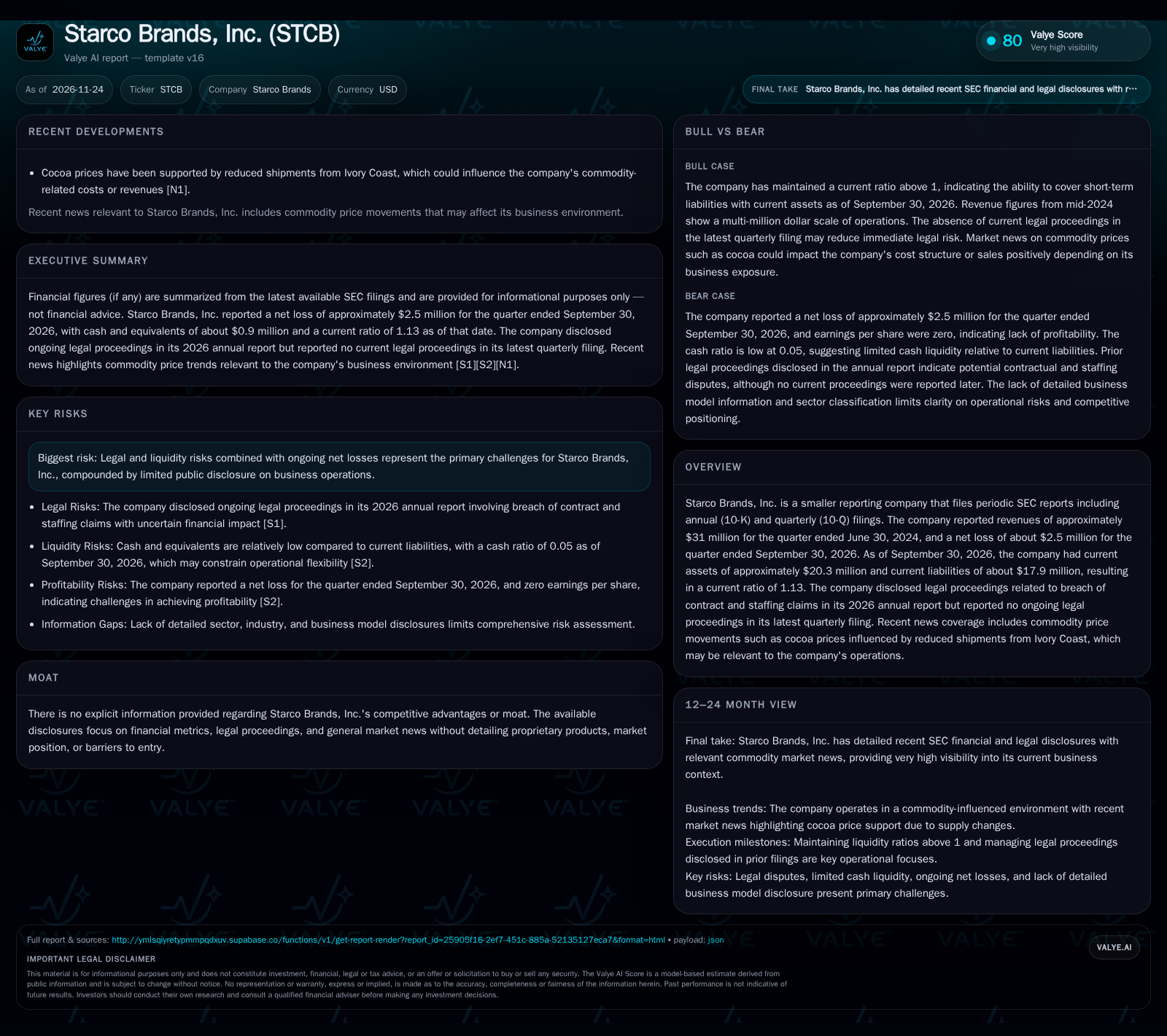
Starco Brands’ multi-brand strategy has produced meaningful revenue scale but has yet to deliver profitability or reported liquidity position. With $0.9M in cash against nearly $18M in current liabilities and a quarterly net loss of $2.5M, the company’s near-term trajectory will hinge on cost control, legal resolution, and the ability to translate its brand portfolio into sustainable cash flows. The absence of updated risk factors and limited insight into brand-level economics increases both the uncertainty and the potential volatility of outcomes. [S2]
Starco Brands, Inc. has assembled a portfolio of consumer-facing brands through acquisition and internal development, aiming to commercialize differentiated products across multiple verticals. [S2]
Recent Financials Highlight Scale—And Strain
Starco Brands reported $31.1 million in revenue for the quarter ending June 30, 2024, but continued to operate at a net loss, posting a $2.5 million deficit for the quarter ending September 30, 2026. As of September 30, 2026, the company’s cash and equivalents totaled $901,130, while current assets stood at $20.3 million and current liabilities at $17.9 million. The company reported cash and liquidity metrics for the period; these figures do not by themselves establish operating runway, investment capacity, financial flexibility, or financing capacity. The most recent quarterly filing reports no current legal proceedings, but prior disclosures indicate a history of contractual and staffing disputes, and commodity price movements—such as cocoa—could impact input costs or sales depending on product mix. [S1] [S2]
How the Portfolio Structure Shapes Profit Potential—and Risk
Starco Brands operates as a holding company, aggregating acquired and internally developed consumer product brands across categories such as nutrition, beauty, and spirits. The company’s revenue scale suggests broad market reach, but with no public segment-level disclosure, it is unclear which lines drive gross profit or absorb fixed costs. Consumer packaged goods (CPG) economics typically feature high variable costs (raw materials, packaging, logistics) and significant marketing outlays, with operating leverage only materializing at scale or through premium pricing and brand loyalty.
The company’s reported cash balance relative to liabilities implies limited margin for operational missteps, especially if any of its core brands experience volatility in demand or supply chain disruptions. Capital needs may remain high if the firm continues to invest in brand-building or inventory, and the lack of profitability suggests that external financing or asset sales could be required absent a rapid turnaround. Without segment disclosure, it is also unclear whether any brands are self-funding or subsidizing others, complicating the path to sustainable free cash flow.
The absence of segment-level profitability data significantly hampers the ability to evaluate the sustainability of Starco Brands’ multi-brand approach. If some brands are operating at scale and generating positive margins, they could subsidize nascent or loss-making brands, but this cross-subsidization may mask underlying inefficiencies and delay necessary portfolio pruning. Conversely, if all brands are incurring losses, the aggregate revenue scale may be more reflective of top-line expansion without accompanying operational leverage. Understanding the cost structure at the brand level—including fixed versus variable costs, marketing spend allocation, and supply chain efficiencies—would help clarify whether the portfolio complexity is a strategic asset or a source of margin dilution.
Moreover, consumer product companies often face nonlinear cost behavior, where incremental revenue growth can disproportionately increase costs due to marketing intensity or distribution fees. Starco Brands’ ability to manage this dynamic—through optimized channel mix, targeted promotions, or improved supplier terms—will be pivotal in transitioning from revenue growth to profitability. If the portfolio contains brands with distinct seasonality or demand volatility, working capital requirements may fluctuate significantly, further stressing liquidity. Therefore, a granular understanding of cash conversion cycles and inventory turnover by brand would be instrumental in forecasting financial sustainability under varying market conditions.
Brand Differentiation Versus CPG Giants and Niche Innovators
The competitive landscape for Starco Brands spans both established CPG conglomerates and emerging niche players. The company’s strategy of pursuing ‘behavior changing’ products and novel brand positioning is designed to carve out defensible niches—often critical for smaller firms lacking scale advantages. However, the absence of disclosed proprietary technology, patents, or unique distribution agreements limits evidence of a durable moat.
In CPG, barriers to entry are generally low, but incumbents benefit from supply chain leverage, deep retailer relationships, and marketing budgets that dwarf those of smaller entrants. Starco’s ability to defend shelf space or digital share will likely hinge on the distinctiveness of its brands and speed to innovate, but with no evidence of recurring-revenue structures or switching frictions, customer retention may remain vulnerable to competitive promotions or private-label encroachment.
If Portfolio Synergies Drive Margin Expansion
The most favorable scenario for Starco Brands would see one or more acquired brands achieve breakout status, enabling the company to leverage fixed costs across a larger revenue base and improve gross and operating margins. If the company can cross-sell products within its portfolio, negotiate better terms with suppliers, or streamline logistics, operating leverage could materialize rapidly—particularly if input cost inflation (such as cocoa) moderates or can be passed on to consumers.
Confirmation of this scenario would require disclosure of positive segment-level EBITDA or operating profit, evidence of improved gross margins, and a reversal of recent net losses. Additional signals would include a reported liquidity-ratio trends, renewed or expanded retail distribution agreements, and market share gains in select product categories. Conversely, continued net losses and flat or declining gross margin would undermine the plausibility of a rapid turnaround.
The realization of portfolio synergies depends not only on revenue growth but also on the integration of operational processes across brands. If Starco Brands can consolidate procurement, harmonize supply chains, and centralize marketing functions, fixed cost absorption may improve, enhancing operating margins. Additionally, cross-brand innovation—such as shared product platforms or co-branded initiatives—could accelerate time-to-market and reduce development costs. However, these benefits are conditional on effective management coordination and cultural alignment across diverse brand teams. Failure to achieve operational integration could result in duplicated efforts and inefficiencies that negate potential margin improvements.
Furthermore, the ability to pass through input cost inflation to consumers is contingent on brand strength and market positioning. Premium or differentiated products may command price premiums, supporting margin resilience, whereas commoditized offerings face price sensitivity that limits cost recovery. In this context, consumer loyalty and brand equity become critical levers. If Starco Brands can demonstrate sustained customer engagement and reduced churn, it may justify pricing power that buffers against raw material volatility. Conversely, if competitive pressures intensify or private-label alternatives gain traction, margin expansion prospects could be constrained despite operational improvements.
Portfolio Complexity Sustains Scale but Delays Cash Flow Breakthrough
The most plausible trajectory for Starco Brands is that the current mix of brands sustains multi-million dollar quarterly revenue but continues to generate modest net losses, with occasional quarters near breakeven.
Liquidity Crunch or Brand Underperformance Forces Restructuring
Warning signs would include a drop in the current ratio below 1, disclosure of overdue payables or new legal disputes, and any material contraction in revenue. If the company is unable to access external financing or monetize assets quickly, the risk of default or formal restructuring would rise. A surge in commodity costs without pricing power, or the loss of a major distribution partner, would further accelerate downside risk.
What Will Determine Starco Brands’ Ability to Unlock Value?
Disclosure of segment-level revenue and margin for each key brand—if provided—would allow investors to distinguish between growth engines and underperforming assets.
Sustained improvement in gross margin or operating margin, particularly if accompanied by a return to positive net income or EBITDA, would indicate successful scaling or cost management.
Resolution or absence of new legal proceedings, especially those relating to major contracts or staffing, would reduce operational risk.
Stability or growth in revenue from core brands, as opposed to aggregate consolidated growth, would help test for true brand strength and pricing power.
Disclosure of new or renewed distribution agreements, retail partnerships, or e-commerce channel expansion would support the case for expanded market reach.
Updates on commodity cost trends (especially cocoa or other key inputs) and the company’s ability to pass through price increases would clarify margin sensitivity.
Management commentary on capital allocation priorities—such as further acquisitions, organic brand investment, or debt repayment—would clarify near-term strategy and risk tolerance.
Disclaimer: This is research-only, informational analysis and not investment advice. It may include AI-generated interpretation and general industry context. Always verify important details using primary sources.

Comments