
Charlie's Holdings: Regulatory Limbo, Cash Burn, and the Fragile Economics of Synthetic Nicotine
Charlie's Holdings remains in a precarious position as it navigates FDA regulatory hurdles, ongoing net losses, and a dependence on contract manufacturing for its synthetic nicotine business. The company's future hinges on the outcome of PMTA litigation, its ability to manage cash outflows, and the durability of its brand in a tightening market.
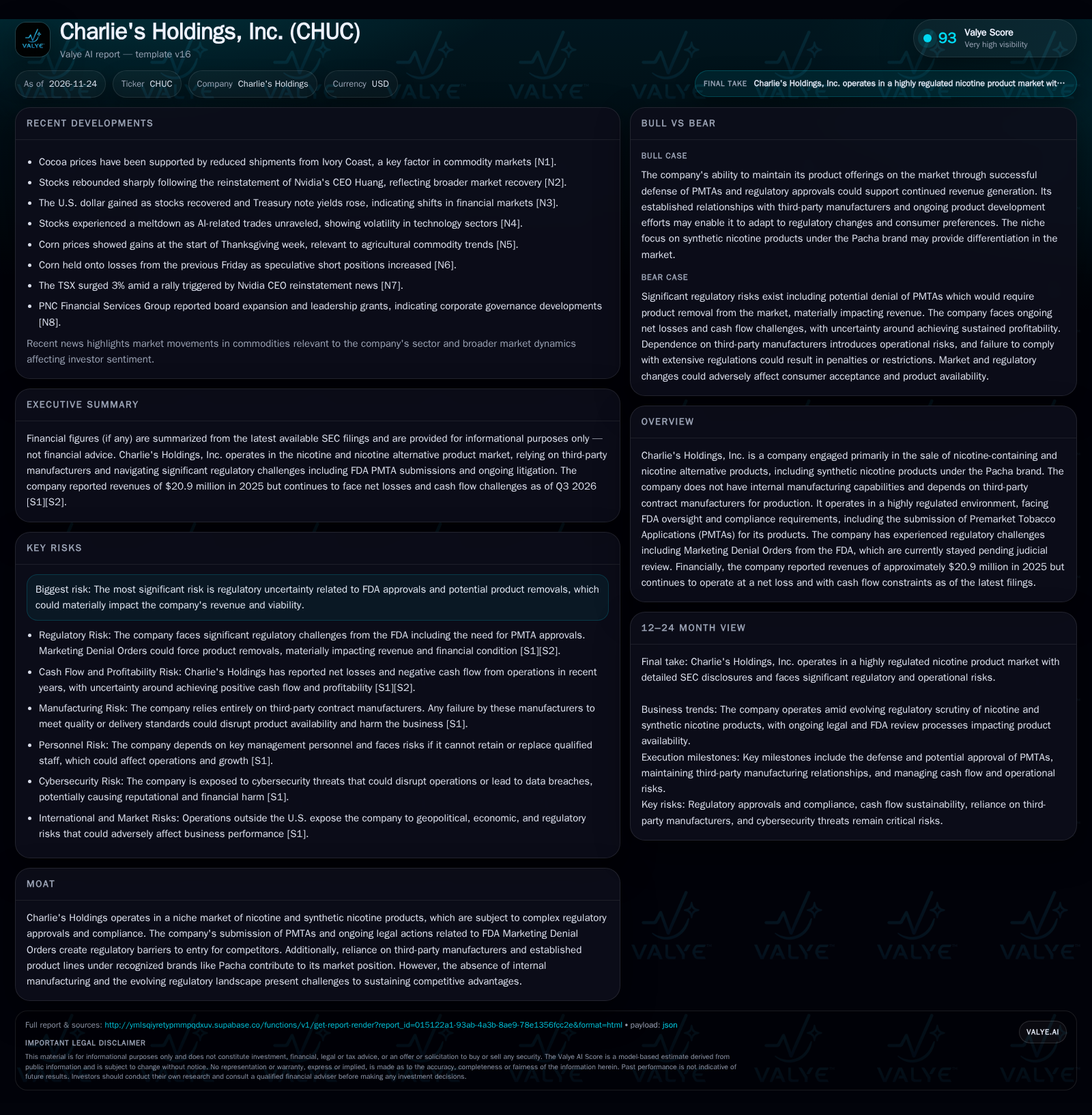
Charlie's Holdings faces a convergence of regulatory, financial, and operational risks: its core synthetic nicotine products remain on the market only due to a court-ordered stay after FDA Marketing Denial Orders, and the company continues to report net losses and negative cash flow. Without internal manufacturing or clear regulatory visibility, long-term viability may depend on successful legal outcomes, cost discipline, and adaptation to evolving compliance rules. [S1] [S2]
Charlie's Holdings, Inc. sits at the intersection of regulatory volatility and business fragility, operating a synthetic nicotine portfolio that depends on the outcome of FDA litigation and the reliability of external manufacturers. Despite generating $20.9 million in revenue in 2025, the company continues to post losses and burn cash, with a current ratio barely above parity and a cash balance of just $401,000 as of September 2026. The core thesis hinges on whether Charlie's can secure regulatory clearance for its key products and stem its cash outflows—or whether regulatory decisions and financial constraints will force a retrenchment from the market. [S1] [S2]
Litigation-Driven Market Access and Persistent Cash Drain Define the Moment
As of late 2026, Charlie's Holdings' core synthetic nicotine products remain on shelves solely due to a temporary administrative stay from the U.S. Court of Appeals, following FDA Marketing Denial Orders issued in October 2025. This stay is not a regulatory approval but a legal pause, leaving the commercial future of key products in limbo. The company reported net revenue of $20.9 million for 2025 but continues to operate at a loss, using $6.3 million in operating cash that year and posting a net loss of $1.83 million for the first nine months of 2026. The company reported a current ratio of 1.11 for the period. The outcome of PMTA litigation is thus both an existential and near-term commercial inflection point. [S1] [S2]
How Regulation and Outsourcing Shape the Profit Equation
Charlie's Holdings’ economics are uniquely exposed to three interlocking forces: regulatory costs, outsourced manufacturing, and the pricing power of branded synthetic nicotine. The company’s $6.5 million in cumulative PMTA-related expenses to date highlight the fixed-cost burden of compliance in a business otherwise structured around variable manufacturing costs. Because Charlie's relies exclusively on third-party contract manufacturers, it avoids capital investments in plant and equipment but cedes margin and supply chain control. Gross margins are therefore sensitive to contract pricing, input cost volatility, and minimum order requirements imposed by manufacturing partners. On the revenue side, the company’s synthetic nicotine products—especially under the Pacha brand—may command premium pricing relative to commodity e-liquids, but this premium is contingent on continued market access and consumer willingness to pay for perceived differentiation. Operating leverage is constrained: fixed regulatory and SG&A costs may not scale down if volumes fall following adverse regulatory outcomes, while marketing and compliance spending must remain high to defend share and navigate legal risks. The company reported cash and liquidity metrics for the period; these figures do not by themselves establish operating runway, investment capacity, financial flexibility, or financing capacity.
Barriers and Vulnerabilities in a Regulatory Minefield
Charlie's Holdings occupies a niche within the broader nicotine and vapor market, focusing on synthetic nicotine products that face fewer legacy brand incumbents but are subject to the same or greater regulatory scrutiny as traditional tobacco. The company’s moat is partially derived from the complexity and cost of FDA PMTA submissions, which discourage smaller entrants and create a compliance barrier. However, this is a double-edged sword: larger, well-capitalized competitors may have greater resources to weather regulatory delays and denials, and could leverage internal manufacturing to achieve better margins and supply chain resilience. The absence of internal production leaves Charlie’s exposed to contract manufacturer performance and bargaining power, while brand equity in the Pacha line offers some consumer stickiness but may not be sufficient to offset product removals or regulatory-driven market exits. Substitutes include both traditional tobacco and other nicotine delivery systems—should regulatory pressure intensify or consumer preferences shift, switching frictions are likely modest.
Successful PMTA Defense Unlocks Margin and Market Share Expansion
If Charlie’s Holdings secures favorable judicial or FDA outcomes, allowing its core synthetic nicotine products to remain on the market, the company could benefit from several reinforcing effects. First, regulatory clearance would transform the current legal stay into a durable license to operate, reducing uncertainty and freeing up resources currently devoted to litigation and compliance. This could enable renewed marketing investment and the expansion of distribution channels. The exit or contraction of less compliant or less resilient competitors—unable to bear the regulatory burden—could further consolidate share among survivors. If Charlie’s can renegotiate more favorable manufacturing contracts or scale volume with regulatory clarity, gross margins could improve. The thesis would be confirmed by a final judicial ruling or FDA approval in favor of the company, a return to positive operating cash flow, and evidence of market share gains in synthetic nicotine categories.
Ongoing Legal Uncertainty and Cash Burn Define the Near-Term Outlook
The most plausible trajectory is one of continued regulatory limbo, with Charlie’s Holdings maintaining market access for core products under the ongoing court stay but facing persistent legal, compliance, and cash flow pressures. Revenue may remain stable or grow modestly if consumer demand for synthetic nicotine holds and competitors are similarly constrained by regulatory uncertainty. However, fixed costs for compliance, legal defense, and third-party manufacturing will continue to erode margins, and cash burn is likely unless cost discipline improves or revenues outpace expense growth. The base case would be supported by continued net losses, stable but not growing revenue, and incremental updates on the status of PMTA litigation without final resolution. Falsification would come from either a sudden regulatory decision (positive or negative) or a substantial change in cash generation.
Adverse Regulatory Rulings Trigger Product Removal and Financial Crisis
Should the FDA or courts ultimately deny PMTAs for Charlie’s key products, the company would be forced to remove affected synthetic nicotine offerings from the market. This would precipitate a sharp revenue decline, likely resulting in immediate operating losses that cannot be offset by cost reductions, given the fixed burden of regulatory and corporate overhead. With just $401,000 in cash as of September 2026 and ongoing negative cash flow, the company may face a liquidity crisis, requiring emergency financing, asset sales, or even restructuring. The downside scenario would be confirmed by a final regulatory or judicial denial, product withdrawals, a collapse in revenue, and urgent capital-raising efforts under distressed terms.
Milestones That Will Determine Charlie's Holdings' Survival and Relevance
The outcome of PMTA litigation and any final FDA or court rulings regarding the marketability of Charlie’s core synthetic nicotine products.
Quarterly trends in cash used in operating activities: a useful metric would be whether the company is able to materially reduce cash burn or approach breakeven, especially as legal costs fluctuate.
Gross margin trends, if disclosed, which would reveal the economics of contract manufacturing and pricing power as regulatory clarity improves or deteriorates.
Any major changes in contract manufacturing terms or disruptions to supply chain continuity.
Product portfolio updates—whether Charlie’s is able to introduce new offerings, reformulate existing products, or diversify beyond the currently at-risk SKUs.
The competitive response: evidence that rivals are exiting the market, consolidating, or gaining share at Charlie’s expense would help test the thesis.
Consumer and retailer acceptance of synthetic nicotine products, as measured by sales velocity, reorder rates, or customer retention (if disclosed).
Disclaimer: This is research-only, informational analysis and not investment advice. It may include AI-generated interpretation and general industry context. Always verify important details using primary sources.

Comments