
Sow Good Inc.: Severe Liquidity Strain, Leadership Overhaul, and the Prospect of Existential Restructuring
With zero revenue in fiscal 2025, a collapsing current ratio, and sweeping leadership turnover in 2026, Sow Good Inc. now faces acute doubts about its ability to remain a going concern. The company’s challenges are compounded by ongoing competitive pressures, a damaged capital base, and the urgent need for external funding or radical strategic change.
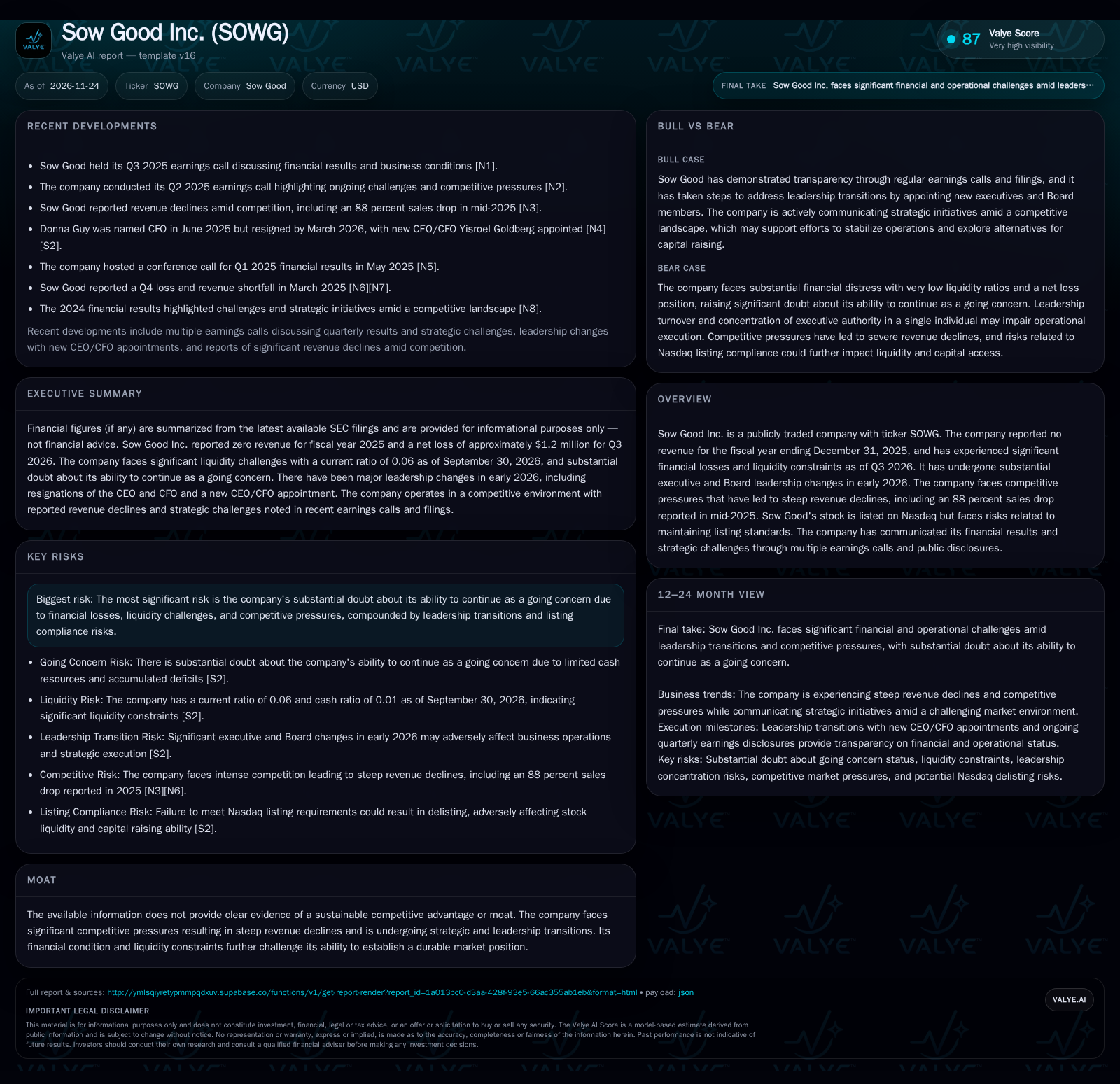
Sow Good Inc. reported no revenue in 2025 and remains deeply unprofitable with a Q3 2026 net loss and a critically reported cash balance. Recent executive and Board changes signal instability amid a collapse in sales and mounting doubts about viability. The company’s ability to survive now hinges on securing outside capital, managing competition, or undertaking a transformative restructuring. [S1] [S2] [N3] [N4] [N6]
Sow Good Inc. stands at an inflection point defined by operational collapse and existential risk. After reporting zero revenue for fiscal 2025 and an 88% sales decline in mid-2025, the company’s liquidity has all but evaporated, with a cash ratio of just 0.01 as of September 2026. Leadership instability—marked by the resignation of both CEO and CFO and the rapid appointment of new executives—underscores the urgency of the situation. With competitive threats undiminished and Nasdaq listing compliance in question, Sow Good’s survival now depends on its ability to secure emergency capital or radically reinvent its business model. [S1] [S2] [N3] [N4] [N6]
Acute Financial Distress and Leadership Upheaval Define Present Reality
Sow Good Inc. reported zero revenue for the entirety of 2025, marking a total halt in commercial activity or product traction [S1]. The company’s net loss for Q3 2026 was $1,218,481, with basic and diluted EPS of -$0.06, reflecting ongoing operating expenses without offsetting income [S2]. Cash and cash equivalents stood at just $70,140 as of September 30, 2026, with a current ratio of 0.06 and a cash ratio of 0.01—metrics that underscore the near-total exhaustion of liquid resources [S2].
There is substantial doubt about Sow Good’s ability to continue as a going concern, as explicitly stated in company filings [S2]. The period also saw sweeping executive turnover: both CEO and CFO positions were vacated by March 2026, with Yisroel Goldberg stepping in as CEO/CFO and new Board members installed [S2] [N4]. Meanwhile, an 88% sales drop reported in August 2025 has not been reversed, and the company faces ongoing risk of Nasdaq delisting, threatening both visibility and capital access [N3] [S2].
Absence of Revenue and Fixed Cost Drag Leave No Margin for Error
The economics of Sow Good’s business are now defined by an absence of any meaningful revenue base, with fiscal 2025 showing zero revenue and continued net losses into Q3 2026 [S1] [S2]. This state implies that any remaining fixed costs—such as facility leases, minimal staffing, compliance, and public company reporting—are now pure cash burn, without the offset of gross profit or contribution margin.
In the absence of disclosed operating details, it is plausible that Sow Good’s prior business model involved physical consumer products or branded goods, given its historical branding. If so, the collapse in sales and the inability to even generate minimal revenue suggest either the loss of distribution, severe competitive displacement, or product obsolescence. Fixed costs for such a business would include inventory commitments, warehousing, and possibly legacy marketing spend, which become unsustainable without volume. Variable costs are now likely negligible, but so is revenue—meaning operating leverage works entirely in reverse, with each dollar of fixed cost contributing to net losses.
The company reported cash and liquidity metrics for the period; these figures do not by themselves establish operating runway, investment capacity, financial flexibility, or financing capacity. Attempts to raise capital could be hampered by the company’s market valuation, its delisting risk, and the absence of a credible growth story.
Competitive Pressures Have Eroded Market Presence and Strategic Options
Sow Good faces a competitive environment so severe that it resulted in an 88% sales collapse in mid-2025 [N3] [N6]. While specific competitor names are not disclosed, such a drop in revenue often points to either aggressive pricing by larger peers, loss of key retail or distribution channels, or the entry of superior substitute products.
Without a sustainable moat—no evidence of proprietary technology, brand stickiness, or cost advantage—the company is vulnerable to both direct competitors and adjacent product substitutes. In the consumer products or packaged goods sector, switching frictions for customers are typically low, allowing rivals to quickly capture share when a company weakens operationally or financially.
The risk of Nasdaq delisting further diminishes Sow Good’s ability to attract partners, suppliers, or new capital, as public listing is often a prerequisite for credibility in these relationships. This creates a negative feedback loop: as competitive position erodes, so too does the ability to invest in recovery or defend share.
Radical Restructuring or Strategic Transaction as a Last Resort for Survival
The only plausible upside for Sow Good at this juncture would involve either a dramatic restructuring—such as cost base slashing, pivoting to a new business line, or licensing out any residual intellectual property—or the successful execution of a strategic transaction. This could take the form of a distressed asset sale, merger with a better-capitalized entity, or attracting a deep-pocketed investor willing to recapitalize the business.
For this scenario to materialize, evidence would need to emerge of a credible turnaround plan, non-dilutive capital infusion, or a binding agreement for asset monetization. Announcements of new product launches, significant cost reductions, or partnerships with established players would also help falsify the current trajectory of decline.
Confirmation would include SEC filings disclosing new financing, material business development, or a shift in strategic direction. Conversely, the absence of such updates, or continued cash burn without revenue recovery, would falsify the upside.
Continued Cash Burn and Erosion of Options Absent External Lifeline
The most likely scenario is continued operating losses, with the company unable to generate meaningful revenue or attract capital on reasonable terms. In this path, Sow Good would continue to incur fixed costs (public company compliance, minimal staff, legal and audit fees) while burning through its scant remaining cash. The company would likely issue going concern warnings, pursue increasingly dilutive or high-cost capital-raising strategies, and face growing risk of Nasdaq delisting.
If disclosed, evidence confirming this scenario would include further net losses, absence of revenue rebound, lack of material financing, and ongoing leadership churn. Falsification would require clear signs of a turnaround: revenue traction, credible partnerships, or successful capital raises on non-punitive terms.
Forced Liquidation, Delisting, and Loss of Shareholder Value Loom
If Sow Good fails to secure an external lifeline or execute a radical restructuring, the downside could be swift and final: forced liquidation of assets, voluntary or involuntary bankruptcy, and Nasdaq delisting. In this case, shareholders would likely face significant or total loss of value, and employees and creditors would bear the brunt of the fallout.
Confirming evidence would include SEC filings announcing bankruptcy proceedings, asset sales at distressed prices, or formal delisting from Nasdaq. Further resignations of key personnel, cessation of public disclosures, or auditor resignations would also signal imminent dissolution.
The absence of any new capital, continued zero revenue, and acceleration of operating losses would make this outcome increasingly probable.
Milestones and Disclosures That Will Reveal Sow Good’s Next Act
Any SEC filing or press release announcing new debt or equity financing, including terms, investor identity, and amount raised, if disclosed.
Evidence of revenue resumption or new commercial contracts—either through financial statements or material business development announcements.
Updates on Nasdaq listing status, including any notices of non-compliance, hearing outcomes, or appeals.
Material changes in executive leadership or Board composition beyond those already disclosed, signaling either stabilization or further turmoil.
Disclosures related to cost reduction initiatives, facility closures, or restructuring charges, if reported.
Announcements of strategic partnerships, asset sales, or merger discussions with credible counterparties.
Quarterly financial statements showing either stabilization of cash burn or reversal of the negative revenue trend.
If disclosed, retention or loss of key supplier, distributor, or customer relationships that could impact any attempt at business revival.
Disclaimer: This is research-only, informational analysis and not investment advice. It may include AI-generated interpretation and general industry context. Always verify important details using primary sources.

Comments