
Coeptis Therapeutics: Crypto Mining Transition Meets Operational Gridlock and Strategic Uncertainty
After a dramatic pivot from biopharma to crypto mining, Coeptis Therapeutics faces acute operational paralysis—its mining fleet is idle amid a dispute with its hosting partner, expansion plans are stymied by local moratoriums, and shareholder dilution looms. The company’s future now hinges on recovering control of assets, securing infrastructure, and proving it can execute in a volatile, capital-intensive sector.
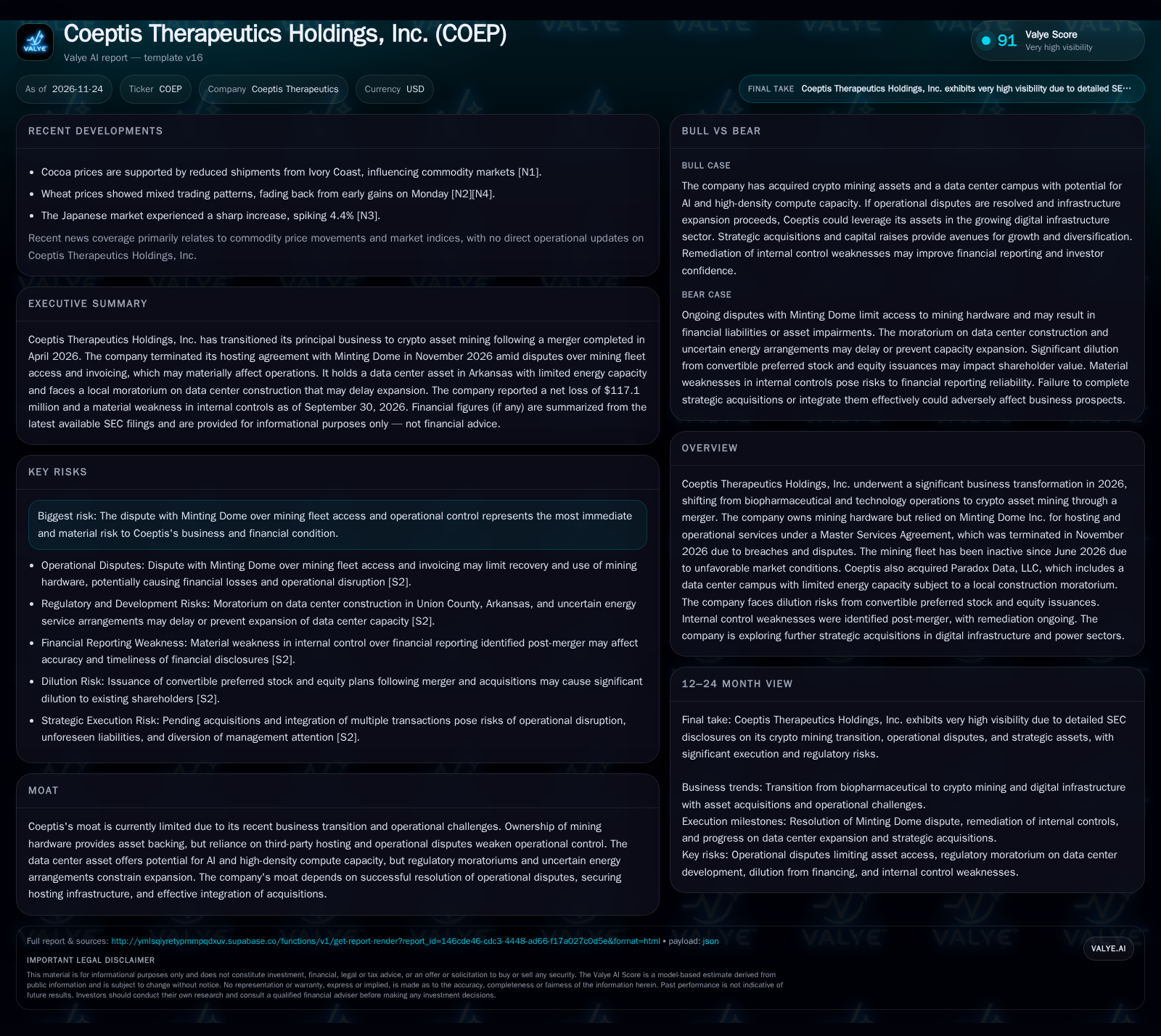
Coeptis Therapeutics has shifted focus from pharmaceuticals to crypto mining, but its mining fleet is offline due to disputes with its hosting partner. Expansion into data centers is blocked by local moratoriums, and dilution risk is high from recent financings. The path forward depends on resolving operational control issues and finding viable infrastructure for mining or compute operations. [S2]
Coeptis Therapeutics Holdings, Inc. has undergone a radical transformation, abandoning its biopharmaceutical roots to pursue crypto asset mining and digital infrastructure. Yet, this strategic reset has quickly run aground: Coeptis’s mining fleet was powered down due to unfavorable market conditions and is now locked in a dispute with its hosting provider. With its major data center asset blocked from expansion by a local moratorium and ongoing dilution from equity financings, Coeptis’s operational and potential financial flexibility are sharply constrained. The company’s fate now rests on its ability to recover control of its assets, secure new infrastructure, and rebuild credibility in a sector marked by volatility and heavy capital requirements.
Operational Paralysis and Asset Access at the Core of Today’s Reality
As of late 2026, Coeptis Therapeutics finds itself in a precarious limbo. The company’s principal business is now crypto asset mining, following a merger completed in April 2026. However, its entire mining fleet has been powered down since June 2026 due to adverse cryptocurrency market conditions and, more critically, is now physically inaccessible after Minting Dome—its hosting partner—unilaterally relocated 3,224 miners and issued approximately $6 million in disputed invoices. Coeptis terminated its Master Services Agreement with Minting Dome in November 2026, but cannot currently access, operate, or monetize its mining hardware, leaving revenue at a standstill and creating the prospect of material asset impairment. Simultaneously, a recent acquisition of Paradox Data, LLC delivered a potential 8 MW data center site in Arkansas, but a county moratorium on data center construction through July 2027 prevents any near-term expansion or activation of that asset. Despite a September 2026 cash balance of $12.39 million and a current ratio above 10, Coeptis reported a net loss of $117.1 million for the period and faces significant dilution from convertible preferred stock and warrants issued during its strategic overhaul [S2].
How Asset-Based Crypto Mining Can Create (or Destroy) Value
The economic engine for Coeptis, as newly configured, is highly sensitive to both capital allocation and operational control. In crypto mining, profitability is a direct function of hardware efficiency, electricity cost, network hash rate, and underlying crypto prices. Coeptis’s model involved owning hardware while outsourcing day-to-day operations and hosting to Minting Dome—a structure that, when functional, can provide capital-light, scalable mining capacity but exposes the company to acute counterparty and operational risk, as now realized.
Revenue generation depends on uptime and efficient deployment of mining assets; with the fleet powered down and physically inaccessible, fixed costs (such as hosting/storage fees, even if disputed) persist while revenue drops to near zero. The Paradox Data acquisition was intended to provide in-house infrastructure and energy capacity—potentially enabling higher margins by reducing reliance on third parties—but the construction moratorium prevents this from materializing in the short term. Meanwhile, capital needs remain high: mining hardware depreciates rapidly, and data center development (especially for AI or high-density compute) is capital-intensive and subject to permitting and power procurement hurdles.
Operating leverage is high in this business: incremental revenue from additional mining capacity or data center tenants can flow rapidly to the bottom line if fixed costs are already covered. However, when assets are underutilized or idle, as they are now, losses can mount quickly. The cited source reports dividend-related activity; that disclosure alone does not establish dividend-policy continuity, management confidence, or a material constraint on capital flexibility. [S2]
Asset Ownership Isn’t Moat Enough: Reliance and Regulatory Barriers Undercut Edge
While Coeptis does own its mining fleet and has acquired a data center site, these assets by themselves do not confer sustainable competitive advantage. In crypto mining, scale, access to ultra-low-cost power, operational reliability, and regulatory stability are prerequisites for cost leadership and survival. Leading competitors typically operate proprietary data centers, maintain direct control over hardware, and have established access to cheap, reliable power—factors now missing or compromised at Coeptis.
Operational reliance on Minting Dome exposed the company to a single point of failure, which has now materialized as a major liability. The Arkansas data center asset could, in theory, provide a future base for AI or high-density compute, but the local construction moratorium and the need for utility consent on energy arrangements create significant execution risks. Other mining and digital infrastructure peers are likely to move more quickly to secure power and scale, especially as regulatory scrutiny of crypto mining intensifies in various jurisdictions.
Switching frictions for customers in hosting or colocation are relatively low, but for Coeptis itself, asset recovery and infrastructure transition are proving costly and slow. Without unique technology, proprietary software, or network effects, and with limited operational track record in its new sector, the company’s moat is currently weak and contingent on resolving its operational and regulatory constraints [S2].
If Disputes Resolve and Infrastructure Comes Online, Value Could Rebound Sharply
A favorable scenario for Coeptis requires a rapid and decisive resolution of the Minting Dome dispute, enabling the company to recover and redeploy its 3,224 mining units. If these assets are restored and either hosted elsewhere or brought online at a new or expanded company-controlled facility, revenue generation could resume—potentially at improved margins if a lower-cost, in-house hosting solution becomes available.
Further upside could come from lifting or navigating around the Union County construction moratorium—either through regulatory change, successful permitting, or by leveraging the acquired 8 MW energy arrangement for non-mining high-density compute, such as AI workloads, which may command premium pricing. If Coeptis can secure new strategic partnerships or complete additional acquisitions (such as the pending Skycore Digital LLC deal) that bring operational expertise or additional infrastructure, it could accelerate its transition to a credible digital infrastructure platform.
Confirmation of this scenario would require public disclosure of: (a) recovery and redeployment of mining hardware; (b) resolution of outstanding legal and financial claims with Minting Dome; (c) new or expanded hosting and power arrangements; and (d) visible progress on data center development or capacity monetization. Evidence of sustained revenue growth, reduced legal liabilities, and improved internal controls would further validate the upside thesis [S2].
Stasis Likely: Asset Inactivity, Ongoing Disputes, and Delayed Expansion
The most plausible medium-term outcome is a protracted period of operational stasis. The Minting Dome dispute may take months to resolve, during which time the mining fleet remains idle and revenue negligible. The Union County data center asset, while offering future optionality, cannot be expanded or meaningfully activated until at least July 2027 due to the local moratorium. Without alternative hosting, power, or infrastructure arrangements, Coeptis’s crypto mining ambitions are effectively on hold.
Remediation of material weaknesses in internal controls may take several quarters, limiting investor confidence and constraining access to additional capital or strategic partners.
This scenario would be confirmed by ongoing lack of revenue, absence of new hosting or infrastructure deals, continued legal disclosures regarding the Minting Dome dispute, and slow progress on internal control remediation. Any further asset impairments or equity issuances would reinforce the base case [S2].
Permanent Asset Loss, Dilution Spiral, and Erosion of Strategic Options
In a more adverse scenario, Coeptis fails to regain control of its mining fleet, either due to legal defeat, asset deterioration, or prohibitive recovery costs. This could force the company to write down a substantial portion of its hardware assets, crystallizing losses and eliminating any near-term path to mining revenue. Meanwhile, the Arkansas data center project could remain frozen or become economically obsolete if regulatory moratoriums persist or energy arrangements fall through.
If internal control remediation stalls or fails, the company could face regulatory penalties or lose access to public capital markets.
Evidence of this scenario would include formal asset impairments, adverse legal judgments, accelerated equity issuance, deepening net losses, and persistent disclosure of unresolved internal control weaknesses. Any public withdrawal from planned acquisitions or infrastructure projects would further confirm a downside spiral [S2].
Testing the Coeptis Turnaround: Asset Control, Infrastructure Progress, and Dilution Dynamics
Resolution status of the Minting Dome dispute and recovery of the crypto mining fleet—public confirmation of hardware redeployment or legal settlement would be pivotal.
Execution of new hosting, power, or infrastructure agreements for mining or compute operations—any signed deals or construction permits would signal operational momentum.
Progress on lifting or navigating the Union County data center construction moratorium—updates on local regulatory developments or successful permitting would change the expansion calculus.
Disclosure of recurring or material impairment charges related to mining hardware—would indicate asset loss or permanent operational contraction.
Pace and magnitude of equity issuance or conversion of preferred stock and warrants—tracking dilution helps assess the risk to existing shareholders.
Remediation milestones and auditor commentary on internal controls—improved disclosures or removal of material weaknesses would support a credibility recovery.
Completion, integration, or abandonment of strategic acquisitions such as Skycore Digital—outcomes here may determine the company’s future scope and capital needs.
Evidence of new or resumed revenue generation—reported revenues above negligible levels would suggest progress in asset deployment or business model adaptation.
Disclaimer: This is research-only, informational analysis and not investment advice. It may include AI-generated interpretation and general industry context. Always verify important details using primary sources.

Comments