
Universal Safety Products, Inc.: Navigating Early-Stage DeFi Ambitions Amid Traditional Revenue Pressures
Universal Safety Products, Inc. is transitioning from its legacy safety products business into decentralized finance (DeFi), but early-stage blockchain operations, operational complexity, and modest financial results present material uncertainties. The company’s ability to convert its DeFi vision into recurring, monetizable revenue streams remains unproven, with execution, adoption, and regulatory hurdles ahead.
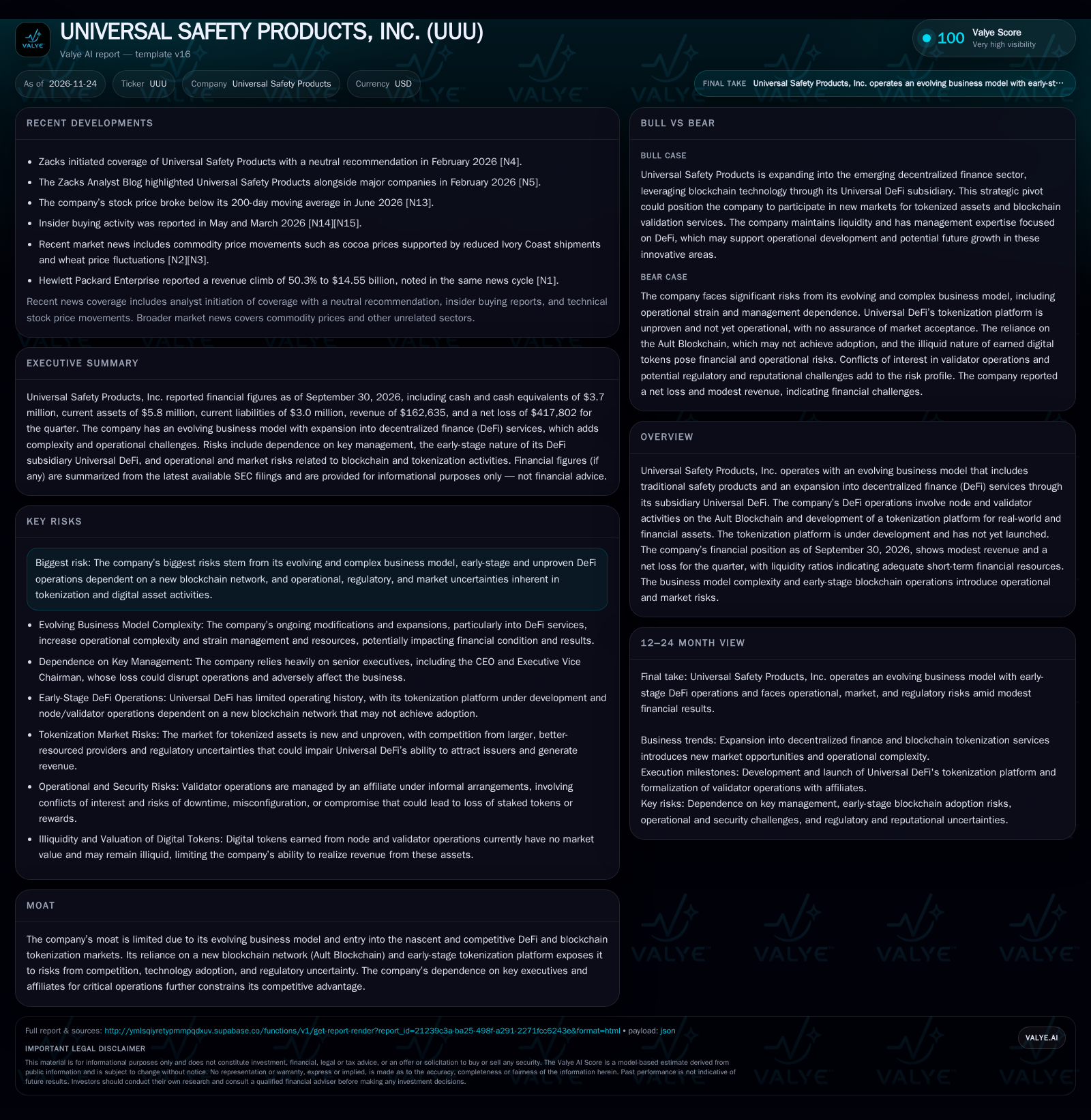
Universal Safety Products, Inc. is attempting to diversify beyond its traditional business by launching DeFi operations through its Universal DeFi subsidiary. However, its DeFi and tokenization platform is still under development, and its digital tokens currently lack market value. The company faces significant operational, competitive, and regulatory risks as it seeks to establish a credible position in the nascent blockchain sector. [S2]
The success of its in-development tokenization platform and validator operations on the nascent Ault Blockchain will determine whether Universal can unlock new, sustainable revenue streams or remain constrained by operational complexity and market headwinds.
Recent Financials and DeFi Expansion Define the Near-Term Outlook
As of September 30, 2026, Universal Safety Products, Inc. reported $162,635 in revenue and a net loss of $417,802 for the quarter. However, these figures reflect a business in transition, with its new DeFi subsidiary, Universal DeFi, having an undeployed tokenization platform and digital tokens from validator operations that are currently illiquid and without established market value. The company’s operational model now depends on the successful development and adoption of these blockchain-based services, which have yet to generate meaningful revenue or demonstrate market traction. [S2]
The transitional phase Universal Safety Products is undergoing necessitates a nuanced understanding of the interplay between legacy revenue streams and emerging blockchain initiatives. Given the nascent stage of the tokenization platform, the company’s near-term financial performance is likely to remain volatile, influenced heavily by development milestones and market reception. Moreover, the illiquidity of digital tokens not only constrains immediate revenue realization but also complicates financial forecasting and investor confidence. The operational shift requires balancing ongoing costs related to traditional safety products with the capital-intensive demands of blockchain infrastructure development, which may pressure cash flow and necessitate careful resource allocation.
How Universal’s Hybrid Model Could (and Might Not) Generate Profits
Universal Safety Products is attempting to pivot from a presumably low-growth, low-margin legacy safety products business to a more scalable, potentially higher-margin DeFi model. In theory, a successful tokenization platform could generate revenue through transaction fees, asset onboarding, and validator rewards. However, the economics of such platforms are highly sensitive to network effects, user adoption, and the credibility of the underlying blockchain (Ault Blockchain in this case).
At present, revenue remains modest, and the company’s DeFi operations are not yet contributing meaningfully to the top line. The illiquidity of earned tokens means there is no realized economic benefit from validation activities. Fixed costs associated with platform development, compliance, and technical staffing may outpace any near-term revenue, putting pressure on cash burn. If the tokenization platform launches and attracts real-world asset originators or financial participants, operating leverage could be significant—marginal costs for digital transactions are low once infrastructure is in place. However, until critical mass is reached, the business may face negative operating leverage and ongoing funding needs.
The hybrid model’s profitability is contingent on multiple conditional factors, including the scalability of the tokenization platform and the network effects that drive user adoption. If the Ault Blockchain can achieve sufficient decentralization and security, it may enhance trust and attract a broader user base, which is critical for transaction volume growth. However, the absence of liquidity in earned tokens delays revenue recognition and may inhibit reinvestment into platform improvements or marketing. Additionally, regulatory compliance costs could escalate unpredictably, potentially offsetting efficiency gains from digital automation. The company must also consider the risk that fixed development and operational costs outpace revenue growth during the platform’s scaling phase, creating periods of negative operating leverage.
Competitive Realities: Can Universal Carve Out a Niche in DeFi?
Universal is entering a DeFi and tokenization market crowded with established blockchain protocols, well-funded fintech startups, and large financial incumbents exploring asset tokenization. Its reliance on the new Ault Blockchain, developed by an affiliate, raises questions about ecosystem adoption and technical reliability. Unlike market leaders with deep technical teams and established user bases, Universal’s platform is untested and its validator operations are managed under informal arrangements—introducing conflicts of interest and operational risk.
Customer switching costs in DeFi are typically low, and network effects favor early movers with robust security, regulatory clarity, and developer engagement. Universal’s dependence on key executives and affiliates could constrain agility and credibility. With digital tokens currently lacking liquidity or market value, the company has yet to demonstrate a compelling value proposition or sustainable moat. If Universal can leverage unique asset partnerships or regulatory advantages, it might differentiate, but the current evidence does not confirm such positioning.
In a sector characterized by rapid innovation and low switching costs, Universal’s competitive positioning depends heavily on its ability to differentiate through technical reliability, regulatory compliance, and partnership ecosystems. The reliance on an affiliated blockchain network introduces potential governance and conflict-of-interest challenges that could undermine stakeholder confidence. Moreover, the absence of a proven track record in blockchain operations places Universal at a disadvantage relative to incumbents with established developer communities and liquidity pools. To carve out a defensible niche, the company would need to leverage unique asset classes or regulatory frameworks that limit competition, but such advantages are uncertain and may require significant time to materialize. Without demonstrable user engagement or liquidity, the platform risks being perceived as experimental rather than commercially viable.
If Tokenization Takes Off: Pathways to Scalable Revenue
Should Universal DeFi’s tokenization platform launch successfully and gain traction among asset issuers and validators, the company could begin to earn recurring transaction fees and validator rewards. If the Ault Blockchain achieves credible adoption, Universal could capitalize on first-mover advantages within certain asset classes or regulatory niches. The conversion of currently illiquid digital tokens into tradable assets with market value would provide a direct revenue stream and potentially attract further network participation.
Evidence that would confirm this upside includes: the formal launch and onboarding of external asset originators on the platform; announcements of material validator rewards realized in fiat or liquid tokens; partnerships with regulated financial institutions; and evidence of growing transaction volume and user engagement. Conversely, continued delays or lack of meaningful platform adoption would falsify the upside scenario.
Evolving but Unproven: A Transitional Business with Execution Risk
The most plausible outcome for Universal Safety Products over the next 12–24 months is one of operational transition with slow progress toward DeFi commercialization. The company may maintain its traditional safety products revenue stream while investing in the development and initial marketing of its tokenization platform. Absent a breakthrough in user adoption or liquidity for its digital tokens, revenue growth is likely to remain muted, and net losses may persist as overhead and development costs continue.
Confirmation would come from incremental product launches, pilot programs, or modest validator rewards. A falsification would be outright abandonment of DeFi initiatives, severe cash burn leading to external financing needs, or regulatory obstacles halting platform progress.
When Complexity Overwhelms: The Risks of DeFi Overreach
Universal faces a credible downside scenario if operational complexity, regulatory scrutiny, and lack of market adoption combine to overwhelm its evolving business model. Should the Ault Blockchain fail to attract network participants, or if the tokenization platform remains delayed or nonviable, the company could see rising costs and persistent net losses without compensating revenue. Illiquid tokens would remain a sunk cost, and management distraction could erode the core safety products business.
Downside confirmation would include escalating losses, management turnover, regulatory actions, or withdrawal from DeFi activities. Severe reputational harm from failed or fraudulent tokenized assets, or operational failures in validator activities, would further exacerbate risks.
Benchmarks for Testing Universal’s DeFi Ambitions and Financial Durability
Formal launch date and onboarding progress of Universal DeFi’s tokenization platform: Announcements or disclosures of live transactions, asset originators, or external users would help test adoption.
Quantification of validator rewards and their conversion into liquid assets, if disclosed: This would reveal whether node operations are generating meaningful, monetizable value.
Clarity and formalization of commercial arrangements with affiliates for validator operations: Disclosures here would reduce conflict-of-interest risk and operational uncertainty.
Regulatory developments or legal proceedings related to tokenized assets or DeFi activities: Any enforcement actions or compliance milestones would materially impact business risk.
Evidence of strategic partnerships with established blockchain or financial institutions: Such partnerships would support credibility and potential network effects.
Management continuity and any changes in the executive team: Given key-person risk, departures or turnover could destabilize operations.
Market liquidity for Universal’s digital tokens: If secondary trading emerges, this would be a pivotal thesis test for DeFi revenue realization.
Disclaimer: This is research-only, informational analysis and not investment advice. It may include AI-generated interpretation and general industry context. Always verify important details using primary sources.

Comments