
Alpex Acquisition Corp: SPAC Structure, Capital Deployment, and the Clockwork of Value Creation
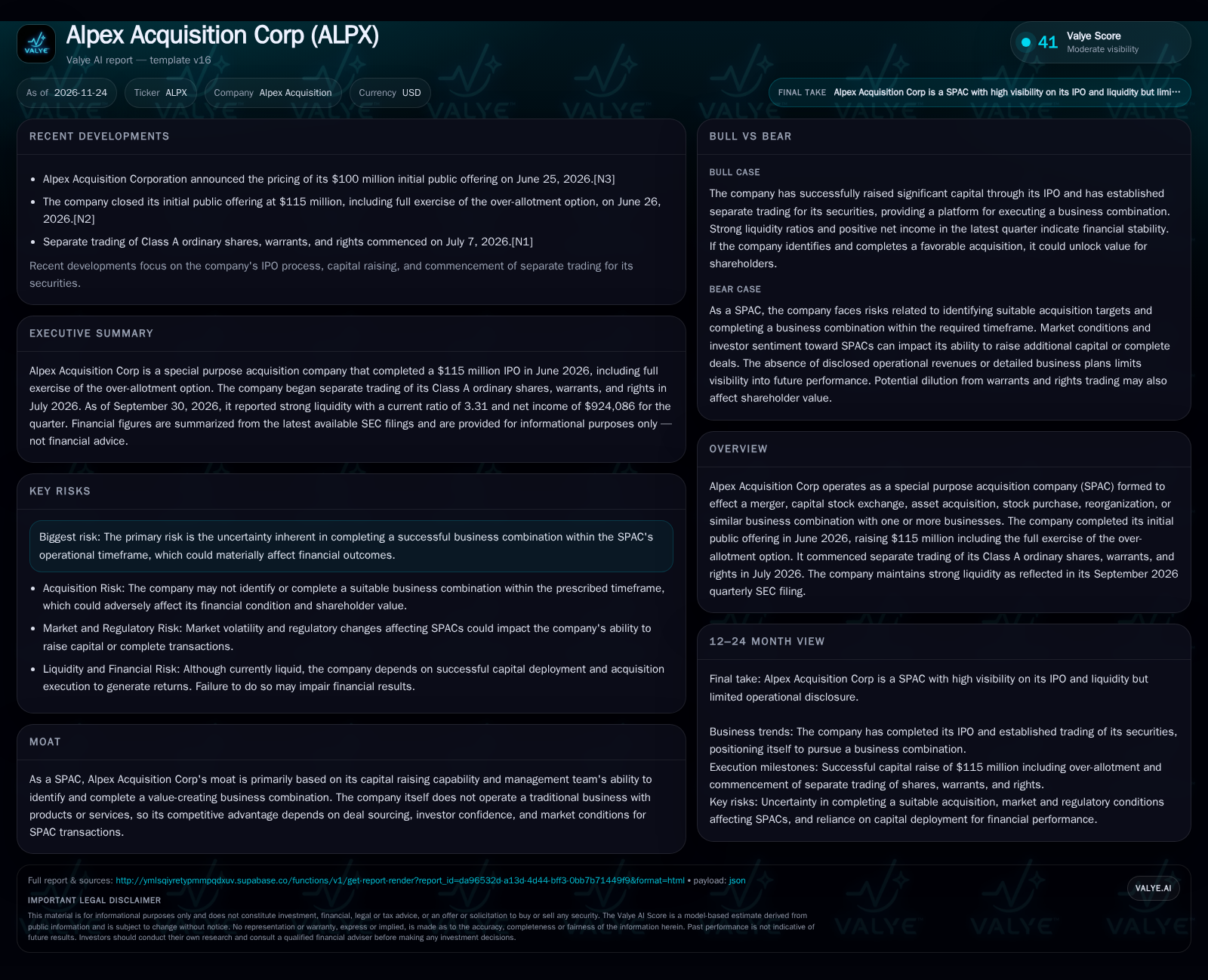
Alpex Acquisition Corp enters the SPAC market with $115 million in trust, high liquidity, and positive net income driven by investment returns. The real test lies ahead: sourcing and executing a value-creating business combination before its 2027 deadline, amid evolving SPAC market dynamics and regulatory scrutiny.
Alpex Acquisition Corp is a newly listed SPAC with $115 million in trust and reported liquidity position as of September 2026. Its net income so far is driven by investment returns, not operations. The company faces a fixed timeline to identify and complete a target acquisition. The core thesis now depends on the management’s ability to source a compelling deal and navigate a more challenging SPAC market environment.[S1] [N2]
Alpex Acquisition Corp enters the public markets with a $115 million war chest from its June 2026 IPO, structured as a typical SPAC: a blank-check company seeking a business combination within a fixed timeframe. With the clock ticking toward a June 2027 deadline, Alpex’s future performance will depend entirely on its ability to source, negotiate, and close a value-generating acquisition against a backdrop of shifting SPAC market conditions and heightened regulatory scrutiny.[S1] [N2]
IPO Proceeds, Trust Mechanics, and the Countdown to Combination
Alpex Acquisition Corp closed its $115 million IPO in June 2026, with capital placed in a trust account as required for SPACs. The company reported a current ratio of 3.31 for the period. [S1] [N2]
How a SPAC Like Alpex Generates (or Destroys) Shareholder Value
Alpex’s economics are fundamentally different from an operating company: it is not generating operational cash flow, but instead holds investor capital in trust, earning risk-free interest until a deal is consummated. Its cash burn is low, largely limited to professional fees, insurance, and minimal executive compensation.[S1] The core economic event—the business combination—has not yet occurred. If Alpex identifies a strong acquisition target, value is created by merging with a company at an attractive valuation, typically one with growth prospects or public-market appeal.
The SPAC structure means most of the IPO proceeds are returned to investors if no deal is completed, reducing long-term downside but also placing pressure on management to find a suitable target within the deadline. The economics of the eventual merger depend on deal quality, dilution from warrants/rights, and whether the post-combination entity can deliver operational growth and cash flow. Operating leverage and capital needs will only become relevant post-combination, and are currently unknowable.
The timing of the business combination is critical to value creation, as the SPAC’s trust account typically holds capital in low-yield, low-risk instruments until deployment. This creates a temporal mismatch where capital is effectively idle, incurring opportunity costs relative to alternative investments. The longer the delay in closing a deal, the greater the risk that market conditions or target valuations shift unfavorably, compressing potential returns. Additionally, the dilution impact from warrants and rights granted to initial investors and sponsors can materially affect post-merger equity value, especially if the transaction valuation is not sufficiently accretive. Therefore, the interplay between deal timing, valuation, and dilution mechanics is central to whether shareholder value is ultimately enhanced or eroded.
Deal Sourcing, Investor Confidence, and the SPAC Field’s Shifting Dynamics
Alpex’s competitive edge—if any—lies in its ability to source, negotiate, and close a value-accretive transaction. In the current environment, SPACs face greater scrutiny from both regulators and investors, with many competing for a dwindling pool of high-quality targets. The market has become crowded, with many SPACs chasing similar acquisition opportunities, leading to increased competition and sometimes less attractive deal terms for sponsors.
Investor sentiment toward SPACs has cooled since the 2021 boom, with concerns about post-merger performance, dilution, and redemption rates. Alpex’s ability to differentiate will depend on the reputation and network of its management team, its agility in identifying targets, and its willingness to negotiate shareholder-friendly terms. Traditional private equity, direct listings, and venture capital-backed IPOs all compete for the same targets, further intensifying the landscape.
A High-Quality Acquisition Unlocks Structural Value
The optimal outcome for Alpex is identifying a private company with compelling growth prospects, agreeing a merger at a reasonable valuation, and leveraging public-market access to accelerate expansion. If the target is well-vetted, has a strong management team, and operates in a sector with public-investor appetite, the business combination could result in substantial value creation for shareholders—potentially driving share price appreciation and warrant value.
Evidence that would confirm this scenario includes: the announcement of a definitive agreement with a credible, high-growth target; limited shareholder redemptions at deal approval; strong PIPE (private investment in public equity) participation; and positive market reaction upon deal announcement. Falsification would include failure to announce a deal, or pursuit of a low-quality target with high redemptions and minimal third-party investor support.
Most Likely Outcome: Deal Execution Under Market Pressure
Given the current SPAC environment, the most plausible scenario is that Alpex will pursue a business combination with a target of modest quality, potentially in a less competitive or niche sector. Shareholder redemptions may be elevated, and PIPE financing could be more difficult to secure, reflecting broader market skepticism toward SPAC mergers.
Confirmation would come from a deal announcement with a credible but not top-tier target, moderate redemptions, and little or no PIPE participation. If the deal is completed but post-merger trading is volatile or flat, this would support the base scenario. Failure to reach a definitive agreement before the 2027 deadline would falsify this outcome.
No Suitable Target, High Redemptions, and Capital Returned
The negative scenario for Alpex is failing to identify or close a business combination before the deadline, resulting in the return of trust capital to shareholders and the effective liquidation of the SPAC. Alternatively, Alpex could announce a deal with an unattractive target, triggering high shareholder redemptions, limited PIPE support, and post-merger share price declines.
This scenario would be confirmed if, as the deadline approaches, Alpex has not announced a definitive agreement, or if a proposed deal is withdrawn or rejected by shareholders. High redemption rates and lack of external investor support at deal approval would further validate the downside risk.
What Could Shift the Alpex SPAC Thesis in the Next 12 Months
Announcement of a definitive agreement with a credible, well-regarded private company—especially if the target operates in a growth sector with public-market demand.
Shareholder redemption rates at the time of merger vote; high redemptions would signal weak investor confidence and threaten post-merger liquidity.
PIPE (private investment in public equity) participation levels, if disclosed, as a proxy for external investor validation of the deal.
Timeline to deal announcement relative to the June 2027 deadline; slippage increases risk of forced liquidation or poor deal quality.
Sponsor and management team alignment—such as additional capital investment or forfeiture of founder shares—would help test commitment to shareholder value.
Post-announcement market reaction, including share and warrant price behavior, would provide real-time feedback on perceived deal quality.
Any regulatory changes or SEC guidance affecting SPAC structure, disclosure, or merger accounting that could impact deal feasibility or attractiveness.
Disclaimer: This is research-only, informational analysis and not investment advice. It may include AI-generated interpretation and general industry context. Always verify important details using primary sources.

Comments