
Alchemy Investments Acquisition Corp 1: Structural Risks and the SPAC Value Creation Imperative
Alchemy Investments Acquisition Corp 1 faces a severe liquidity imbalance and internal control weaknesses as it approaches a critical phase in its SPAC lifecycle. With no operating revenues and a business combination yet to be completed, the company’s ability to navigate execution, governance, and market risks will determine whether it can create value for shareholders—or face the consequences typical of unsuccessful SPACs.
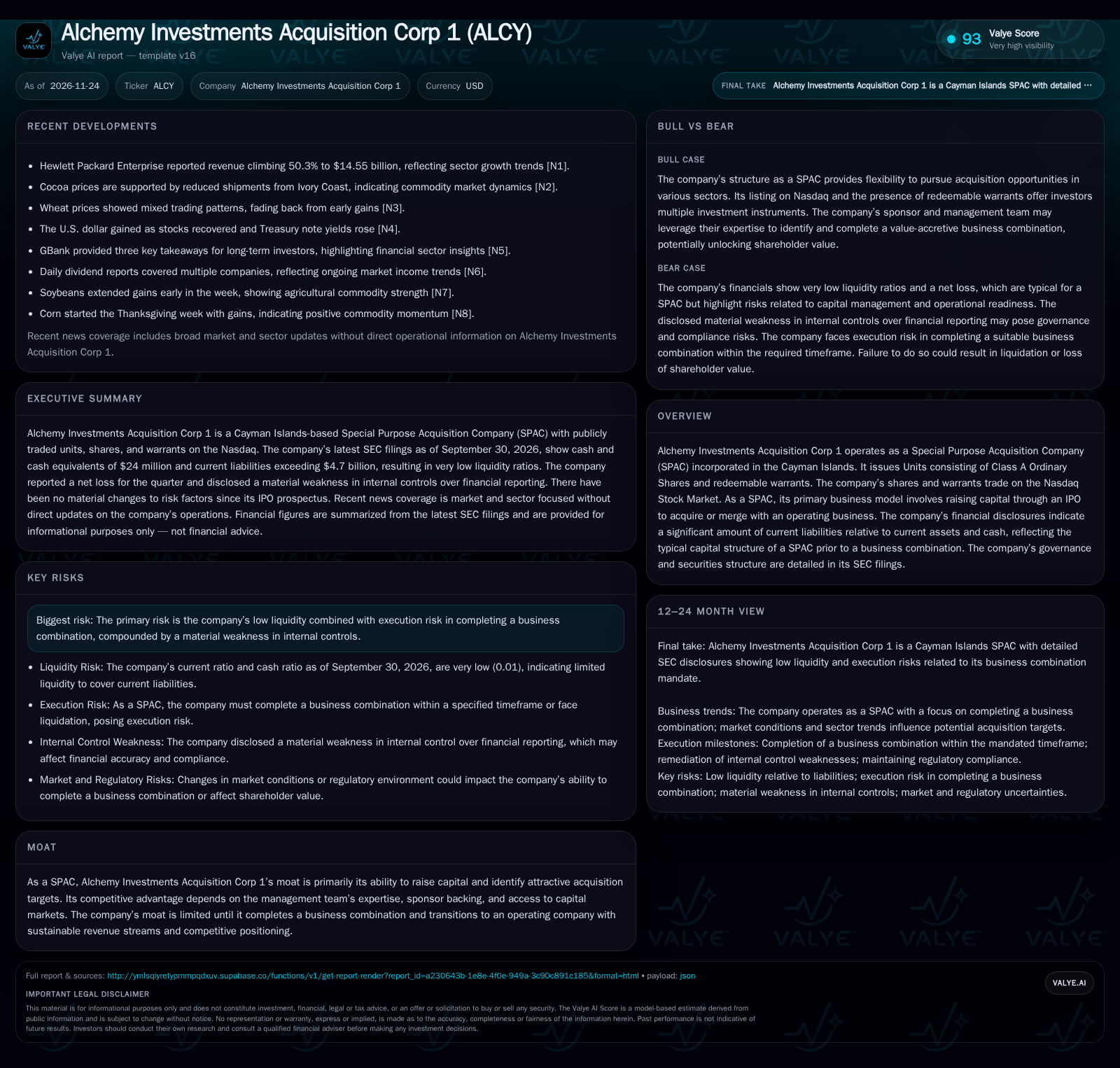
Alchemy Investments Acquisition Corp 1 is a Cayman Islands-incorporated SPAC with $24 million in cash but over $4.7 billion in current liabilities, resulting in a dangerously low liquidity ratio as of September 30, 2026. The company has not yet completed a business combination and reported a net loss for the recent quarter, alongside a disclosed material weakness in internal controls. Its future hinges on successfully identifying and closing a value-accretive merger before time and capital run out. [S2]
Alchemy Investments Acquisition Corp 1 exemplifies the high-wire act inherent in the SPAC model: significant capital raised, a ticking clock to secure an acquisition, and the ever-present risk of failing to complete a deal that justifies investor trust. The company’s financials as of September 30, 2026, reveal a stark liquidity mismatch—$24 million in cash against over $4.7 billion in current liabilities—while its operations remain limited to searching for a merger target. With material weaknesses in internal controls and no operating revenues, Alchemy must overcome both structural and execution risks or risk joining the ranks of SPACs that return capital to shareholders without delivering transformative value.
Liquidity Imbalance and Control Weaknesses Define the Pre-Combination Landscape
Alchemy Investments Acquisition Corp 1’s most recent SEC filings paint a challenging picture: as of September 30, 2026, the company held $24 million in cash and cash equivalents, alongside current liabilities of $4.75 billion. The company reported cash and liquidity metrics for the period; these figures do not by themselves establish operating runway, investment capacity, financial flexibility, or financing capacity. The company reported a net loss of $198,212 for the quarter and disclosed a material weakness in internal control over financial reporting. These factors are critical because they signal both financial and governance vulnerabilities at a pivotal moment in the SPAC lifecycle, as the company has yet to complete its initial business combination. [S2]
How SPAC Economics Shape Incentives and Outcomes Before a Merger
SPACs like Alchemy Investments Acquisition Corp 1 generate no operating revenues prior to merging with a target. The business model is predicated on raising funds through an IPO, holding them in trust, and using those proceeds to acquire or merge with an operating business. The economics are unusual: large trust assets (often offset by redemption liabilities) sit on the balance sheet, while ongoing costs—legal, compliance, diligence, listing fees—result in net losses until a deal is closed.
The capital structure typically features units with shares and warrants, which provide optionality for early investors but can dilute future equity holders. The sizable current liabilities reported are likely a function of redeemable shares or warrants, as is common for SPACs, not traditional operating obligations. However, the extremely low liquidity ratio constrains the company’s ability to absorb unexpected costs or delays and may create pressure to expedite a business combination, potentially at the expense of quality.
Once a business combination is executed, the economics shift dramatically: the merged entity’s revenue streams, expense base, and capital needs become paramount. Until then, operating leverage is negative, as fixed public company costs accrue without offsetting income. If the SPAC fails to consummate a merger in the allotted time, it must liquidate and return most trust proceeds to shareholders, with sponsors losing their at-risk capital.
SPAC Competition: Sponsor Reputation, Deal Flow, and Market Sentiment
Prior to a business combination, a SPAC’s competitive position is determined by its sponsor team’s reputation, sector expertise, and access to a differentiated pipeline of targets. Alchemy Investments Acquisition Corp 1 is competing in a crowded field—hundreds of SPACs vie for a finite pool of attractive private companies willing to go public via merger rather than IPO or direct listing.
The ability to create value post-merger depends on sourcing a target with compelling growth prospects, negotiating favorable terms, and structuring a deal that minimizes redemptions and dilution. Market sentiment toward SPACs has become more cautious since 2021, making it harder to attract both targets and PIPE (private investment in public equity) investors. Additionally, internal control weaknesses, as disclosed by Alchemy, may erode trust among deal counterparties and institutional investors, further disadvantaging the company relative to better-governed SPACs.
A High-Quality Acquisition Could Transform Alchemy’s Risk Profile
The most favorable outcome for Alchemy would be identifying and closing a business combination with a fast-growing, scalable operating company in a sector with robust public market demand. In this scenario, the SPAC structure allows the target to access public capital rapidly, while investors benefit from equity in a business with strong fundamentals and a credible growth story.
Confirmation of this scenario would require several signals: public announcement of a definitive merger agreement with a target exhibiting clear revenue growth, margin improvement potential, and sector tailwinds; evidence of successful PIPE funding or low redemption rates; and remediation of internal control weaknesses prior to the merger close. A post-combination transition to positive operating cash flow and improved liquidity ratios would further validate the thesis.
The Most Likely Course: Execution Strain and Deal-Making Under Pressure
Given the current SPAC market environment and Alchemy’s reported governance and liquidity challenges, the most plausible scenario is that the company will pursue a business combination under significant time and financial pressure. This could mean settling for a less attractive target, offering more favorable terms to the seller, or facing high shareholder redemptions that erode the capital base available to the combined entity.
The base case would be confirmed if Alchemy announces a merger with a modestly sized, late-stage private company or one in a less competitive sector, with deal terms that include significant warrant coverage, sponsor concessions, or a high proportion of shares subject to redemption. Persistent internal control weaknesses or a failure to raise sufficient PIPE capital would reinforce the view that Alchemy’s post-merger economics are likely to be challenged.
Failure to Secure a Merger or Remedy Governance Risks Could Force Liquidation
The adverse scenario is that Alchemy fails to identify and close a business combination within the SPAC’s mandated timeframe, or that governance deficiencies prevent regulatory approval or investor support for a proposed deal. In this case, the company would be compelled to liquidate, returning most of the trust proceeds to shareholders and leaving sponsors with a material loss of their at-risk capital.
Red flags confirming this scenario would include repeated delays in deal announcements, public withdrawal or rejection of a proposed merger, regulatory scrutiny linked to internal control weaknesses, or persistent liquidity shortfalls that threaten basic corporate operations. A spike in shareholder redemptions or a failed PIPE raise would further increase liquidation risk.
Milestones That Will Determine Whether Alchemy Unlocks or Destroys Shareholder Value
Announcement of a definitive business combination agreement, including the identity, sector, and financial profile of the target company.
Redemption rate at the time of shareholder vote—high redemptions would signal weak investor confidence and reduce post-merger capital.
Updates on remediation of the disclosed material weakness in internal controls; a clear timeline and auditor validation would help test governance improvements.
PIPE (private investment in public equity) commitments or alternative financing arrangements to backstop redemptions and provide post-merger liquidity—if disclosed.
Regulatory feedback or delays related to the merger approval process, especially if tied to governance or disclosure issues.
Shareholder communications about extension votes, liquidation triggers, or sponsor capital infusions that could signal time pressure or deal uncertainty.
Disclaimer: This is research-only, informational analysis and not investment advice. It may include AI-generated interpretation and general industry context. Always verify important details using primary sources.

Comments