
Longevity Health Holdings: Strategic Expansion Meets Severe Liquidity Strain in the Competitive Bio-Aesthetics Market
Longevity Health Holdings is commercializing innovative skincare and haircare products, including those derived from human tissue, and has recently acquired new product lines and entered merger agreements to broaden operations.
Longevity Health Holdings is commercializing innovative skincare and haircare products, including those derived from human tissue, and has recently acquired new product lines and entered merger agreements to broaden operations. Strategic moves signal ambition, but survival depends on resolving near-term financial risks and achieving consumer acceptance. [S1] [S2] [N8]
Longevity Health Holdings, Inc. is attempting to carve out a niche in the crowded cosmetics sector by commercializing skincare and haircare products, including those derived from human tissue. While the company has moved rapidly to launch new products, execute acquisitions, and enter strategic merger agreements, it faces acute financial distress, including a technical default on convertible debt and a severely constrained liquidity position. The combination of high ambition and operational fragility sets up a binary scenario: either recent strategic actions catalyze a turnaround and unlock new capital, or financial pressures force retrenchment or restructuring, testing the very premise of Longevity’s growth strategy.
Liquidity Crisis and Strategic Moves Define the Current State
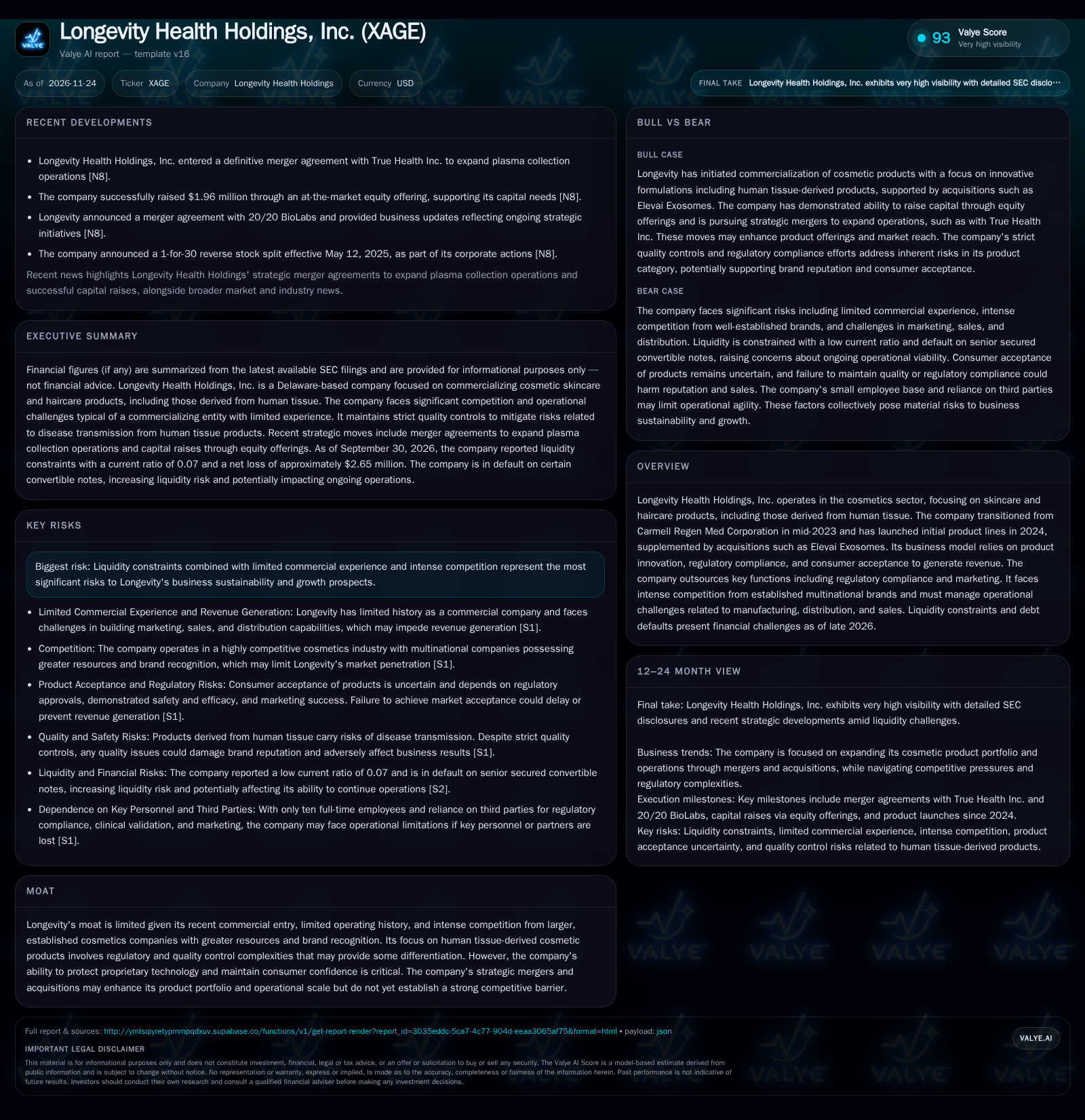
As of September 30, 2026, Longevity Health Holdings reported cash and cash equivalents of $107,985 against current liabilities exceeding $12.3 million, resulting in a current ratio of 0.07 and a cash ratio of 0.01—figures that signal acute liquidity distress. The company is currently in default under certain provisions of its senior secured convertible notes held by Puritan Partners LLC, further heightening operational risk and limiting access to additional debt financing. Despite these pressures, Longevity has raised $1.96 million through an at-the-market equity offering and signed merger agreements with True Health Inc. and 20/20 BioLabs, aiming to expand its plasma collection and product development capabilities. These actions reflect an urgent effort to reposition and recapitalize, but the path to operational stability remains uncertain. [S2] [N8]
Product Innovation, Outsourcing, and the Economics of Scale
Longevity’s business model hinges on the commercialization of cosmetic products—primarily skincare and haircare—targeted at both professional care providers and retail consumers. The company has launched seven new skincare products since 2024 and acquired Elevai Exosomes to accelerate portfolio growth. These moves suggest a strategy focused on innovation and differentiation, particularly through the use of human tissue-derived ingredients. However, the economics of this approach are challenging: sourcing, processing, and quality control for such products are capital- and compliance-intensive, and require rigorous regulatory oversight.
With only ten full-time employees, Longevity outsources critical functions such as manufacturing, regulatory compliance, and marketing. This structure can keep fixed employment costs low and theoretically allow for scalability, but it also limits the company’s ability to capture margin and control the customer experience. In the absence of meaningful operating leverage or recurring revenue from subscription-like contracts, the need for external funding remains high—making the company acutely sensitive to capital market conditions and consumer demand volatility. The net loss of $2.65 million for the most recent period underscores the gap between current scale and break-even economics. [S1] [S2]
The reliance on third-party vendors for manufacturing and regulatory compliance introduces additional layers of complexity and risk. While outsourcing can reduce fixed costs and provide flexibility, it also limits direct oversight and responsiveness to quality issues or supply chain disruptions. In a sector where product safety and regulatory adherence are paramount, any lapse could result in costly recalls or reputational damage, further straining financial resources. Consequently, the company’s ability to establish robust vendor management and contingency planning is critical to maintaining operational continuity and protecting its brand equity.
Economies of scale in bio-aesthetic product manufacturing are challenging to achieve without substantial upfront investment in specialized facilities and technology. Given Longevity’s current scale and capital constraints, expanding production capacity may require incremental outsourcing or partnerships that could dilute margins. Moreover, the company’s product innovation cycle depends heavily on scientific research and development, which typically involves long lead times and uncertain outcomes. This dynamic necessitates a careful balance between investing in pipeline development and preserving liquidity, with strategic prioritization of projects that demonstrate the highest probability of regulatory approval and market acceptance.
A Challenging Competitive Landscape: Barriers and Differentiators
Longevity operates in the highly fragmented and competitive cosmetics sector, facing both multinational consumer products giants and a proliferation of indie beauty and specialty skincare brands. Incumbents benefit from brand scale, established distribution, vast marketing budgets, and deep regulatory experience. For Longevity, potential differentiation stems from its focus on human tissue-derived products and strict quality controls, which could appeal to the growing demand for scientifically validated, high-efficacy skincare.
However, the company’s lack of established brand equity, limited commercial track record, and reliance on outsourced functions dilute these potential advantages. Switching costs for consumers in beauty and skincare are typically low, and product innovation cycles are fast, making it difficult for new entrants to build defensible moats. The question is whether the company can build a reputation for safety, efficacy, and regulatory compliance quickly enough to gain a foothold before larger or more agile competitors respond. [S1]
How Strategic Partnerships and Product Acceptance Could Catalyze a Turnaround
The most favorable scenario for Longevity involves a successful integration of the True Health Inc. and 20/20 BioLabs merger agreements, leading to expanded plasma collection and enhanced product development capabilities. If the company can demonstrate clear clinical or cosmetic efficacy for its human tissue-derived products—and secure the necessary regulatory approvals—consumer acceptance could accelerate, especially among professional care providers seeking differentiated solutions.
A positive feedback loop could emerge if early adopters validate product performance, driving word-of-mouth and enabling Longevity to command premium pricing or secure distribution partnerships. Additional capital raised through equity or strategic investors would then be deployed into marketing and R&D, potentially enabling the company to scale more efficiently and approach break-even. Evidence confirming this scenario would include rapid revenue growth from new product lines, successful completion and integration of the announced mergers, positive clinical or consumer data, and improved gross margins as fixed costs are leveraged. [N8]
Commercial Progress Constrained by Financial and Operational Headwinds
The most plausible near-term trajectory for Longevity is one of incremental progress hampered by ongoing financial and operational constraints. The company may realize some benefit from its recent product launches and acquisitions, but the acute liquidity shortfall and default under convertible notes will likely force management to prioritize cash preservation over aggressive expansion.
Growth could occur in niche segments, particularly where regulatory hurdles are high and consumer demand for novel bio-aesthetic solutions is strongest. However, without a material improvement in working capital or a breakthrough in consumer traction, Longevity is likely to remain subscale and reliant on further dilutive capital raises. Confirmation of this scenario would include continued but modest revenue growth, persistent operating losses, and ongoing financial engineering to manage liquidity.
Failure to Secure Funding or Market Traction Forces Retrenchment or Restructuring
Default under senior secured convertible notes could trigger creditor actions, restrict access to additional capital, and force asset sales or restructuring. Meanwhile, slow uptake of new products—due to regulatory setbacks, safety concerns, or ineffective marketing—would prevent the company from achieving revenue scale, leading to further cash burn.
If the company cannot renegotiate debt terms, attract new investment, or demonstrate clear product-market fit, it may be forced to curtail operations, pursue a distressed sale, or enter formal restructuring. [S2]
Milestones That Will Determine Longevity’s Trajectory in the Cosmetics Market
Resolution of default status under senior secured convertible notes and any new or amended debt agreements.
Revenue growth, particularly attributable to newly launched skincare products and acquired Elevai Exosomes lines, if disclosed.
Progress on the integration and operational impact of the True Health Inc. and 20/20 BioLabs merger agreements.
Clinical or consumer validation data demonstrating safety and efficacy of human tissue-derived products.
Gross margin improvement and evidence of scalable cost structure as sales grow, if disclosed.
Changes in third-party relationships for regulatory, manufacturing, or marketing support—especially if affecting operational continuity.
Regulatory developments, product recalls, or adverse events related to human tissue-derived product safety.
Disclaimer: This is research-only, informational analysis and not investment advice. It may include AI-generated interpretation and general industry context. Always verify important details using primary sources.

Comments