
DNA X, Inc.: AI Platform Transition, Capital Structure, and the Challenge of Sustained Profitability
DNA X, Inc. is repositioning itself as an AI platform company, leveraging a reported cash position and an experienced leadership team. Yet, with ongoing net losses and limited public disclosure on operating details, the company's long-term economics and competitive edge remain open questions.
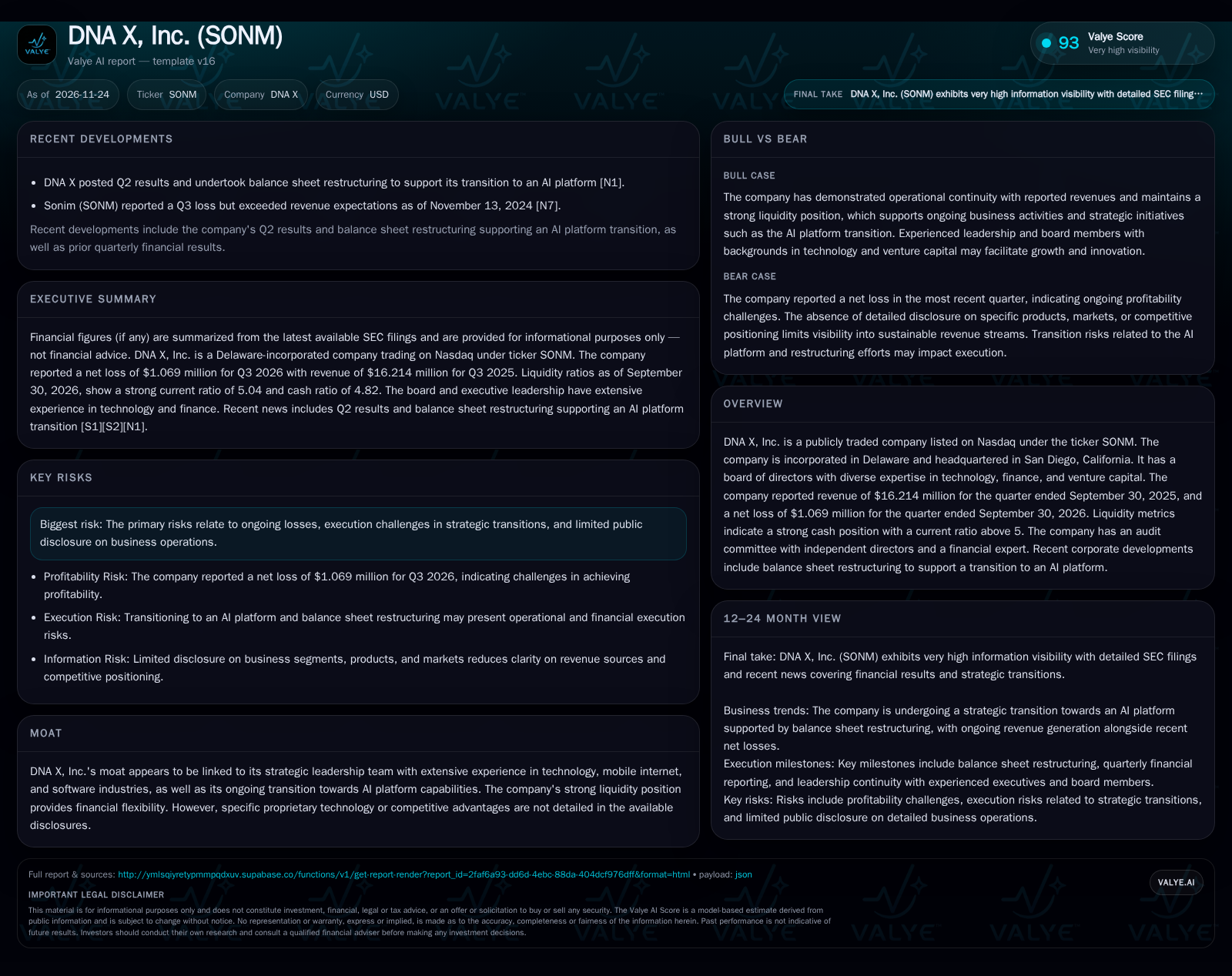
DNA X, Inc. Despite generating $16.2 million in quarterly revenue (Q3 2025), the company posted a net loss of $1.069 million in Q3 2026. The lack of disclosure on product specifics and market focus leaves the durability of its business model and competitive position uncertain. Execution on the AI transition—and evidence of sustainable, profitable growth—are central to the forward thesis. [S1] [S2]
DNA X, Inc. stands at a strategic crossroads, leveraging a reported cash position and an experienced board to fuel its transition into an AI platform company. Despite reporting $16.2 million in revenue for Q3 2025, the company posted a net loss in the most recent quarter, and its filings offer little detail on specific products, customers, or end markets. The next phase will hinge on evidence of operational execution, commercial traction, and the company’s ability to build sustainable competitive advantages. [S1] [S2]
Recent Performance and Strategic Repositioning: What the Numbers Reveal
As of September 30, 2026, DNA X, Inc. reported a net loss of $1.069 million for the quarter, with basic and diluted EPS of -$0.71. The most recent revenue figure available is $16.214 million for Q3 2025, suggesting a business with ongoing operational scale but persistent unprofitability. This financial cushion is set against a backdrop of balance sheet restructuring and a declared transition toward AI platform capabilities. The board and management team bring extensive experience in technology and venture capital, theoretically equipping DNA X for strategic pivots. However, the absence of granular disclosure on products, customers, or end-market focus leaves open critical questions about how these resources are being deployed and which business lines are driving results. [S1] [S2]
How DNA X Could Monetize an AI Platform: Revenue Mechanics and Margin Potential
The company’s pivot toward an AI platform suggests a move away from traditional hardware or legacy software models toward cloud-based, subscription, or usage-based revenue streams. In principle, AI platforms often rely on a mix of initial integration fees, recurring SaaS contracts, and potentially transaction-based or consumption pricing. This model can drive higher gross margins and more predictable cash flows if customer acquisition costs and churn are contained. However, the lack of disclosure about commercial mechanics—such as pricing, contract structure, or customer concentration—makes it impossible to confirm whether DNA X is actually achieving these economics.
Fixed costs associated with AI R&D and platform development can create operating leverage if revenue grows faster than overhead. Conversely, if customer uptake is slow or switching costs are low, the company could see losses persist or widen. But durable profitability will depend on the company’s ability to scale its platform, retain customers, and demonstrate value that justifies recurring payments. Without more detail on unit economics, mix, or pricing power, the sustainability of the business model remains speculative.
In addition to revenue mix and pricing strategies, the scalability of DNA X's AI platform hinges on the efficiency of its underlying infrastructure and data management capabilities. Cloud-based AI platforms often require substantial upfront investment in computing resources and data pipelines, but these costs can become more efficient with scale if the company optimizes resource utilization and leverages automation. Conversely, failure to achieve such operational efficiencies could erode gross margins despite revenue growth. Furthermore, the platform’s ability to integrate with customers’ existing IT environments and workflows is crucial; seamless integration can reduce customer onboarding friction and support higher retention rates, directly impacting lifetime customer value and overall unit economics.
Another critical factor influencing DNA X’s margin potential is the balance between customer acquisition costs (CAC) and customer lifetime value (LTV). In AI platform markets, where customers often require extensive customization and ongoing support, CAC can be substantial. If DNA X can develop scalable sales and marketing channels, possibly through partnerships or self-service models, it could lower CAC and accelerate payback periods. However, if the platform requires high-touch sales or customization, the fixed costs per customer may remain elevated, limiting margin expansion. Monitoring the evolution of CAC relative to revenue per customer, if disclosed, would help clarify whether DNA X is moving toward a more sustainable, unit-economics-driven business model.
Assessing Moat and Market Position: What We Know and What Remains Opaque
DNA X’s competitive position is difficult to assess in the absence of disclosed information on target verticals, proprietary technology, or customer adoption. The board’s collective experience in technology, mobile internet, and software may offer access to networks, partnerships, and strategic insight. If the company’s AI platform leverages unique algorithms, proprietary datasets, or integration capabilities, these could confer a defensible edge.
However, the AI platform space is highly competitive, with established players and new entrants ranging from cloud hyperscalers to vertical SaaS startups. In such an environment, switching frictions, network effects, and customer lock-in are critical. Without evidence of a differentiated platform, embedded customer relationships, or ecosystem effects, DNA X could face commoditization pressure or struggle to command premium pricing. The company’s cash resources may buy time, but sustained advantage will likely require demonstrable technological or go-to-market differentiation.
If the AI Platform Gains Traction: Pathways to Operating Leverage and Market Recognition
The most favorable scenario would see DNA X successfully commercialize its AI platform, securing anchor customers and demonstrating strong product-market fit. This would likely be evidenced by accelerating revenue growth, improving gross margins, and the announcement of strategic partnerships or multi-year contracts. As fixed platform investments are leveraged over a growing user base, operating losses could narrow, eventually flipping to profitability.
Confirmation of this scenario would include disclosure of recurring revenue contracts, customer case studies, and evidence of retention or upsell. External validation—such as industry awards, high-profile hires, or integration with major enterprise systems—would further bolster the thesis. Conversely, if the company fails to disclose new customer wins or meaningful revenue growth, the upside case would be undermined.
Sustaining Operations While Searching for Product-Market Fit
Key evidence confirming this scenario would include continued quarterly losses, limited disclosure on product traction, and steady but unspectacular revenue. The base case is neither a rapid growth story nor an immediate turnaround; rather, it is a period of strategic repositioning and operational experimentation. Sustained lack of commercial traction or the need for further capital raises would challenge even this moderate outlook.
When Strategic Ambition Collides with Execution Risk
The bear case centers on the risk that DNA X’s transition to an AI platform fails to attract meaningful customer adoption or differentiate itself in a crowded market. In this scenario, cash burn outpaces revenue growth, and the company is forced to seek dilutive financing, scale back ambitions, or pivot yet again. Execution missteps—such as delayed product launches, high churn, or technical setbacks—would compound these pressures.
Evidence supporting downside risks would include shrinking cash balances, widening losses, or negative operational surprises such as layoffs or restructuring. If the company fails to disclose new wins, partnerships, or progress toward profitability, investor confidence could erode, limiting access to additional capital and increasing existential risk.
Milestones That Will Clarify DNA X’s Strategic Direction and Business Durability
Quarterly revenue growth or contraction, especially as it relates to the AI platform transition, will be critical for establishing commercial momentum. [S2]
Gross margin trends, if disclosed, would illuminate whether the business is achieving leverage from platform economics or remains stuck in low-margin activities.
Customer concentration and retention metrics, if disclosed, would help test the stickiness and scalability of the platform.
Cash burn rate and changes in cash/cash equivalents should be monitored to assess the adequacy of the current liquidity cushion and capital runway. [S2]
Announcements of strategic partnerships, anchor customer wins, or ecosystem integrations would provide external validation of the AI platform’s value proposition.
Disclosures on contract structure (recurring vs. one-time, multi-year vs. transactional) would help clarify revenue visibility and business model durability.
Any signals of product or market focus—vertical specialization, geographic expansion, or technology differentiation—would sharpen the competitive thesis.
Disclaimer: This is research-only, informational analysis and not investment advice. It may include AI-generated interpretation and general industry context. Always verify important details using primary sources.

Comments