
Valuence Merger Corp. I: SPAC Extensions, Delisting, and the Shrinking Window for Business Combination
With its trust account balance greatly diminished and liquidity severely constrained, Valuence Merger Corp. I faces mounting pressure to identify and close a business combination before its extended March 2027 deadline. The company's delisting from Nasdaq and reliance on sponsor loans further concentrate risk around execution, target quality, and the ability to restore investor confidence.
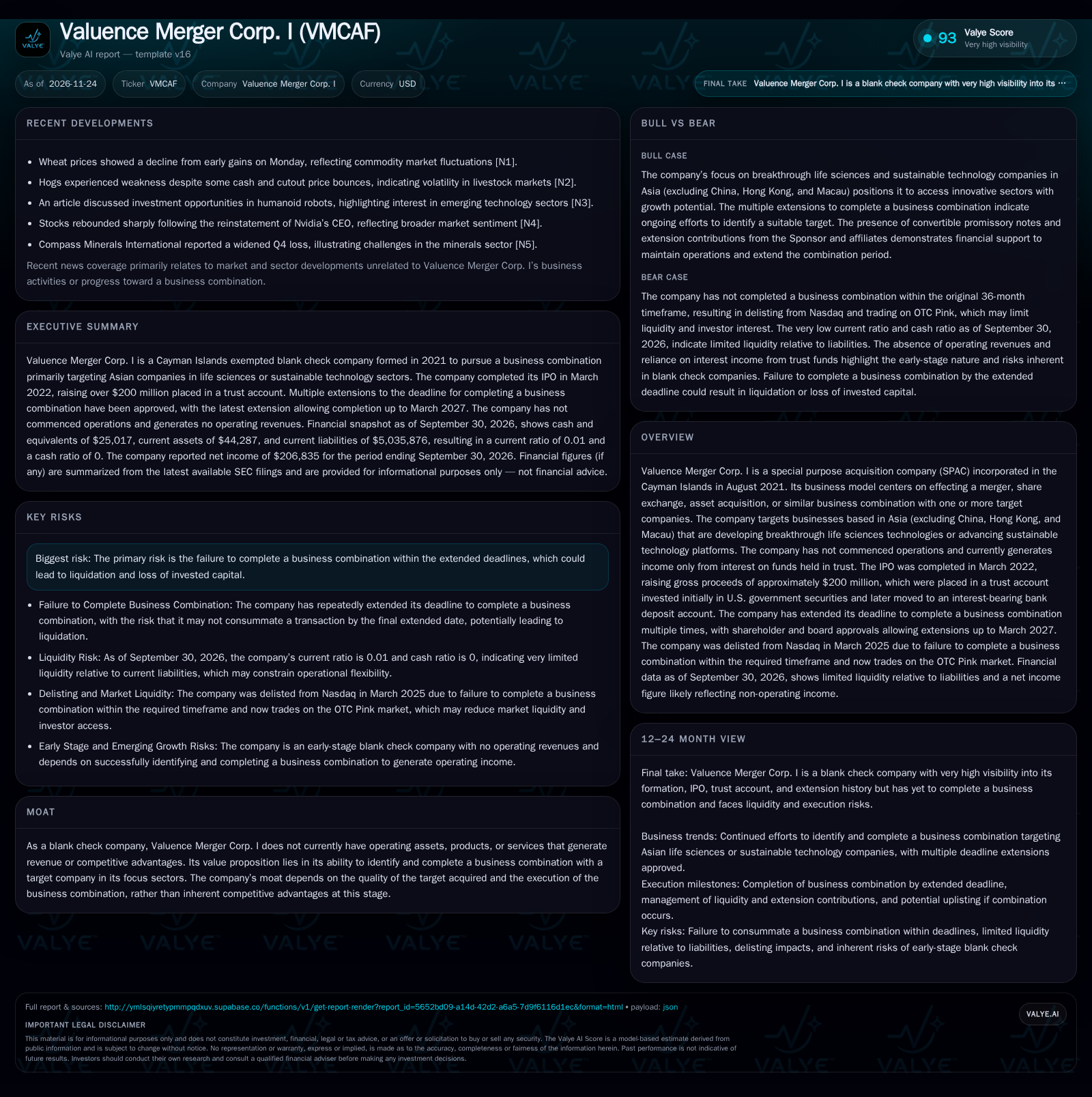
Valuence Merger Corp. I, a SPAC targeting Asian life sciences and sustainable tech (ex-China/HK/Macau), faces very low liquidity, a trust account balance under $6 million, and delisting from Nasdaq after failing to complete a business combination. With deadline extensions now stretching to March 2027 and sponsor loans funding operations, the SPAC’s path depends entirely on identifying and executing a compelling acquisition before time and cash run out [S2].
Valuence Merger Corp. I exemplifies the challenges facing late-stage SPACs that have yet to complete a business combination. After raising $200 million in its 2022 IPO, the company’s trust account has been eroded by successive shareholder redemptions, leaving under $6 million available and forcing reliance on sponsor loans for working capital. Delisted from Nasdaq and with a deadline extended to March 2027, Valuence’s future is now binary: either secure a credible merger partner in the targeted Asian life sciences or sustainable technology space, or face eventual liquidation.
Shrinking Trust Account and Severe Liquidity Constraints Define the Present
As of September 30, 2026, Valuence Merger Corp. I’s trust account held just $5.99 million, a dramatic reduction from its original $200 million post-IPO balance. This shrinkage is the result of multiple shareholder redemptions during deadline extensions, most notably a $167.8 million redemption in May 2023. The company reported a current ratio of 0.01 for the period. Meanwhile, the company has not commenced operations and generates no operating revenues, relying solely on interest income from the trust account and sponsor funding via convertible promissory notes. Following its delisting from Nasdaq in March 2025 for missing the combination deadline, Valuence now trades on the OTC Pink market, further limiting its market visibility and investor access [S2].
The erosion of the trust account not only constrains the capital available for a business combination but also increases the relative impact of fixed operational expenses on the remaining funds. As the trust balance diminishes, the proportion of resources consumed by administrative and compliance costs rises, accelerating the depletion of funds critical for deal-making activities. This dynamic places additional pressure on the sponsor to secure financing through convertible notes or other mechanisms, which can further complicate the capital structure and investor returns. The interplay between shrinking trust assets and fixed overhead costs creates a feedback loop that intensifies liquidity challenges and narrows strategic options for the SPAC.
SPAC Economics: Dilution, Redemptions, and the Binary Value Proposition
The commercial mechanics of Valuence Merger Corp. I are those of a classic SPAC: capital is raised in trust, expenses are minimized, and value for public shareholders hinges entirely on the successful identification and completion of a business combination. Revenue is not generated from operations but from interest on remaining trust assets. As redemptions accelerate, the capital available for a target shrinks, which can limit the scale and attractiveness of any potential merger. Extension periods require the sponsor to fund monthly contributions—here, $140,000 per month after September 2023—through loans that convert to promissory notes, further increasing dilution risk for remaining shareholders if a deal is eventually consummated. If a business combination is achieved, the trust account (less redemptions and expenses) becomes the acquisition currency; if not, the SPAC is liquidated and residual funds are returned to holders, with sponsor loans typically unrecoverable unless a deal closes. The economics thus become more binary and less favorable to public shareholders as time passes and the trust diminishes.
The dilution effect inherent in SPAC structures becomes more pronounced as redemption rates increase and sponsor loans accumulate. Each redemption reduces the pool of committed capital, which can force the sponsor to accept smaller or less attractive targets, potentially undermining the long-term value proposition for remaining shareholders. Moreover, the conversion of sponsor loans into equity or warrants upon deal completion can significantly dilute public shareholders’ stakes, especially when the trust account is depleted. This creates a tension between the sponsor’s incentive to extend the SPAC’s life and the public investors’ interest in preserving value, highlighting the importance of aligning sponsor economics with shareholder outcomes to avoid adverse selection in target pursuit.
SPAC Competition Intensifies as Trust Dwindles and Investor Appetite Fades
Valuence’s ability to secure a compelling target is shaped by a highly competitive landscape for SPACs, especially those operating with diminished trust funds and a history of extensions. The company’s focus on Asian life sciences and sustainable technology (excluding China, Hong Kong, and Macau) narrows the field but may also offer access to less crowded deal flow compared to U.S.-centric SPACs. However, the delisting from Nasdaq and shift to OTC Pink status can make the SPAC less appealing to both targets and investors, reducing bargaining power and the likelihood of attracting a high-caliber merger partner. Competing SPACs with larger remaining trust accounts or ongoing exchange listings may be able to offer more attractive terms. The company is also vulnerable to alternative capital sources—such as venture capital, private equity, or direct listings—which may be preferred by leading Asian technology firms wary of SPAC dilution or reputational risk.
If a Transformative Target Is Secured: The Path to Redemption and Re-Listing
The most favorable scenario for Valuence is the identification and successful negotiation of a merger with a high-quality, growth-oriented target in Asian life sciences or sustainable technology. Such a target would need to accept the reduced trust proceeds and be willing to structure a deal that rewards remaining public holders while providing growth capital for the combined entity. If the resulting business demonstrates credible growth prospects and operational substance, the company could seek to uplist to a major exchange, restoring liquidity and potentially reversing the negative effects of dilution and redemptions. Confirmation of this scenario would come from a merger announcement featuring a target with strong fundamentals, limited need for further redemptions, and a clear path to exchange re-listing. Early signs would include regulatory filings, investor presentations, and credible third-party validation of the target’s market opportunity and business model.
Incremental Progress but No Transformative Outcome: The Most Probable Course
Absent a breakthrough, the most plausible path is continued sponsor support to fund extensions and working capital, further shareholder redemptions, and a narrowing set of potential targets willing to transact with a SPAC trading on the OTC Pink. This scenario would likely see Valuence pursuing smaller or less mature targets, possibly with more aggressive deal terms or a higher reliance on PIPE (private investment in public equity) funding to supplement the depleted trust. The result could be a business combination with a limited growth profile, ongoing dilution, and uncertain prospects for exchange uplisting or value creation. This outcome would be confirmed by further deadline extensions, additional sponsor loans, and a deal announcement featuring a modest target, possibly accompanied by continued redemptions and limited post-merger trading activity.
Failure to Execute: Liquidation Risk and Sponsor Losses Loom Large
The primary risk is that Valuence is unable to identify or close a business combination by the March 2027 deadline, forcing liquidation of the trust account. In this scenario, remaining public shareholders would receive a pro-rata share of the trust (now under $6 million), while sponsors and affiliates would forfeit their investment in extension loans and warrants. This outcome is made more likely by the SPAC’s delisting, diminished trust assets, and the increasingly challenging environment for late-stage SPAC transactions. Confirmation would be seen in a lack of deal announcements, further reductions in trust balance, and regulatory filings signaling intent to liquidate or wind down operations.
Milestones That Will Define the Future of Valuence Merger Corp. I
Announcement of a definitive business combination agreement and details on the target’s financials, sector, and growth outlook.
Changes in trust account balance and further redemptions, as these directly impact deal size and potential dilution.
Disclosure of new sponsor loans or extensions, as ongoing funding is critical to maintain operations and signal sponsor commitment.
Regulatory filings regarding potential uplisting or changes in trading venue, which would affect post-merger liquidity and investor access.
PIPE financing commitments or other external capital raises to supplement the depleted trust and enable a competitive transaction.
Updates on shareholder approval processes, as high redemption rates could further shrink available proceeds and affect deal feasibility.
A useful metric would be the valuation and growth prospects of any announced target, especially as compared to the remaining trust size and public float.
Disclaimer: This is research-only, informational analysis and not investment advice. It may include AI-generated interpretation and general industry context. Always verify important details using primary sources.

Comments