
Rubber Leaf Inc: Customer Concentration, Technical Depth, and the Challenge of Sustainable Growth Post-Restructuring
The company’s technical edge and recent agreements with top auto brands provide a growth platform, yet the path to durable profitability depends on diversifying revenue streams and navigating stringent OEM qualification hurdles.
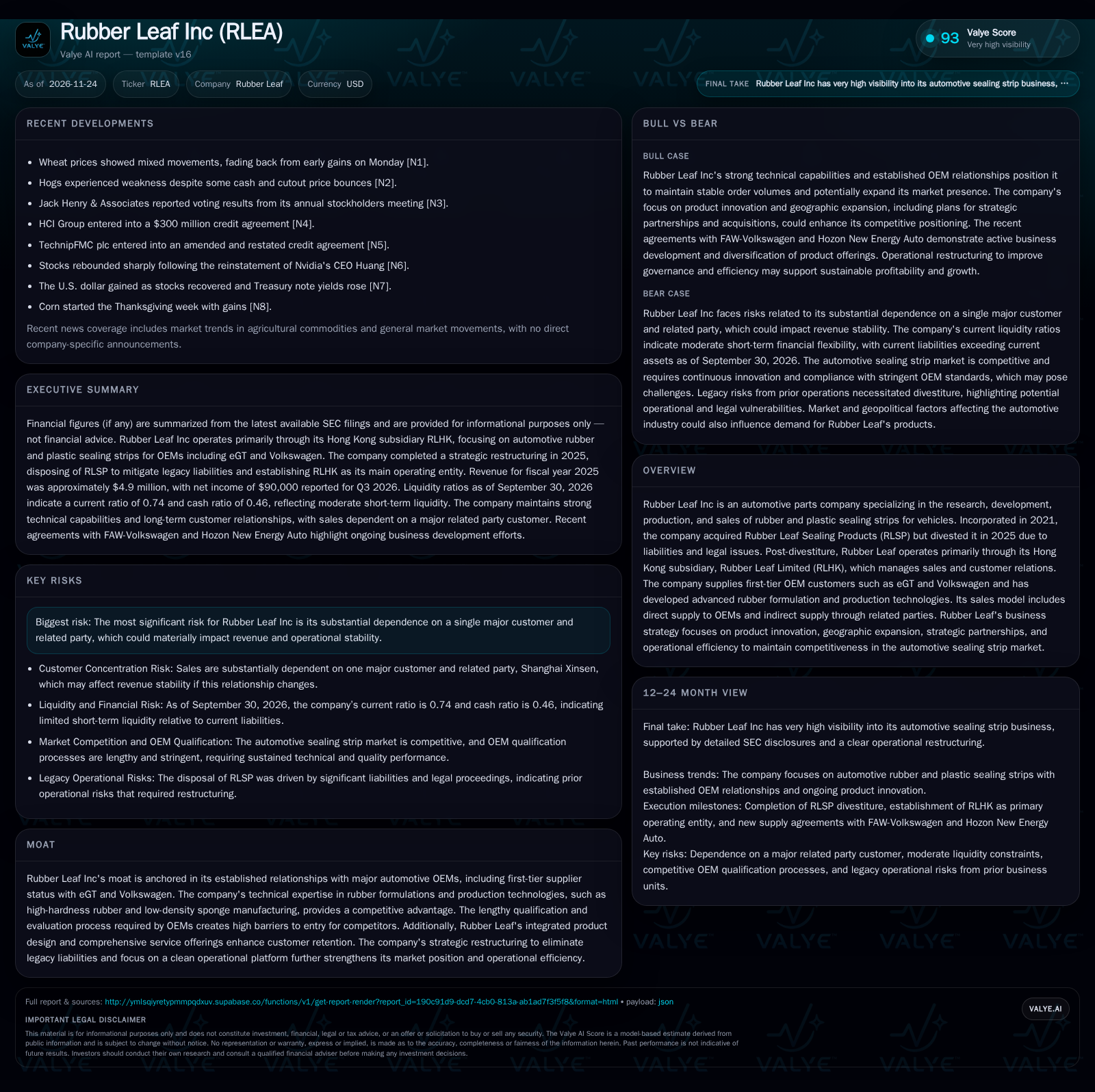
Rubber Leaf Inc specializes in automotive rubber and plastic sealing strips, supplying OEMs such as Volkswagen and eGT, with sales primarily dependent on related party Shanghai Xinsen. Following a 2025 divestiture to shed legal and financial liabilities, the company operates through its Hong Kong subsidiary and reported FY2025 revenue of $4.9M and Q3 2026 net income of $90K. [S2]
Rubber Leaf Inc is at a pivotal juncture following its strategic restructuring and renewed focus on supplying technically advanced automotive sealing strips to top-tier OEMs. Having divested a legacy subsidiary burdened by liabilities, the company now operates primarily through its Hong Kong entity, leveraging deep technical expertise and established industry relationships. However, the business model is defined by two sharp counterforces: the opportunity to scale through new OEM agreements and the acute risk of revenue disruption due to heavy dependence on a single related-party customer. The next phase for Rubber Leaf will depend on its ability to broaden its customer portfolio and translate product innovation into sustainable, diversified growth.
Post-Divestiture Structure, Revenue Profile, and Customer Dependence: What Has Changed?
Rubber Leaf Inc underwent a transformative restructuring in late 2025, disposing of its legacy RLSP subsidiary to eliminate substantial liabilities and legal risks. The company received $3 million in cash consideration for this divestiture, payable in installments. This move repositioned Rubber Leaf to operate mainly through its Hong Kong-based entity, Rubber Leaf Limited (RLHK), which now manages all core commercial activities. For fiscal year 2025, the company reported $4.9 million in revenue and $90,000 in net income for the quarter ended September 30, 2026. Most notably, sales remain heavily concentrated with a single major related party, Shanghai Xinsen, underscoring a persistent vulnerability to shifts in this relationship. [S2]
How Rubber Leaf’s Revenue Model and Cost Structure Shape Its Financial Trajectory
Rubber Leaf’s economics are anchored in supplying highly engineered rubber and plastic sealing strips to automotive OEMs and their immediate suppliers. The business model likely involves a mix of direct sales to OEMs and indirect sales via related parties, with pricing and volume determined by long-term relationships, technical qualification, and customer-specific program launches. Given the specialized nature of automotive sealing products, margins can be stable for established suppliers, but the need for continuous innovation and compliance with stringent OEM standards keeps R&D and quality assurance costs high.
The company’s technical edge—including advanced rubber formulations, high-hardness products, and modular 3D molding—may allow for premium pricing or preferred supplier status, but these advantages are counterbalanced by the capital intensity of product development and the long lead times (six months to over a year) required for new model integration. Operating leverage is constrained by the project-based nature of automotive supply, where volumes can ramp only after lengthy qualification. The moderate net income reported for Q3 2026 suggests that, despite restructuring, fixed costs and the burden of indirect sales channels may still dilute profitability. [S2]
Technical Capabilities and OEM Barriers: Where Rubber Leaf Stands in the Value Chain
Rubber Leaf’s principal competitive strengths lie in its decades of technical experience, proprietary rubber formulations, and the ability to meet complex OEM requirements for durability, fit, and performance. The automotive sealing market is characterized by high entry barriers due to lengthy OEM qualification cycles, the necessity for rigorous quality control, and the importance of integrated design support. Rubber Leaf’s status as a first-tier supplier to brands such as Volkswagen and eGT validates its technical credibility and positions it for recurring program business—provided it maintains quality and delivery standards.
However, the competitive landscape includes both global automotive parts conglomerates and local Chinese suppliers, many of whom are also investing in automation, materials science, and in-house R&D. Substitutes could include alternative materials or integrated sealing systems from larger suppliers with broader portfolios. The company’s reliance on related-party channels may expose it to margin compression and limit direct customer feedback, potentially weakening its position if automotive OEMs consolidate suppliers or shift toward vertically integrated solutions. Sustained differentiation will depend on Rubber Leaf’s ability to innovate faster than peers and to secure a more diversified customer base.
If Customer Diversification and R&D Partnerships Translate to Revenue Acceleration
A constructive scenario for Rubber Leaf would see its recent agreements with FAW-Volkswagen and Hozon New Energy Auto convert into recurring, multi-year supply programs, reducing dependence on Shanghai Xinsen and providing greater revenue visibility. If the company’s advanced rubber technologies are adopted into new vehicle models, this could drive both volume and margin expansion, especially if direct OEM relationships deepen.
Confirmation of this upside would come from disclosures of new direct OEM contracts, a rising share of revenue from non-related parties, and evidence of multi-year production awards. A meaningful improvement in liquidity ratios, driven by cash flow from diversified sales, would further validate a positive inflection. Conversely, if incremental OEM agreements remain small, one-off, or fail to scale, the expected upside would not materialize.
Sustained Technical Execution, But Revenue Remains Concentrated
The most plausible scenario is that Rubber Leaf continues to fulfill orders for its primary customer, Shanghai Xinsen, while gradually expanding R&D and pilot projects with additional OEMs. Revenue may grow modestly as new agreements with brands like FAW-Volkswagen and Hozon New Energy Auto progress through development and into partial production, but the pace of diversification is likely to be incremental given the typical length of OEM qualification cycles.
This scenario would be confirmed by stable or slightly rising revenue, continued disclosure of pilot or low-volume supply agreements, and liquidity ratios that remain moderate but do not deteriorate further. A continued concentration of sales with the related party, with only slow growth in direct OEM business, would falsify a rapid diversification thesis and suggest that Rubber Leaf remains exposed to customer-specific risks.
Customer Loss or Working Capital Strain Triggers Operational Instability
The most adverse scenario would involve a material reduction or loss of business from Shanghai Xinsen, whether due to customer consolidation, shifting procurement strategies, or relationship deterioration. Given the current sales concentration, even a temporary disruption could create a steep revenue decline and immediate pressure on working capital, especially with current liabilities already exceeding current assets.
This downside would be confirmed by a sudden drop in reported revenue, a spike in accounts payable or overdue obligations, and urgent capital-raising activities or restructuring announcements. Further, if attempts to scale with new OEMs are delayed or unsuccessful, the lack of alternative revenue sources would exacerbate the company’s vulnerability.
Testing the Durability of Rubber Leaf’s Growth and Diversification Efforts
The proportion of revenue derived from Shanghai Xinsen versus direct OEM contracts—if disclosed—will be critical for assessing customer concentration risk.
Details and scale of new agreements or production awards with FAW-Volkswagen, Hozon New Energy Auto, or other OEMs would help validate diversification progress.
Gross margin trends, particularly on new product lines, would clarify whether technical differentiation is translating into sustainable pricing power.
Cash flow from operations and changes in working capital will reveal the company’s true liquidity trajectory beyond static balance-sheet ratios.
Evidence of successful product qualification and ramp-up for new vehicle models, such as disclosed order volumes or multi-year commitments, would support the case for durable growth.
Any changes in executive or board composition, especially after restructuring, could signal shifts in governance or strategic direction.
A useful metric would be R&D expenditure as a proportion of sales, indicating ongoing investment in product innovation relative to peers.
Monitoring for any legal or regulatory proceedings that could arise from legacy operations or cross-border sales channels remains important given prior liabilities.
Disclaimer: This is research-only, informational analysis and not investment advice. It may include AI-generated interpretation and general industry context. Always verify important details using primary sources.

Comments