
Home Depot: Margin Pressures, Shifting Demand, and the Resilience of the Home Improvement Retail Model
While Home Depot continues to generate strong profits and maintain a diversified product portfolio, the latest quarter highlights growing margin pressures and subtle shifts in consumer behavior tied to rising mortgage rates. The company’s future performance will hinge on its ability to balance cost control, competitive differentiation, and evolving demand from both professional and DIY customers.
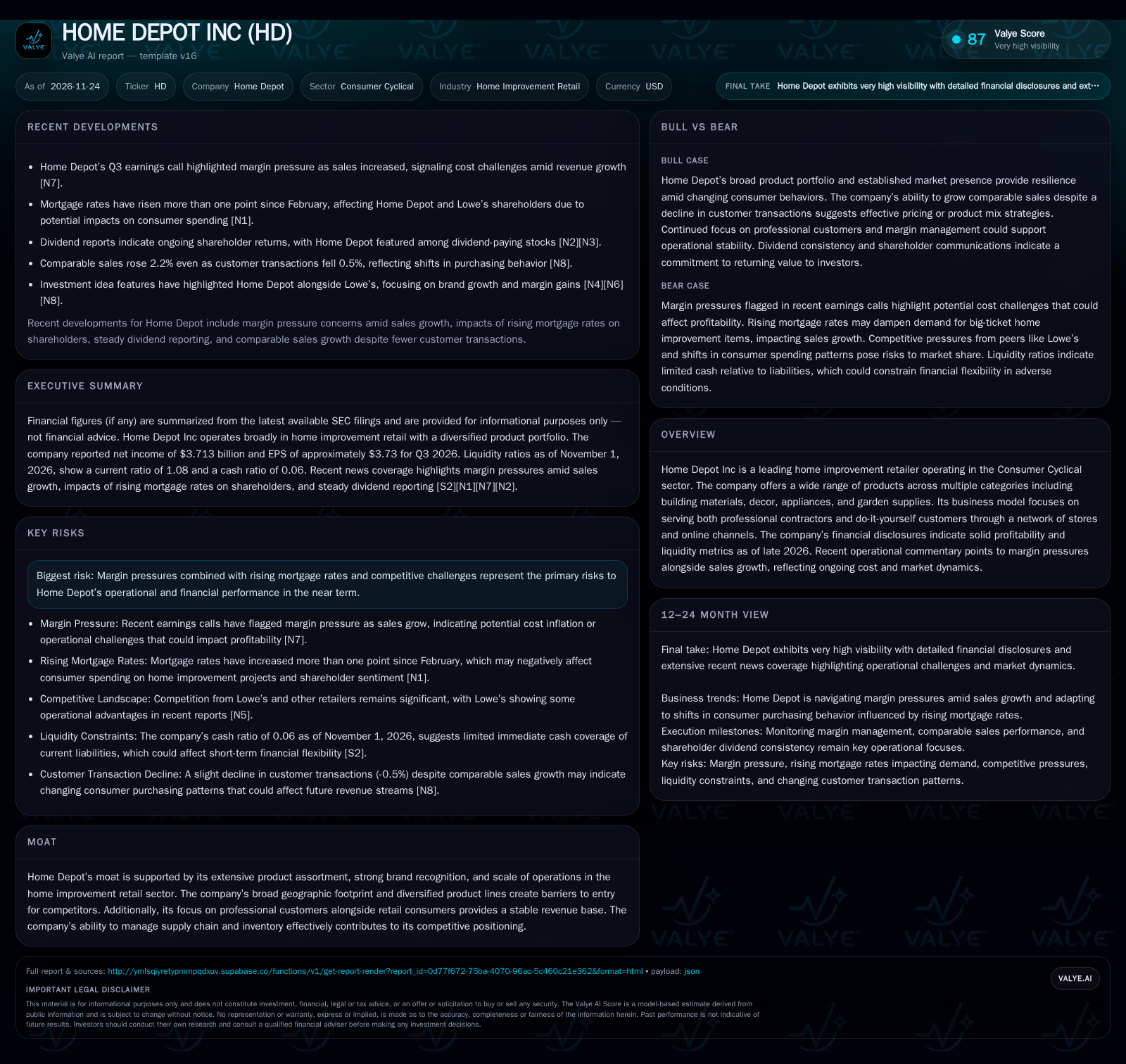
Home Depot reported $3.713 billion in net income for Q3 2026, with a current ratio of 1.08 and a cash ratio of 0.06. Despite a 2.2% increase in comparable sales, customer transactions declined by 0.5%, signaling changing consumer patterns. Margin pressures are intensifying, and rising mortgage rates could further dampen big-ticket spending. The company's durable brand and broad assortment remain strengths, but competitive and macroeconomic headwinds are increasingly relevant. [S2] [N7] [N8] [N1]
Home Depot’s latest financial results underscore a retail giant in transition: robust net income and sales growth coexist with intensifying margin pressures and subtle but meaningful shifts in customer behavior. The company’s ability to leverage its broad product assortment and scale is being tested by a challenging macroeconomic backdrop, including rising mortgage rates and evolving consumer preferences. As Home Depot navigates these headwinds, the mechanisms of pricing, volume, and mix—along with careful cost management—will likely determine whether its historic resilience continues or faces new limits.
Recent Financials Reveal Margin Squeeze and Changing Shopper Patterns
Home Depot reported net income of $3.713 billion for the quarter ending November 1, 2026, with basic EPS of $3.73 and diluted EPS of $3.72, confirming ongoing profitability at scale [S2]. However, the company’s Q3 earnings call flagged margin pressure even as sales grew, reflecting a tightening spread between revenue and costs [N7]. [S2] Notably, comparable sales increased by 2.2%, but customer transactions declined by 0.5%, suggesting that sales growth is being driven by higher average tickets rather than increased shopper traffic [N8]. These facts collectively highlight an environment where top-line growth is not translating into proportional profitability, and where consumer behavior is evolving in ways that could challenge traditional volume-driven retail models.
How Home Depot’s Revenue Model Absorbs Shifts in Pricing, Volume, and Mix
Home improvement retail economics are driven by a blend of high-ticket project sales, everyday consumables, and professional contractor demand. Home Depot’s broad product portfolio—spanning building materials, appliances, decor, and garden supplies—allows for cross-category resilience and the ability to adjust product mix in response to macroeconomic shifts [S1]. The company’s recent growth in comparable sales, despite fewer transactions, likely reflects a combination of price increases, a move toward higher-value projects, or greater penetration of professional customers who tend to purchase in larger quantities. However, this strategy can increase margin volatility: larger-ticket items often carry lower gross margins, and aggressive pricing to maintain volume can compress profitability. Fixed costs—store leases, distribution infrastructure, and technology investments—create operating leverage, meaning that even modest declines in traffic or mix can have outsized effects on earnings. [S2] This heightens the importance of inventory and working capital management, especially in a climate of rising interest rates and potential demand softness.
Competitive Dynamics: Brand Strength, Scale, and the Threat from Substitutes
Home Depot’s moat is rooted in its national footprint, deep supplier relationships, and strong brand recognition among both DIY consumers and professional contractors. Its extensive product assortment and integrated omnichannel model make it difficult for new entrants to match its breadth or convenience. However, competitive pressure from Lowe’s—its primary national rival—remains intense, with both companies racing to capture share in the pro segment and invest in digital capabilities [N6] [N8]. Substitutes are also a rising concern: online-only platforms, specialty retailers, and even direct-to-consumer brands are chipping away at select categories. In an environment where customer transactions are falling, the risk is that share gains in average ticket could mask underlying erosion in customer loyalty or traffic. Additionally, private-label expansion and supply chain integration, while sources of margin upside in good times, carry execution risk if demand softens or cost inflation persists. The question is whether Home Depot’s scale and operational discipline can continue to offset these counterforces, or if the current macro backdrop will erode its competitive advantages over time.
If Professional Demand Holds and Cost Discipline Improves, Margin Recovery Could Follow
A favorable scenario for Home Depot hinges on several reinforcing mechanisms: stabilization or renewed growth in professional contractor demand, effective pass-through of cost inflation to consumers, and successful efforts to control operating expenses. If mortgage rates plateau or decline, pent-up demand for home projects—especially among professionals—could drive both volume and mix improvements. Confirmation would come from a reversal in transaction declines (i.e., rising customer counts) alongside continued gains in average ticket. Additionally, evidence of sequential margin improvement—either through lower supply chain costs, improved inventory turns, or reduced shrink—would signal that operational discipline is counteracting external pressures. Expansion of private-label offerings or services that deepen customer loyalty (such as pro loyalty programs or integrated digital tools) could further differentiate Home Depot and drive higher-margin sales. If the company demonstrates these trends in coming quarters, it would support a narrative of resilience and renewed operating leverage.
Most Likely Path: Margin Recovery Remains Elusive as Macro Headwinds Persist
The most plausible scenario is one of continued modest sales growth, with persistent margin pressure reflecting both cost inflation and a consumer environment constrained by high mortgage rates. Home Depot’s broad assortment and brand loyalty may help it defend share, but ongoing declines in customer transactions suggest that the company is relying more on pricing and mix than true volume growth. Confirmation would come from stable or slightly positive comparable sales offset by flat or declining operating margins and no material improvement in transaction counts. If mortgage rates remain elevated and consumer confidence stays muted, big-ticket discretionary projects may remain under pressure, while core maintenance and repair categories provide a floor for demand. This scenario would likely see Home Depot generating solid but unspectacular earnings, maintaining its dividend, and focusing on incremental operational improvements rather than transformative growth.
Worsening Consumer Sentiment and Cash Constraints Expose Operating Risks
A more adverse scenario would unfold if mortgage rates continue to rise or remain stubbornly high, further eroding consumer willingness to undertake home improvement projects—especially those requiring financing. In this case, both professional and DIY demand could weaken, leading to steeper declines in customer transactions and potential inventory overhang. Margin pressures could intensify if Home Depot is forced to discount aggressively to move product, or if supply chain costs continue to outpace pricing power.
What Will Reveal the Durability of Home Depot’s Model in a Shifting Market?
Comparable sales growth versus transaction count: Whether sales growth continues to rely on higher average tickets or if transaction declines stabilize or reverse would clarify the underlying demand trend.
Gross and operating margin trends: Sequential margin improvement or continued compression will indicate how effectively Home Depot is managing costs and pricing in the current environment.
Pro segment performance (if disclosed): Growth or contraction in sales to professional contractors would signal the resilience of this higher-value customer base.
Inventory turnover and working capital metrics: Changes here would reveal how well the company is adjusting to demand fluctuations and supply chain pressures.
Mortgage rate trajectory and housing market indicators: External conditions will remain a leading driver of big-ticket demand and overall home improvement activity.
Competitive pricing and promotional intensity: Shifts in discounting or pricing strategies, especially in response to Lowe’s or other key rivals, could impact both market share and margin structure.
Disclaimer: This is research-only, informational analysis and not investment advice. It may include AI-generated interpretation and general industry context. Always verify important details using primary sources.

Comments