
i3 Verticals: Recurring Revenue Strength Meets Liquidity Constraints in Public Sector SaaS
i3 Verticals generates roughly 81% recurring revenue from mission-critical SaaS and integrated payment solutions for public sector clients in the U.S.
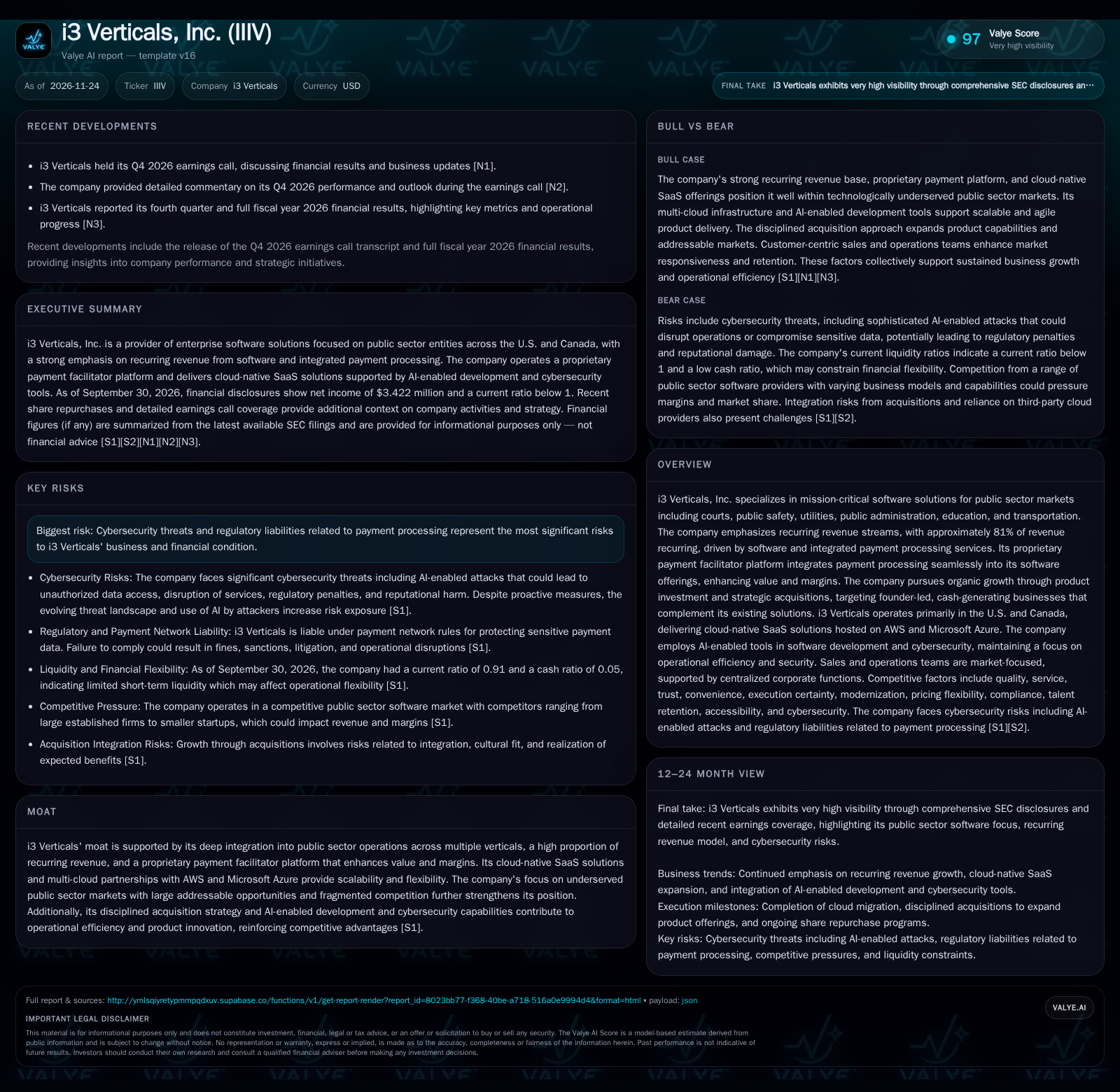
i3 Verticals generates roughly 81% recurring revenue from mission-critical SaaS and integrated payment solutions for public sector clients in the U.S. and Canada. Its proprietary payment facilitator platform and cloud-native strategy drive value and scale, while recent share repurchases signal capital return. The balance between operational resilience, competitive differentiation, and potential financial flexibility will shape its medium-term outlook. [S1] [S2]
i3 Verticals has carved out a niche in the public sector software ecosystem by combining a sticky, high-recurring-revenue SaaS model with integrated payments and a disciplined acquisition strategy. Its focus on mission-critical applications for courts, utilities, education, and transportation gives it a degree of insulation from market volatility and positions it to benefit from ongoing digital transformation in government services. The interplay of these strengths and vulnerabilities will define i3 Verticals’ value creation potential in the coming cycle.
Recent Financials Highlight Resilient Revenue and Liquidity Tightness
As of September 30, 2026, i3 Verticals reported that approximately 81% of its revenue from continuing operations is recurring, derived primarily from software and integrated payment processing services for public sector entities in the U.S. and Canada [S1]. This high proportion of recurring revenue underpins business visibility and operational stability. Net income for the fiscal year reached $3.422 million, and the company executed share repurchases totaling $48.6 million in the June 2026 quarter [S1] [S2].
The company reported a current ratio of 0.91 for the period. [S1] This signals limited near-term liquidity and may restrict the company’s flexibility to respond to operational shocks, invest in growth, or weather working capital volatility.
The company’s proprietary payment facilitator platform remains central to its value proposition, integrating payment processing into its SaaS solutions and supporting margin expansion [S1].
Recurring Revenue, Integrated Payments, and Margin Dynamics
i3 Verticals’ economics center on a high mix of recurring revenue, primarily from SaaS contracts and transaction-based fees on integrated payments. Recurring revenue streams offer visibility and dampen cyclicality, especially in public sector verticals where technology adoption is often supported by multi-year modernization mandates and budget allocations.
The proprietary payment facilitator platform is a key differentiator. By embedding payment processing within its software, i3 Verticals may capture both software subscription fees and a share of payment transaction economics, potentially increasing customer stickiness and lifetime value. If payment processing volume grows alongside software adoption, transaction-based revenues could scale with little incremental cost, supporting operating leverage.
The cloud-native SaaS model, hosted on AWS and Microsoft Azure, implies a variable cost structure with lower upfront capital needs than on-premise deployments, but also introduces recurring third-party hosting expenses. The company’s use of AI tools for software development and cybersecurity may improve efficiency and reduce operational costs over time, but the benefits will depend on effective implementation and ongoing investment.
Although the company has demonstrated acquisition discipline, integration costs, and the need for ongoing product investment could pressure margins if not offset by scale or synergies. The recent share repurchases, while signaling capital return, represent a significant cash outlay relative to current liquidity and could limit future strategic optionality.
Defensible Niche Amid Fragmented Public Sector Software Landscape
i3 Verticals competes in a fragmented market for public sector software, where barriers to entry include regulatory compliance, domain expertise, integration complexity, and the mission-critical nature of client operations. Its focus on technologically underserved verticals—such as courts, public safety, utilities, and education—provides exposure to customers with high switching costs and long procurement cycles. These factors can support customer retention and recurring revenue.
The company’s proprietary payment facilitator platform and cloud-native SaaS offerings further differentiate its suite, enabling deeper integration and potential margin advantages compared to software-only or less integrated competitors.
However, the public sector software space is seeing increased competition from both legacy enterprise vendors and more agile SaaS upstarts. Larger incumbents can leverage scale, while newer entrants may innovate faster or offer lower prices. Factors such as modernization speed, pricing flexibility, cybersecurity posture, and compliance credentials will influence competitive outcomes. The risk is that pricing pressure or lost bids could erode margins or slow growth if i3 Verticals cannot continue to outpace the field on execution and product relevance.
Margin Expansion and Product Depth Drive Durable Growth
In a favorable scenario, i3 Verticals leverages its high recurring revenue base, payment integration, and cloud-native SaaS platform to drive both top-line growth and operating leverage. Successful execution on AI-enabled development and cybersecurity tools could further reduce operational costs and enhance product stickiness, while disciplined acquisitions add complementary capabilities and expand the addressable market.
If the company can maintain or grow payment processing volumes, deepen penetration within existing public sector customers, and continue migrating clients to higher-value SaaS tiers, margin expansion is possible. Confirmation of this scenario would require evidence of accelerating SaaS revenue growth, rising payment processing transaction volume, improved gross and operating margins, and successful integration of acquired businesses.
Additional signals would include new multi-year public sector contracts, expanded cloud adoption among legacy customers, and reduced customer churn rates. Demonstrated ability to manage cybersecurity risks without material incidents would further reinforce the case for sustainable growth.
Steady Execution Constrained by Liquidity and Cybersecurity Overhang
The most plausible outlook is that i3 Verticals continues to deliver moderate growth in recurring revenues, supported by incremental wins in core public sector markets and ongoing product enhancements. The company’s cloud migration and AI initiatives may yield efficiency gains, but benefits will likely accrue gradually rather than as a step-change.
Share repurchase activity, while providing capital return, may further restrict investment capacity unless offset by improved cash generation.
Competition remains manageable but persistent, with i3 Verticals defending share through domain expertise, integrated payments, and modernization capabilities. However, the threat of cybersecurity incidents or regulatory liabilities related to payment processing remains a chronic risk that could disrupt operations or trigger non-recurring expenses.
Evidence for this scenario includes stable recurring revenue growth, continued albeit modest margin improvement, limited but ongoing product launches or contract wins, and no major liquidity or security events.
Liquidity Crunch or Cybersecurity Breach Derails Growth
The company may be forced to slow investment, curtail acquisitions, or seek external financing on unfavorable terms, impairing its ability to execute on its growth strategy.
Alternatively, a major cybersecurity incident—particularly an AI-enabled attack targeting payment data—could disrupt mission-critical services for public sector clients, trigger regulatory penalties, and cause reputational damage. This could accelerate customer churn, increase compliance costs, and erode the company’s competitive position.
Confirmation of this downside would involve a deterioration in the current ratio, urgent capital raises, missed payments to vendors, or public disclosure of security breaches. Loss of key contracts, negative regulatory actions, or a material decline in recurring revenue would further validate a bear case.
Testing the Resilience of i3 Verticals’ Recurring Revenue Model
Quarterly recurring revenue growth rates, segmented by vertical (JusticeTech, Utilities, Education, Transportation), would help gauge underlying demand and customer retention.
Payment processing volume and transaction-based fee growth, if disclosed, would clarify the scale and profitability of the proprietary payment facilitator platform.
Gross and operating margin trends, especially in relation to cloud infrastructure costs and AI-enabled efficiency initiatives, are critical for assessing operating leverage.
Disclosure of customer churn or renewal rates in key verticals would help test customer stickiness and the durability of recurring revenues.
Frequency, severity, and resolution time of cybersecurity incidents, if disclosed, will be central to evaluating operational resilience and compliance risk.
Pace and outcomes of acquisition integration, including realized synergies and retention of acquired customers, would help validate the acquisition strategy.
Updates on new multi-year public sector contracts or expansion within existing accounts would signal ongoing market relevance and sales execution.
Disclaimer: This is research-only, informational analysis and not investment advice. It may include AI-generated interpretation and general industry context. Always verify important details using primary sources.

Comments