
Mobile Global Esports: Proprietary Fantasy Engines, User Migration Uncertainties, and Monetization Sustainability
Mobile Global Esports (MGAM) is betting on proprietary technology and behavioral personalization to redefine fantasy sports engagement, but faces acute capital constraints, unproven user migration from acquired assets, and the uphill battle of monetizing differentiated experiences in a crowded, evolving digital entertainment landscape.
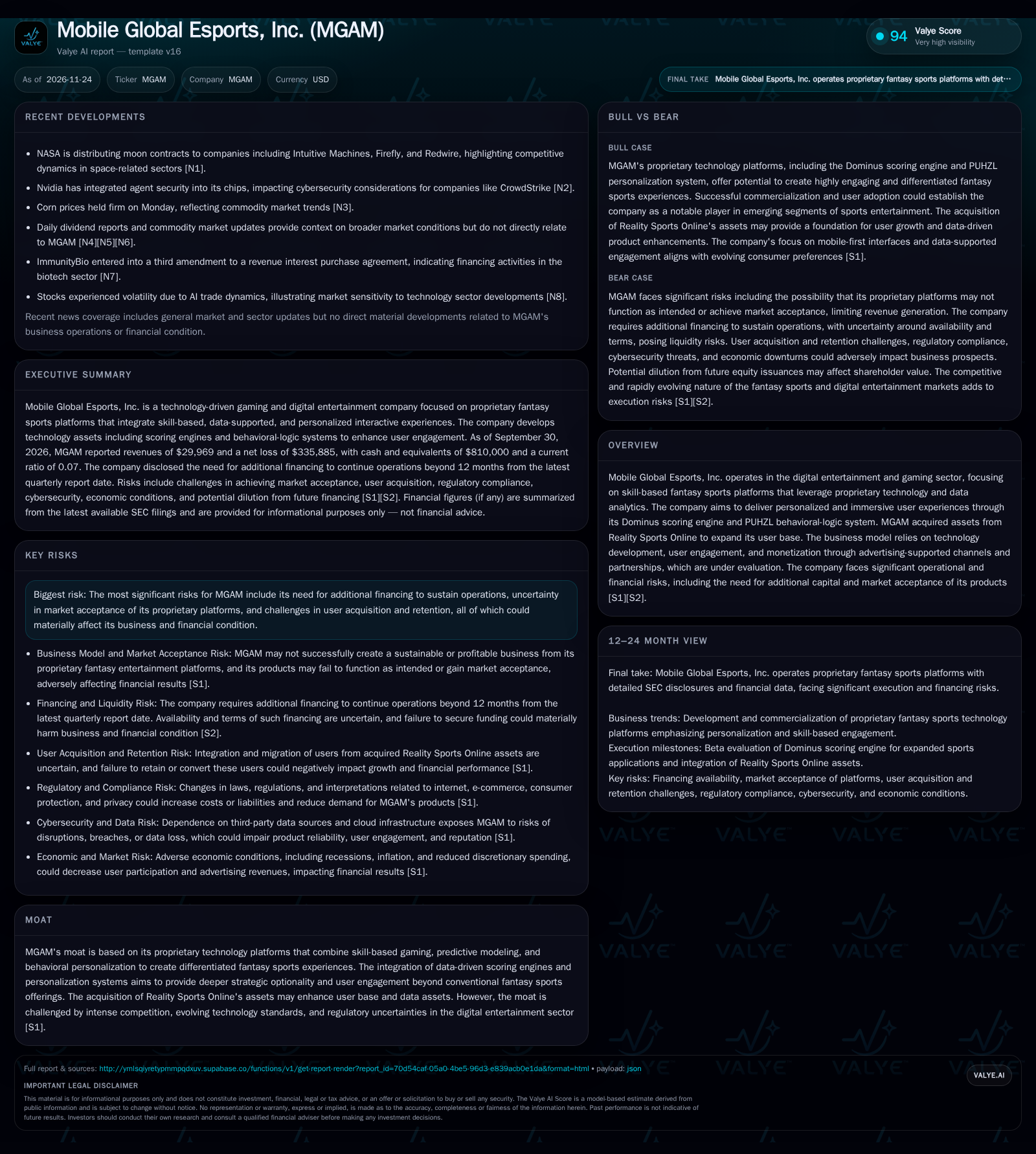
MGAM’s core strategy centers on developing proprietary, data-driven fantasy sports platforms and leveraging recently acquired user assets, but the company’s limited revenues, significant net losses, and urgent need for new financing highlight the existential risks tied to market acceptance, user retention, and operational runway [S1] [S2].
Mobile Global Esports, Inc. (MGAM) is attempting to carve out a niche in the fantasy sports and digital entertainment sector through proprietary technology platforms that promise richer, more personalized user experiences. The company’s approach fuses skill-based gaming, predictive modeling, and behavioral engagement mechanics, with new assets from Reality Sports Online offering a possible user base to accelerate adoption. The next year will test whether its technology-driven differentiation can translate into sustainable user growth and monetization before capital constraints force a strategic reset or deeper dilution.
MGAM’s Financial and Strategic Position at a Critical Juncture
As of September 30, 2026, Mobile Global Esports reported $29,969 in revenue versus a net loss of $335,885 for the nine-month period, reflecting nascent commercialization and a high-burn, pre-scale operating model [S2]. The company’s balance sheet is strained, with $810,000 in cash and equivalents, current assets of $88,719, and current liabilities of $1,219,105—resulting in a current ratio of 0.07 and a cash ratio of 0.66 [S2]. MGAM has openly disclosed a need for additional financing to support operations for the next 12 months, with no certainty around availability or terms [S2].
Strategically, MGAM is advancing its proprietary Dominus scoring engine (targeting beta for football in 2026) and the PUHZL behavioral-logic personalization system, both aimed at delivering deeper engagement than conventional fantasy sports [S1]. The company’s acquisition of Reality Sports Online’s assets provided historical access to 7,500 active users and a 40,000+ email database, but it remains unclear to what extent these users will migrate or convert to MGAM’s new offerings [S1]. These facts underscore the dual challenge: execution risk on both the technology and go-to-market fronts, and an urgent need for capital to bridge to potential proof points.
Exploring Monetization Models and Engagement Economics
MGAM’s revenue ambitions rest on the commercialization of proprietary fantasy sports platforms that combine skill-based play, predictive analytics, and behavioral personalization. In theory, this opens multiple monetization avenues: subscription fees for premium features, transaction or contest entry fees, advertising revenue, and potential data partnerships or B2B licensing. Given the company’s current revenue base and disclosed model, advertising and partnership models are still under evaluation, and there is no evidence yet of significant recurring or transactional revenue [S1] [S2].
The economics of fantasy sports platforms are typically characterized by high initial technology development costs, relatively low marginal costs per additional user, and the potential for operating leverage if user acquisition and retention are successful. However, the fixed cost base—including platform development, data licensing, and cloud infrastructure—can drive persistent losses if user scale is not achieved. MGAM’s need for additional financing suggests that current user monetization is insufficient to cover fixed costs, let alone support growth.
A critical unknown is the willingness of users—especially those migrated from Reality Sports Online—to pay for differentiated engagement features. If MGAM can successfully convert its database into paying, active users, the resulting scale could improve gross margins and support reinvestment in further personalization and engagement technology. Conversely, if conversion rates are low, fixed costs will continue to outweigh revenue, and the need for repeated external funding will intensify.
Technology Differentiation Facing Market and Regulatory Challenges
MGAM’s competitive thesis relies on proprietary technology: the Dominus scoring engine, which promises deeper strategic play, and the PUHZL system for personalized engagement. These could offer a differentiated user experience versus conventional, rules-based fantasy or prediction platforms [S1]. However, the market for fantasy sports and digital engagement is intensely competitive, with entrenched platforms (including large U.S. and international fantasy operators, daily fantasy companies, and social gaming apps) already investing in gamification, analytics, and mobile-first interfaces.
Switching costs for users in this space are generally low unless a platform offers either unique formats, substantial network effects, or meaningful real-money incentives. MGAM’s focus on skill-based and data-driven personalization could attract a segment of advanced or underserved users, but broad adoption will depend on onboarding ease, perceived fairness, and compelling prizes or community features.
Additionally, the company’s reliance on third-party data, licensed content, and cloud infrastructure introduces both cost and regulatory risks. Data licensing constraints and regulatory changes—especially in skill-based gaming or real-money contests—could quickly erode any technical advantage or create new compliance costs. Without a demonstrable, retained user base and a clear regulatory roadmap, MGAM’s moat remains conceptually promising but commercially unproven.
Indicators of a Breakout Success for MGAM’s Fantasy Platforms
The most favorable scenario for MGAM involves the successful launch and user adoption of its Dominus and PUHZL-powered platforms, with high rates of migration and engagement from the acquired Reality Sports Online user base. If MGAM can demonstrate distinctive engagement metrics—such as session frequency, time spent, and user retention—this would support premium pricing or high-value advertising inventory.
Commercial validation could come in the form of growing active user counts, meaningful conversion of the existing email database to registered and paying users, and early evidence of recurring, predictable revenue streams. Additional upside could be unlocked if the company secures high-visibility partnerships or data licensing deals that leverage its proprietary scoring and personalization engines.
Confirming this scenario would require disclosures of rapid user growth, positive cohort retention data, and evidence that revenue per user is rising as engagement deepens. Conversely, if user migration stalls, engagement metrics are weak, or revenue remains stagnant, the breakout thesis would be undermined.
Potential Outcomes Amid Funding and User Adoption Challenges
The most plausible scenario is one of incremental progress: MGAM continues to develop and iterate its proprietary platforms, launches beta versions for new sports applications, and achieves modest user migration from the acquired Reality Sports Online assets. Revenue remains limited, with losses persisting as the company invests in technology and user acquisition.Financing is secured, but likely at dilutive terms given the reported current ratio and lack of near-term cash flow [S2].
The company may succeed in demonstrating some engagement advantages—such as higher session lengths or unique gameplay mechanics—but struggles to achieve breakout user or revenue scale in the face of established competitors and regulatory friction. Over time, MGAM could pivot toward niche or B2B opportunities (licensing its engines or personalization algorithms to other gaming providers) if direct-to-consumer adoption is slower than hoped.
This scenario would be confirmed by continued small-scale revenue, repeated financing events, and modest but positive product development milestones. It would be falsified if the company either fails to secure necessary funding or if an unexpected surge in user adoption and revenue occurs.
Risks from Execution Issues and Liquidity Constraints
The adverse scenario is characterized by continued user acquisition and retention challenges, low conversion from the Reality Sports Online user base, and minimal revenue growth. If MGAM is unable to demonstrate compelling engagement or product-market fit, the cost of acquiring new users—especially in a competitive environment—could further widen losses.
In this scenario, the company fails to secure additional financing on acceptable terms or at all, leading to severe liquidity constraints and potential operational cutbacks or restructuring [S2]. Dilution from emergency financings erodes existing shareholder value, and the company may be forced to sell assets, pivot to a pure technology licensing model, or seek a distressed exit.
Evidence for this scenario would include flat or declining user metrics, persistent cash burn without new capital, negative disclosures regarding financing efforts, or regulatory/legal setbacks that further constrain the business.
Milestones Reflecting MGAM’s Path to Sustainable Scale
Active user count and engagement trends post-integration of Reality Sports Online assets—if disclosed—will be critical for assessing early adoption and retention.
Conversion rate from the 40,000+ email database to active, paying users: a key indicator of MGAM’s ability to monetize acquired assets.
Monthly or quarterly revenue trajectory and revenue per active user, to test whether engagement is translating into meaningful monetization.
Progress toward beta launch and commercial deployment of the Dominus scoring engine in new sports verticals, such as college and professional football.
Disclosure of material financing events, including size, terms, and dilution impact, to gauge operational runway and balance-sheet risk.
Retention and churn rates for users engaging with the new platforms, which would clarify the stickiness and competitive durability of MGAM’s engagement mechanics.
Any updates on strategic partnerships, licensing deals, or B2B commercialization of MGAM’s core technology, as these could provide non-dilutive revenue and validate the platform’s broader appeal.
Evidence of regulatory or data-licensing developments that could either unlock new markets or impose additional constraints.
Disclaimer: This is research-only, informational analysis and not investment advice. It may include AI-generated interpretation and general industry context. Always verify important details using primary sources.

Comments