
Balance Labs, Inc.: Digital Asset Advisory Ambitions Collide with Severe Liquidity Constraints
Balance Labs, Inc.
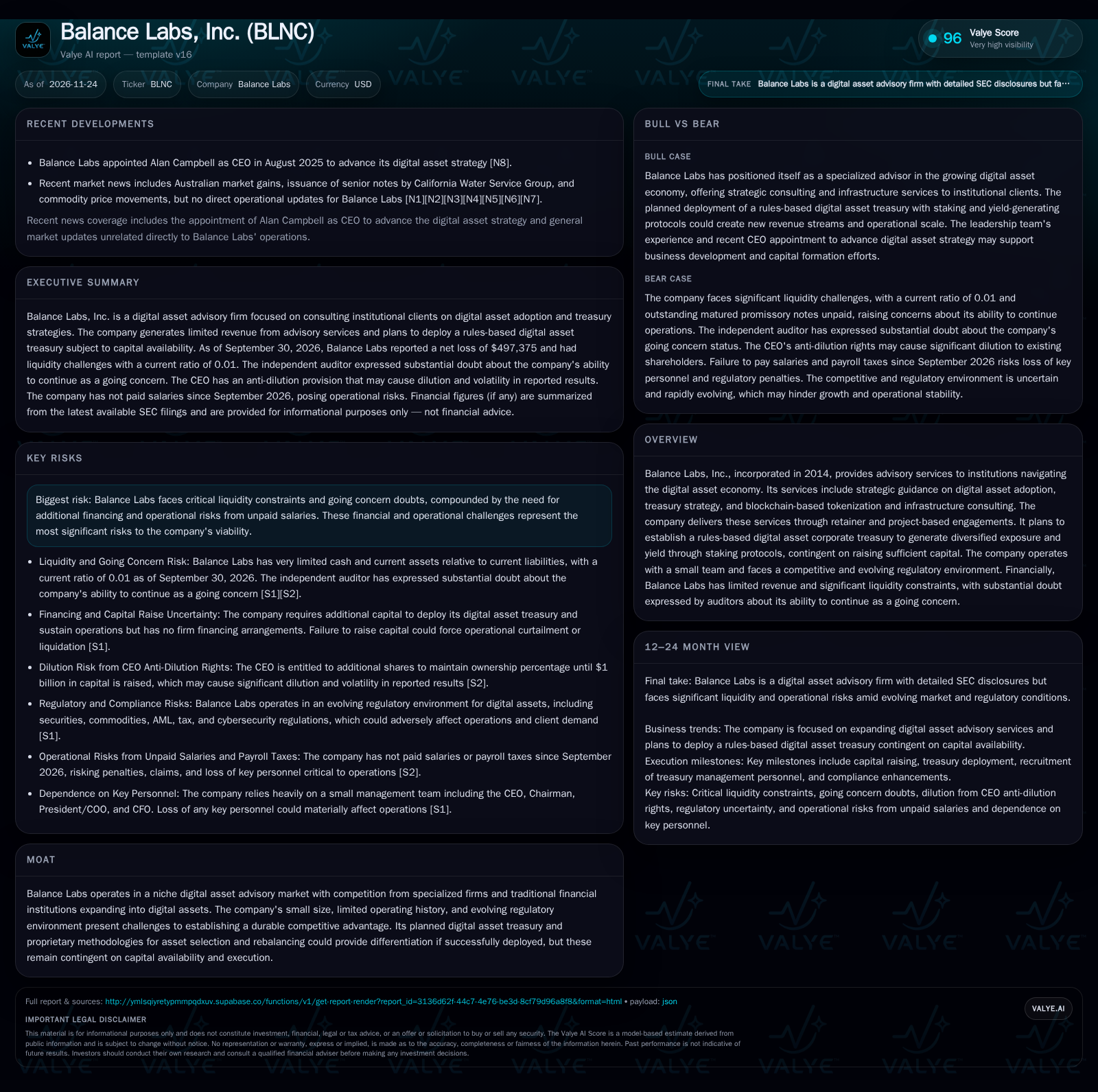
Balance Labs, Inc. targets institutional clients with digital asset advisory services and plans for a rules-based digital asset treasury. However, with less than $20,000 in liquid assets against over $3 million in current liabilities, a net loss, unpaid promissory notes, and a going concern warning, its operational viability and future growth are at significant risk. Execution hinges on urgent capital infusion, personnel stability, and regulatory navigation [S1] [S2].
Balance Labs, Inc. is attempting to build a specialized advisory platform for institutions navigating the digital asset economy, promising insights on tokenization, treasury strategy, and blockchain infrastructure. Yet, the company’s ambition is at odds with its financial reality: minuscule revenue, acute liquidity shortfall, and unpaid liabilities that threaten its ability to operate. While a differentiated digital asset treasury could, in theory, unlock new recurring revenue streams, the near-term focus is survival—capital raising, talent retention, and regulatory compliance are existential hurdles. The coming months will test whether Balance Labs can transition from advisory boutique to scalable operator or become another casualty of the sector’s volatility [S1] [S2].
Liquidity Crisis and Operational Disruption Define the Present Reality
Balance Labs, Inc. reported advisory revenue of approximately $40,000 in Q1 2026 but posted a net loss of $497,375 for the nine months ended September 30, 2026 [S1] [S2]. Cash and cash equivalents stood at $16,392, with an additional $2,238 in short-term investments, against current liabilities of $3,030,765, resulting in a current ratio and cash ratio of just 0.01 [S2]. The company has not paid salaries or payroll taxes since September 2026, raising the risk of regulatory penalties and potential loss of its core team [S2]. Outstanding promissory notes totaling $500,000 to related parties remain unpaid, and the independent auditor has expressed substantial doubt about the company’s ability to continue as a going concern [S2]. These facts indicate an immediate need for capital and expose the business to operational breakdown and reputational risk.
Advisory-Driven Revenues and the Challenge of Scaling a Digital Asset Treasury
Balance Labs’ current economics are driven by project-based and retainer advisory engagements for institutions exploring digital asset adoption, tokenization, and related infrastructure [S1]. Present advisory revenue is small and lumpy, with approximately $6,000 in Q4 2025 and $40,000 in Q1 2026 [S1]. This revenue model is high-margin in theory (given low direct delivery costs) but highly dependent on client acquisition, credibility, and the ability to maintain a stable, knowledgeable team. The company’s plan to establish a rules-based digital asset treasury—potentially generating yield via staking or other protocols—could introduce a recurring and scalable revenue stream if sufficient capital is raised. However, treasury deployment would require significant upfront funding, robust risk management, and ongoing compliance infrastructure. With only four employees and no salaries paid since September 2026, fixed costs are currently suppressed, but this is not sustainable and could quickly translate into loss of operational capacity or knowledge drain. The company’s capital structure is further complicated by the CEO’s anti-dilution rights, which could cause substantial dilution for existing shareholders if new capital is raised [S2].
Specialization Versus Scale: Navigating an Evolving Competitive Landscape
Balance Labs operates in a highly competitive and rapidly evolving market. Its competitors include specialized digital asset advisors, established consulting firms expanding into crypto, and traditional financial institutions launching digital asset practices [S1]. Many rivals benefit from greater capital, stronger brand recognition, deeper regulatory expertise, and established client networks. The company’s potential differentiation lies in its focus on rules-based digital asset treasury management and proprietary methodologies for asset selection and rebalancing—if it can execute on this vision. However, the absence of a deployed treasury product and the company’s limited operating history make it difficult to establish a durable competitive edge. Regulatory uncertainty further erodes the ability to build long-term client relationships, as institutions may prefer to work with better-capitalized, compliance-savvy firms. The company’s small size and governance structure—where the largest shareholder and Chairman controls over 25% of the stock—also introduce potential conflicts and limit institutional appeal.
Unlocking the Digital Treasury: A Pathway to Scalable, Recurring Revenue
The most optimistic scenario envisions Balance Labs successfully raising sufficient capital to launch its rules-based digital asset treasury. This would allow the company to move beyond episodic advisory fees to a model capturing recurring management fees, yield from staking, and potentially performance-linked revenue from digital asset strategies. If the firm can demonstrate robust risk controls, regulatory compliance, and transparent reporting, it could attract institutional assets and command premium consulting engagements. Confirmation of this scenario would include a material capital raise, successful onboarding of treasury management personnel, client mandates for treasury management, and evidence of repeat advisory engagements from large institutions. Falsification would occur if the company fails to raise capital, loses key personnel, or continues to generate only nominal advisory revenue over several quarters.
Survival Mode: Maintaining Advisory Services Amid Funding and Talent Pressures
The most plausible near-term outcome is that Balance Labs remains a niche advisory boutique, focusing on small, ad hoc consulting assignments while struggling to secure major mandates or sufficient capital for its treasury ambitions. In this scenario, revenue remains volatile and insufficient to cover basic operating costs, with the company relying on bridge financing or insider loans to extend runway. Personnel retention becomes increasingly challenging as unpaid salaries accumulate. Compliance and regulatory risks persist, limiting the ability to sign larger or more sophisticated clients. Confirmation would be continued low advisory revenue, ongoing net losses, lack of operational treasury deployment, and further deferrals of compensation or payments to insiders. A break from this pattern would require evidence of a significant capital infusion, new recurring client contracts, or tangible progress toward treasury productization.
Potential for Operational Breakdown or Forced Liquidation
The adverse scenario is one in which Balance Labs is unable to secure new capital, forcing it into operational curtailment or liquidation. The combination of unpaid promissory notes, mounting payroll tax liabilities, and an inability to pay salaries could trigger regulatory action, lawsuits from employees or creditors, and reputational damage that deters any future fundraising. The CEO’s anti-dilution provision may further complicate any emergency financing. The company could lose all key personnel, resulting in a collapse of client delivery capability and an effective wind-down of operations. This scenario would be confirmed by further delays in payments, resignation of executives, auditor resignation, or bankruptcy filings. Falsification would require evidence of a meaningful capital raise or new business win sufficient to stabilize operations.
Milestones That Will Determine Whether Balance Labs Can Outlast Its Liquidity Squeeze
Evidence of a successful capital raise or new financing arrangement—either from insiders or external investors—would be a critical inflection point.
Deployment of the digital asset treasury product: an announcement or disclosure of assets under management, client mandates, or operational launch would signal progress beyond advisory-only revenue.
Restoration of regular salary and payroll tax payments would indicate improved financial health and may help retain key personnel.
Any changes to the CEO’s anti-dilution rights or a dilution event tied to new capital could materially impact shareholder value and governance dynamics.
Disclosure of new, recurring advisory contracts—especially with institutional asset managers or enterprises—would suggest traction and a potential revenue base for growth.
Resignation or replacement of any member of the four-person executive team would increase operational risk given the company’s size.
Updates on regulatory investigations, compliance actions, or penalties related to payroll taxes or digital asset operations would be highly material.
A useful metric would be client concentration—if disclosed—to assess dependence on single or few clients, which could amplify revenue volatility.
Disclaimer: This is research-only, informational analysis and not investment advice. It may include AI-generated interpretation and general industry context. Always verify important details using primary sources.

Comments