
Equus Total Return: Transitioning from Investment Vehicle to Operating Company Amid Compliance and Profitability Pressures
Equus Total Return, Inc. faces a pivotal transformation as it seeks to shift from a traditional investment entity toward an operating company, while contending with persistent net losses, regulatory scrutiny, and the looming risk of NYSE delisting. The company’s substantial short-term investment holdings and the need to remediate compliance deficiencies will shape its ability to execute this transition and restore shareholder value.
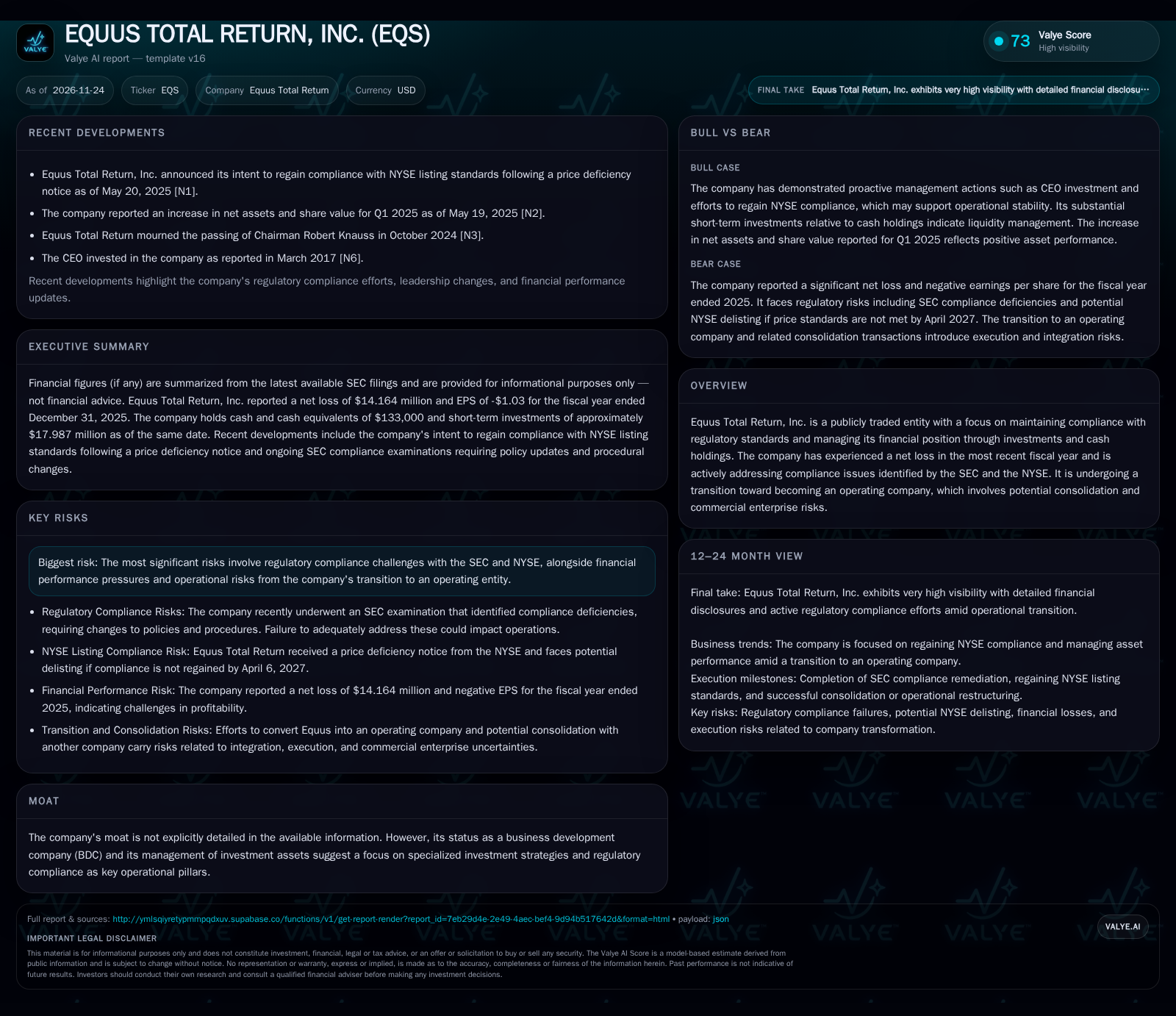
Equus Total Return, Inc. is navigating a high-stakes transition from a business development company to an operating company, with a net loss of $14.164 million in 2025, minimal cash, significant short-term investments, and active regulatory compliance challenges. Success hinges on regaining NYSE compliance, resolving SEC-identified deficiencies, and effectively managing the operational risks of transformation. The company’s future will be determined by its ability to deploy assets productively, integrate acquisitions, and restore profitability while maintaining regulatory standing. [S1] [N1] [N2]
Equus Total Return, Inc. stands at a crossroads as it attempts to reinvent itself from a business development company (BDC) focused on managing a portfolio of investments, to an operating company with direct business activities. The company’s 2025 net loss of $14.164 million and its minimal cash position underscore the urgency of this transformation. With the added pressure of a NYSE price deficiency notice and recent SEC-identified compliance gaps, Equus must not only restructure its operations but also prove it can effectively deploy its nearly $18 million in short-term investments. The stakes are high: successful execution could restore value and regulatory standing, while missteps risk delisting and further financial deterioration. [S1] [N1] [S2]
Pivoting Under Pressure: Financial Losses, Compliance Gaps, and Strategic Redirection
Equus Total Return, Inc. reported a net loss of $14.164 million for the fiscal year ended December 31, 2025, with basic and diluted EPS at -$1.03, reflecting persistent profitability challenges. As of the same date, the company had $133,000 in cash and cash equivalents and $17.987 million in short-term investments, indicating significant deployable assets but low immediate liquidity. In May 2025, Equus received a price deficiency notice from the NYSE, placing it at risk of delisting if compliance is not restored by April 2027. In September 2026, a completed SEC examination highlighted compliance deficiencies, requiring policy and procedural remediation. These developments frame a period of acute operational and regulatory stress as Equus pursues a transition to an operating company. [S1] [N1] [S2]
From Asset Management to Operating Company: Shifting Revenue Streams and Cost Structures
Historically, Equus Total Return operated as a business development company (BDC), generating income primarily from investment returns—interest, dividends, and capital gains—on its portfolio. This model typically features variable, performance-dependent revenue and relatively fixed administrative expenses, resulting in high sensitivity to asset performance and market cycles. The reported net loss for 2025 suggests that investment returns were insufficient to cover operating costs and impairments, a common risk for externally managed BDCs, especially in volatile or underperforming portfolios. [S1]
The company’s plan to become an operating company marks a fundamental shift. Operating companies derive revenue from direct commercial activity—product sales, services, or extractive operations—introducing new fixed costs (personnel, infrastructure, integration) and capital requirements, but potentially offering greater long-term revenue stability and operating leverage if scale is achieved. The transition phase is capital-intensive and may temporarily depress margins as Equus absorbs integration costs and builds out operational capacity. The company reported cash and liquidity metrics for the period; these figures do not by themselves establish operating runway, investment capacity, financial flexibility, or financing capacity. [S1]
If the company’s future operating business is in sectors such as energy, as suggested by references to oil and gas property accounting in recent SEC context, revenue will depend on commodity prices, production volumes, and efficient capital deployment. The full cost method used for oil and gas properties, for example, can defer expense recognition but also risks large impairment charges if reserves are not realized. [S2]
Navigating a Crowded Field: Regulatory Constraints and Competitive Uncertainties
Equus’s legacy as a BDC positioned it among specialized investment vehicles, where competitive differentiation comes from sourcing proprietary deals, managing risk, and executing exits. The move toward operating company status exposes Equus to a new set of competitors—established operators in whichever industry it enters (potentially oil and gas, given recent SEC disclosures). In these sectors, scale, operational expertise, and balance sheet strength are critical advantages. Entrenched peers can often outcompete new entrants on cost, access to capital, and regulatory compliance infrastructure.
A unique challenge for Equus is its ongoing regulatory scrutiny. The recent SEC examination requiring remedial actions and the NYSE price deficiency notice create distractions and may deter counterparties from engaging in strategic transactions. This erodes negotiating leverage relative to competitors not facing similar overhangs.
Strategic Execution Unlocks Value: Successful Transition and Asset Deployment
The most favorable scenario for Equus involves the successful conversion of its short-term investments into productive operating assets, effective remediation of SEC-identified compliance deficiencies, and a return to NYSE price compliance. If management secures attractive acquisitions or launches a viable operating business—potentially in oil and gas, as implied by recent reporting practices—the company could establish positive operating cash flows, leverage fixed costs, and demonstrate a credible growth trajectory.
Confirmation of this scenario would come from several developments: public disclosure of a completed, accretive acquisition or launch of a profitable operating division; improved quarterly profitability metrics; restoration of compliance with NYSE listing standards; and SEC acceptance of the company’s remedial compliance measures. Evidence of improved share price performance and net asset value growth would further support the thesis that the company’s asset deployment strategy is working.
Incremental Progress Amid Headwinds: Compliance Remediation and Cautious Asset Moves
The most plausible near-term path is one of incremental progress. Equus may achieve partial remediation of SEC compliance deficiencies and avoid NYSE delisting through modest share price improvement or extensions, but substantial operational transformation could be delayed by execution risk and regulatory distractions. The company could deploy a portion of its short-term investments into small-scale operating assets or acquisitions, but integration challenges and limited scale may prevent a rapid return to profitability.
Evidence supporting this scenario would include ongoing SEC/NYSE communications extending compliance deadlines, small or pilot operating ventures launched, and gradual improvements in net assets or share value without a clear inflection to positive earnings. Falsifying this scenario would require either a major regulatory setback (such as delisting) or the announcement of a transformative transaction that materially changes the company’s scale or scope.
Regulatory and Execution Failures Trigger Value Erosion and Delisting Risk
In the adverse case, Equus fails to remediate SEC-identified compliance deficiencies or cannot restore NYSE price compliance by the April 2027 deadline, resulting in delisting and severely impaired access to public capital markets. Continued net losses, delayed or failed asset deployment, and unsuccessful attempts to convert to an operating company could quickly erode the remaining asset base.
This scenario would be confirmed by formal delisting notifications, lack of progress or negative findings in SEC follow-up examinations, further deterioration in net asset value, and shareholder exits. Operationally, mounting losses and an inability to convert short-term investments into productive assets would signal a downward spiral, potentially culminating in forced asset sales or liquidation.
Milestones That Will Define Equus’s Transformation Trajectory
Progress in addressing and remediating all SEC-identified compliance deficiencies, as evidenced by public filings or SEC correspondence.
Restoration and maintenance of compliance with NYSE listing standards, particularly regarding share price and market capitalization.
Disclosure of major acquisitions or the launch of a core operating business, including terms, scale, and integration plans.
Quarterly changes in net asset value per share and reported profitability (or reduction in net losses).
Conversion of short-term investments into operating assets, with details on timing, asset type, and expected returns.
Cash flow from operations, if disclosed, as a measure of whether the operating transition is yielding sustainable results.
Board and management continuity or changes, especially following the October 2024 passing of the Chairman, as leadership stability will influence execution.
Any further regulatory actions or deadlines imposed by the SEC or NYSE that could accelerate or impede the company’s strategic options.
Disclaimer: This is research-only, informational analysis and not investment advice. It may include AI-generated interpretation and general industry context. Always verify important details using primary sources.

Comments