
Olenox Industries: Modular Construction Ambitions Meet Financial and Integration Hurdles
Olenox Industries has built a diversified portfolio spanning modular construction, technology, oil & gas, and environmental services, backed by proprietary technology and recent acquisitions.
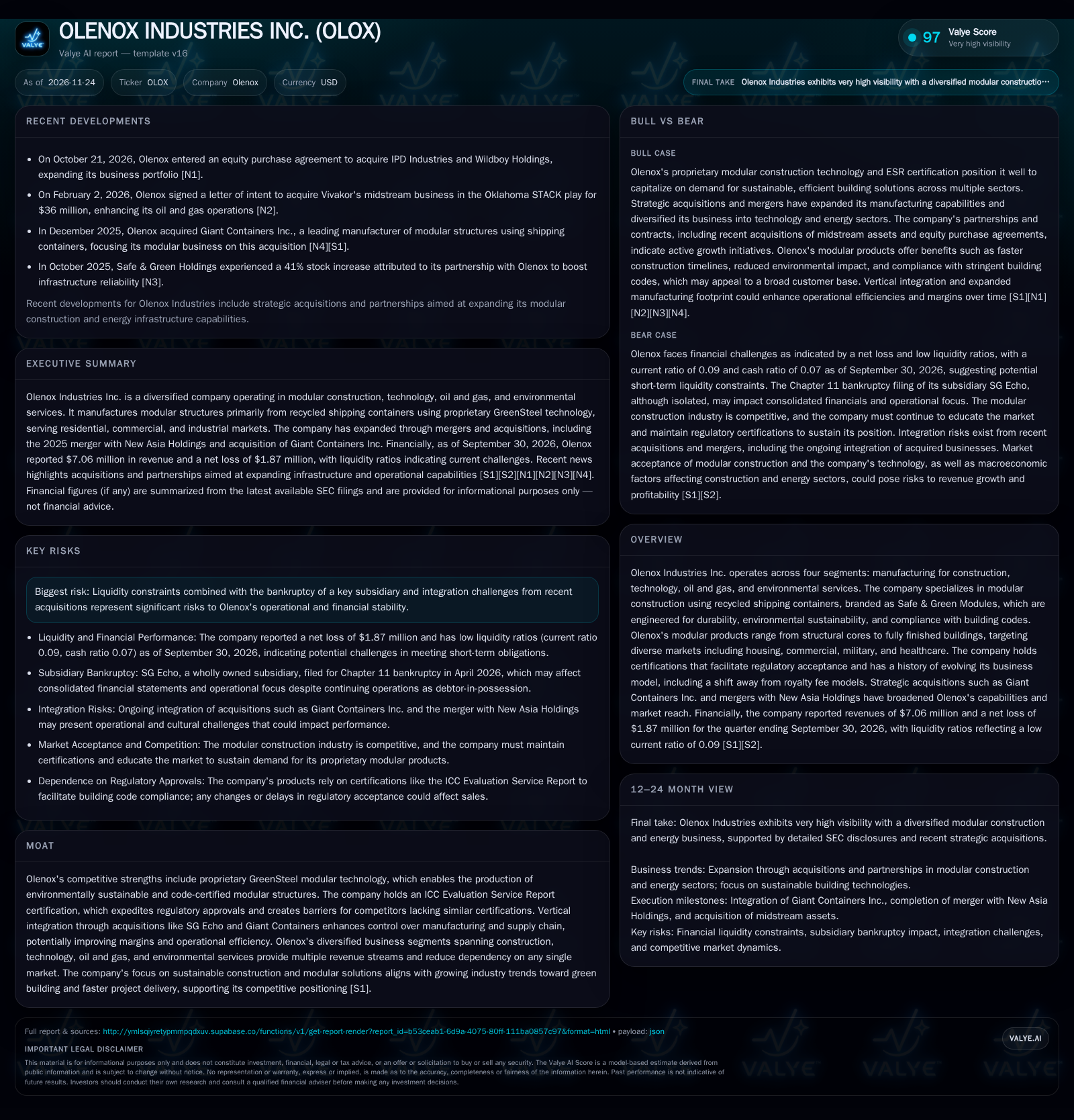
Olenox Industries is attempting to scale a multi-segment business anchored in modular construction using recycled shipping containers and proprietary technology. Recent acquisitions expand its reach into energy and technology, but the company faces acute liquidity pressures and bankruptcy at a key subsidiary. The long-term thesis hinges on Olenox's ability to integrate acquisitions, achieve sustainable margins, and manage capital needs in a sector where speed, cost, and regulatory compliance are critical advantages [S1] [S2] [N1] [N2].
Olenox Industries is navigating a pivotal period: its modular construction business, built on proprietary GreenSteel technology and recycled shipping containers, is aggressively expanding through acquisitions and new market entries. However, the company’s ambitions are checked by acute liquidity pressures and the bankruptcy of its modular subsidiary, SG Echo. Olenox’s future depends not just on the appeal of sustainable, rapid-construction modules, but also on its ability to integrate diversified operations, restore financial stability, and win market share in a sector where capital, credibility, and execution are unforgiving gatekeepers.
Liquidity Crunch and Acquisition Drive Define Olenox’s Current Trajectory
Olenox Industries’ latest financial snapshot reveals both expansion and strain: for the quarter ending September 30, 2026, the company posted $7.06 million in revenue and a net loss of $1.87 million. Its cash and equivalents stood at $3.02 million, dwarfed by current liabilities of $40.51 million, resulting in a precarious current ratio of 0.09 and a cash ratio of just 0.07 [S2].
Amid these pressures, Olenox has pursued multiple acquisitions: Giant Containers Inc. (December 2025), a letter of intent to acquire Vivakor’s midstream business for $36 million (February 2026), and an equity purchase agreement for IPD Industries and Wildboy Holdings (October 2026) [S1] [N1] [N2].
Notably, SG Echo, Olenox’s modular manufacturing subsidiary, filed for Chapter 11 bankruptcy in April 2026 but continues to operate as debtor-in-possession. The bankruptcy is isolated to SG Echo, but it underscores operational and financial risk at the heart of Olenox’s modular business [S1].
Modular Construction Economics: Promise and Pitfalls
Olenox’s business model is built around manufacturing modular structures from recycled shipping containers, leveraging its proprietary GreenSteel technology. Products range from basic cores to fully finished, ready-to-occupy buildings, targeting residential, commercial, and industrial markets [S1].
Modular construction offers potential economic advantages: factory-based manufacturing can reduce labor costs, accelerate project timelines, and enable higher quality control versus traditional construction. These efficiencies, in theory, should support lower per-unit costs and enable Olenox to compete on speed and price, particularly in markets where construction labor is scarce or expensive.
However, the economics are capital intensive. Upfront investments in manufacturing capacity, inventory, and logistics are substantial, and working capital cycles can be long—especially when serving large-scale or government projects. Olenox’s current liquidity snapshot suggests that the company may struggle to fund ongoing operations and absorb acquisition costs without new capital or improved cash conversion [S2].
Vertical integration through acquisitions like Giant Containers and entry into oil & gas and technology segments could eventually provide margin leverage and cross-segment synergies, but integration costs and complexity may weigh on near-term profitability.
Navigating a Crowded and Evolving Modular Marketplace
Olenox’s competitive positioning is anchored in its proprietary GreenSteel technology and ICC ESR certification, which may facilitate faster regulatory approvals and set it apart from smaller or less credentialed competitors [S1].
The modular construction industry, however, is characterized by both established players and a growing cohort of startups—many touting their own sustainability credentials or innovative manufacturing processes. Competing platforms may focus on traditional modular wood-frame or steel-frame systems, volumetric modular, or hybrid prefab approaches.
Customer decision factors often include cost, speed, customization, code compliance, and sustainability. Olenox’s emphasis on recycled materials and LEED point contributions may resonate with environmentally conscious buyers, municipalities, and large corporates seeking to meet ESG targets. Yet, mainstream adoption of container-based modular construction can be hampered by perceptions of limited design flexibility, potential insulation/thermal challenges, and regulatory hurdles in certain jurisdictions.
Diversification into oil & gas and technology via recent acquisitions may help Olenox buffer construction cyclicality, but also exposes it to new sets of competitors—ranging from established energy service providers to specialized IoT and infrastructure technology firms.
How Olenox Could Turn Integration into a Platform for Growth
The bull case for Olenox rests on successfully integrating its acquisitions to create a vertically integrated platform that delivers sustainable modular solutions across construction, energy, and technology verticals. If the company can leverage Giant Containers’ manufacturing expertise and capacity, while cross-selling technology and energy services, it could drive higher utilization, improved gross margins, and differentiated offerings.
Wider adoption of modular construction—driven by labor shortages, ESG mandates, and regulatory support—could expand the addressable market and enable Olenox to scale rapidly. The ICC ESR certification, if recognized by major institutional buyers and regulators, could accelerate project wins and reduce sales cycles.
Confirmation of this scenario would come from evidence of improved operating margins, successful completion of large-scale projects with repeat customers, and stabilized or improving liquidity metrics despite ongoing expansion. A pipeline of contracted backlog, if disclosed, and positive operating cash flow would further validate the thesis.
Managing Through Capital Constraints While Seeking Market Traction
The most plausible outlook is one where Olenox continues to win projects and expand its modular footprint, but remains constrained by reported liquidity position and integration complexity. Revenue may grow incrementally as new acquisitions contribute, but margin expansion could be offset by working capital needs, restructuring costs at SG Echo, and ongoing investment in regulatory compliance and product development.
Market adoption of Olenox’s modular solutions is likely to be gradual, with project-based revenue subject to lumpy timing and competitive bidding. Diversification into oil & gas and technology may provide some revenue smoothing, but also introduces execution and integration risks.
If disclosed, a mix of one-off project wins and a modest pipeline of repeat customers would support this trajectory.
Liquidity Pressures and Subsidiary Bankruptcy Could Derail Expansion
The bear case centers on Olenox’s acute liquidity crunch and the operational fallout from SG Echo’s bankruptcy. If the company cannot secure new financing or rapidly convert projects into cash, it may be forced to curtail operations, delay integration of acquisitions, or divest assets at distressed valuations.
Bankruptcy at SG Echo could spill over if cross-defaults, supply chain disruptions, or reputational damage impair Olenox’s broader modular business. Integration of newly acquired businesses could stall, resulting in lost customers or erosion of acquired value.
Confirmation of this scenario would include further deterioration in liquidity ratios, delays or cancellations of announced acquisitions, missed payroll or supplier payments (if disclosed), and increasing reports of project delays or customer attrition.
Milestones That Will Determine Olenox’s Ability to Scale and Survive
Updates on the resolution of SG Echo’s bankruptcy—such as emergence from Chapter 11, sale of assets, or impact on ongoing modular projects—would signal operational stability or further risk.
Evidence of successful integration and revenue contribution from recent acquisitions (Giant Containers, IPD Industries, Wildboy Holdings, Vivakor’s midstream assets) would indicate progress toward diversification.
If disclosed, a growing backlog of contracted modular projects and repeat customer wins would support the thesis of scalable demand.
Any new regulatory hurdles or loss of ICC ESR certification would be a negative inflection point for Olenox’s modular business.
Gross margin trends and disclosures around manufacturing utilization rates would provide insight into whether vertical integration is delivering expected efficiencies.
Announcements of additional capital raises, asset sales, or restructuring efforts would provide clues to near-term financial viability.
Market acceptance metrics—such as customer testimonials, industry awards, or LEED/ESG project milestones—would help validate Olenox’s differentiation in the modular construction market.
Disclaimer: This is research-only, informational analysis and not investment advice. It may include AI-generated interpretation and general industry context. Always verify important details using primary sources.

Comments