
CFN Enterprises: Wine Ambitions, Regulatory Shocks, and the Strain of Severe Liquidity Constraints
CFN Enterprises has repositioned itself as a multi-subsidiary wine and beverage platform, acquiring new distribution and IP assets while exiting its hemp business under legal duress. Despite expanded operational scope, the company faces acute financial distress, with auditors questioning its ability to continue as a going concern and liquidity ratios near zero.
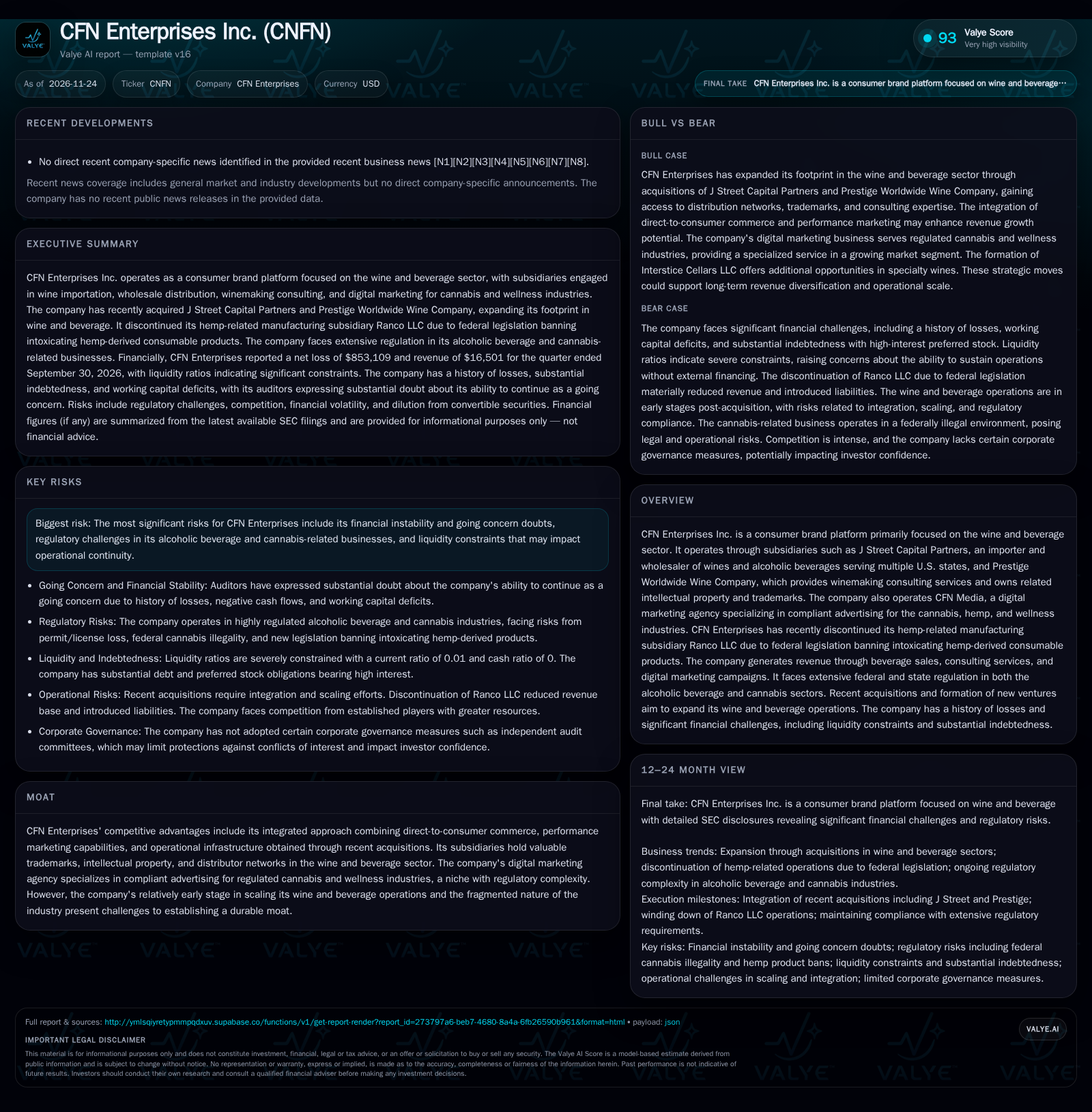
CFN Enterprises has rapidly expanded into wine and beverage distribution and consulting through recent acquisitions, but faces existential threats from a near-complete liquidity shortfall, significant debt, and large working capital deficits. The abrupt loss of its hemp co-packing business—forced by federal legislation—has compounded financial pressures, while regulatory demands and competitive intensity in both beverage and cannabis marketing continue to challenge any path to stable profitability. Execution on integration and operational scaling, as well as urgent balance sheet repair, are critical to the company's survival and any potential shareholder upside. [S1] [S2]
CFN Enterprises Inc. has sought to reinvent itself as a multi-pronged platform in the wine and beverage sector, leveraging recent acquisitions to expand its distribution, consulting, and intellectual property portfolio. With auditors raising going concern warnings and the company operating under the weight of substantial debt and regulatory complexity, the fundamental question is whether CFN can stabilize its platform and unlock value from its new assets before financial pressures force more drastic restructuring or asset sales.
Liquidity Crisis and Strategic Pivots Define the Current State
CFN Enterprises’ recent period is marked by two defining events: the acquisition of J Street Capital Partners and Prestige Worldwide Wine Company in 2025, and the discontinuation of its hemp manufacturing business (Ranco LLC) following a federal ban on intoxicating hemp-derived consumables effective November 2026. These actions have reoriented the company toward wine and beverage, but the transition has been financially punishing. At September 30, 2026, the company reported a current ratio of 0.01, a cash ratio of 0, and a working capital deficit of $25.5 million, with total debt of $7.5 million and a net quarterly loss of $853,109. Auditors have flagged substantial doubt about CFN’s ability to continue as a going concern for two consecutive years, highlighting the urgency of its liquidity and solvency challenges. [S1] [S2]
How the Integrated Beverage Platform Could Generate Profits—And Where the Model Strains
CFN Enterprises’ business model now revolves around three primary revenue streams: (1) wholesale and distribution of wine and alcoholic beverages through J Street, (2) winemaking consulting, IP licensing, and potential brand development via Prestige Worldwide Wine Company, and (3) digital marketing campaigns for the cannabis and wellness sectors through CFN Media. In theory, the platform could benefit from direct-to-consumer commerce, performance marketing synergies, and margin capture from vertically integrated distribution and brand building.
However, the economics of wine distribution are notoriously low-margin and working capital intensive—distributors typically face extended receivables, heavy inventory requirements, and costly compliance. Consulting and IP licensing may offer higher gross margins, but scaling requires substantial brand equity and client acquisition. The media agency segment is exposed to regulatory volatility and fluctuating demand in cannabis and wellness marketing. Fixed costs from regulatory compliance, debt service (including 12% preferred stock), and overhead remain high relative to the company’s modest and recently diminished revenue base, limiting operating leverage. The legacy of negative cash flows and the need to finance integration, inventory, and marketing initiatives further strain capital needs.
Can a Niche Platform Stand Out in Fragmented, Heavily Regulated Markets?
CFN’s competitive position is shaped by its attempt to combine distribution scale, proprietary brands, and specialized marketing under one roof—an approach that, if executed, could create cross-segment synergies and modest switching costs for beverage partners. The company’s assets include trademarks, proprietary formulations, and a nascent distribution network across several key states. Yet, the wine and beverage sector is deeply fragmented and dominated by entrenched distributors, established brands, and regional specialists with stronger balance sheets and entrenched customer relationships.
In cannabis and wellness marketing, regulatory complexity creates barriers to entry but also exposes CFN Media to sudden legal or advertising platform policy shifts. Larger competitors in both beverage and digital marketing typically enjoy better access to capital, broader distribution footprints, and more robust compliance infrastructure. Without demonstrable brand pull, sustained DTC traction, or unique IP, CFN’s ability to defend margin or retain partners in either segment remains uncertain.
Unlocking Value from Integration and Regulatory Clarity
A favorable scenario for CFN Enterprises would require rapid and successful integration of J Street and Prestige operations, enabling the company to leverage its distribution network for both owned and third-party brands, and to monetize its consulting and IP portfolio. If the beverage segment can achieve meaningful volume growth and improve mix toward higher-margin proprietary brands or consulting services, while controlling inventory and receivables, the platform could begin to deliver positive operating leverage.
Regulatory stability—particularly in the cannabis and beverage sectors—would be essential, reducing compliance costs and opening new marketing opportunities for CFN Media. Evidence supporting this scenario would include sustained quarter-over-quarter revenue growth from beverage operations, gross margin expansion, improved receivables turnover, and a narrowing of net losses. External financing or asset sales that reduce debt and bolster working capital would further confirm a viable turnaround.
Operational Strain and Uncertain Path to Stability
In a base case, CFN Enterprises continues to face significant operational and financial strain as it attempts to integrate its recent acquisitions and rebuild its revenue base following the loss of Ranco LLC. The wine and beverage operations may achieve incremental growth, but the combination of low margins, high compliance costs, and working capital constraints could limit the pace of improvement. The company may need to rely on external financing or asset sales to address immediate liquidity needs, but such measures could be highly dilutive or only provide temporary relief.
Regulatory uncertainty in both the beverage and cannabis sectors may persist, requiring ongoing investment in compliance and risk management. While the company could stabilize its operations if integration efforts yield cost savings or cross-segment synergies, the absence of clear evidence of margin expansion or cash flow improvement would keep the risk of further restructuring or distress elevated.
Liquidity Exhaustion and Forced Asset Sales
In the adverse case, CFN Enterprises could exhaust its remaining cash and find itself unable to meet near-term obligations, leading to creditor actions, forced sales of recently acquired assets, or an outright restructuring. The company’s inability to generate positive operating cash flow, combined with high-interest obligations and large current liabilities, creates a narrow margin for error.
Additional regulatory shocks—such as further restrictions in beverage or cannabis advertising—or integration failures could accelerate financial distress. Signs of this scenario would include default on debt or preferred stock, fire-sale divestitures of J Street or Prestige assets, and the inability to maintain required licenses or permits. Any further legal or compliance liabilities would worsen the outlook.
Milestones and Data Points That Will Shape CFN’s Survival or Recovery
Quarterly beverage segment revenue and gross margin trends—if disclosed—will indicate whether acquisitions are translating into operational scale and improved economics.
Receivables turnover and inventory days for J Street and Prestige, as evidence of working capital management and discipline in a cash-constrained environment.
Quarterly cash flow from operations and any material changes in cash or current assets, to track the pace of liquidity depletion or stabilization.
Updates on asset sales, external financing, or restructuring efforts—including dilution, debt renegotiation, or preferred stock conversions.
Progress reports on the integration of J Street and Prestige operations, including any synergies, cost savings, or cross-selling achievements.
Regulatory developments impacting beverage distribution, cannabis, or wellness marketing—especially any new federal or state restrictions or enforcement actions.
Changes in auditor opinion or management disclosure regarding going concern status and risk mitigation plans.
Client retention and new business wins in CFN Media, as a gauge of marketing segment resilience and potential for margin recovery.
Disclaimer: This is research-only, informational analysis and not investment advice. It may include AI-generated interpretation and general industry context. Always verify important details using primary sources.

Comments