
Elastic N.V.: AI-Driven Search Platform Expands, But Competitive and Concentration Risks Persist
Elastic’s AI-powered search and analytics platform continues to gain traction with major enterprise customers, supported by a robust subscription model and global reach. However, execution challenges and competitive pressures from larger cloud and AI vendors remain central to the evolving thesis.
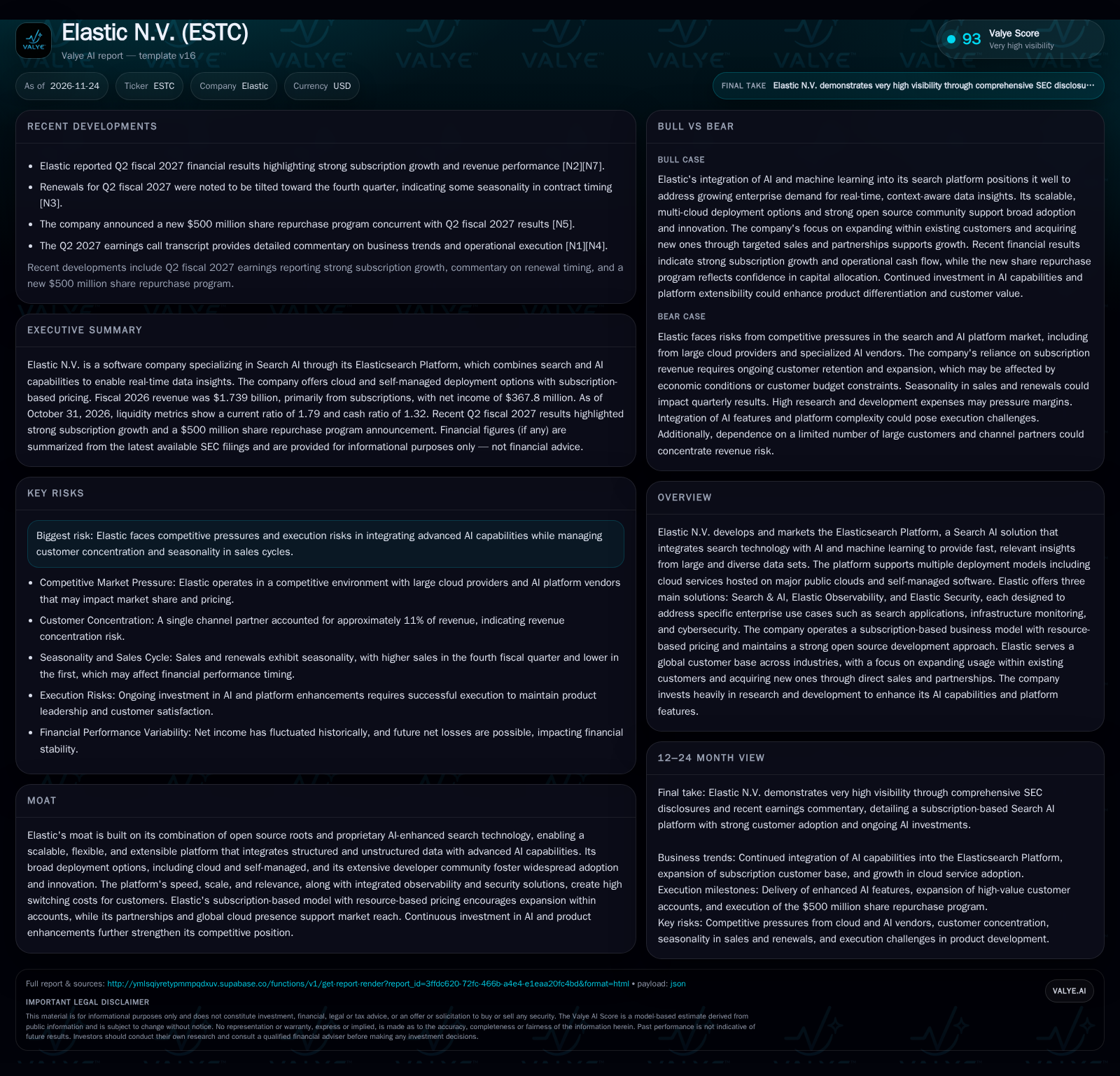
Elastic N.V. (ESTC) reported $1.739 billion in FY 2026 revenue, with 94% from subscriptions and an expanding international presence. The company had 24,000 customers as of April 2026, including a substantial number of high-value accounts. A new $500 million share repurchase program was announced in conjunction with Q2 fiscal 2027 results. The business model is subscription-driven, leveraging resource-based pricing, and the company continues to invest heavily in AI and platform development. While the platform’s flexibility and integration with major cloud providers offer adoption advantages, customer concentration and competitive threats from hyperscalers and specialized AI vendors remain key issues. [S1] [S2] [N5]
Elastic N.V. stands at a critical inflection point as it deepens the integration of AI and machine learning across its core search, observability, and security offerings. With nearly all revenue now coming from subscriptions and a growing roster of high-value global customers, Elastic’s scalable platform and open-source roots underpin its expansion strategy. Yet, as the company embarks on a $500 million share buyback and continues heavy R&D investment, the sustainability of its growth will hinge on successfully navigating intense competition, customer concentration, and the complexity of delivering differentiated AI-powered solutions at scale.
Recent Performance and Strategic Moves Shape Elastic’s Trajectory
Elastic reported $1.739 billion in revenue for the fiscal year ended April 30, 2026, with 94% coming from subscriptions, highlighting the predominance of its recurring revenue model. As of April 2026, the company served approximately 24,000 customers, including a notable cohort of high-value accounts spending over $100,000 or $1 million annually. International customers contributed 46% of revenue, evidencing Elastic’s global penetration. Liquidity as of October 31, 2026, included $744.9 million in cash and equivalents and $677.7 million in short-term investments, yielding a current ratio of 1.79. The company announced a new $500 million share repurchase program in conjunction with its Q2 fiscal 2027 results, signaling capital allocation confidence. [S1] [S2] [N5]
Subscription Economics, Resource-Based Pricing, and the Leverage of AI Investment
Elastic’s business model is anchored in subscriptions, which account for the vast majority of revenue. The company employs resource-based pricing for its cloud offerings—customers pay based on their consumption of compute, storage, and data transfer—creating a direct link between platform usage and revenue. Self-managed deployments blend free and paid proprietary features, encouraging broad adoption while offering upsell opportunities to premium tiers. This model enables Elastic to land accounts with low initial friction and expand contract value as enterprise needs scale.
Heavy R&D investment ($451.9 million in FY 2026) is a double-edged sword: it funds rapid feature innovation, particularly in AI and machine learning, but also pressures margins. Operating leverage is plausible as fixed platform costs are spread across a growing customer base, but the company’s ongoing need to differentiate against larger, better-resourced competitors may constrain margin expansion. Elastic’s cloud services, delivered via AWS, GCP, and Azure, also expose the company to variable infrastructure costs and potential margin compression if hyperscalers alter terms or pricing.
Capital needs are currently met through strong operating cash flow ($326.9 million in FY 2026) and significant liquidity reserves, but the company’s aggressive investment cadence suggests a continued need for disciplined capital allocation as growth opportunities and competitive threats evolve. [S1] [S2]
Open Source Roots, Platform Breadth, and the Shadow of Hyperscaler Competition
Elastic’s competitive differentiation is rooted in its open source heritage, extensible single-codebase architecture, and robust developer community. The platform’s ability to integrate structured and unstructured data, support hybrid/multi-cloud deployments, and offer proprietary AI features enables broad applicability across industries and use cases. The company’s three solution pillars—Search & AI, Observability, and Security—allow cross-sell and account expansion.
However, Elastic faces formidable competition from two fronts: hyperscale cloud providers (AWS, Azure, GCP) that increasingly offer native search, analytics, and AI tools, and specialized AI platform vendors that may outpace Elastic in deep learning and generative AI capabilities. The risk is compounded by customer concentration—one channel partner accounted for about 11% of revenue—as well as the possibility that large customers may shift workloads to bundled offerings from their primary cloud providers. Switching costs are elevated by platform integration and operational dependencies, but not insurmountable for large enterprises with substantial IT budgets.
Elastic’s open source model is a double-edged sword: it accelerates adoption and community innovation but can also enable competitors to fork or replicate core capabilities, potentially eroding differentiation unless proprietary features and AI integration remain a step ahead. [S1]
AI-Led Differentiation and Cloud Expansion Accelerate Account Growth
A favorable scenario sees Elastic’s sustained investment in AI and machine learning yielding differentiated features—such as advanced anomaly detection, vector search, and seamless LLM integration—that drive adoption among both new and existing enterprise customers. The company’s cloud-based resource pricing could benefit from rising data volumes and more complex analytics workloads, leading to expansion in average contract value and a higher proportion of seven-figure customers.
If Elastic’s platform continues to outpace competitors in usability, extensibility, and integration of structured/unstructured data, customer lock-in could deepen, raising switching costs and reducing churn. International expansion, aided by the flexibility of multi-cloud and hybrid deployment, could further diversify revenue away from US-centric risks. Evidence for this scenario would include accelerating growth in high-value accounts, increasing cloud ARR, higher net revenue retention, and visible customer wins in AI-driven use cases. Sustained margin improvement alongside top-line growth would also support the upside thesis.
Sustained Subscription Growth, But Margin and Concentration Risks Persist
The most plausible near-term path is continued steady growth in subscription revenue, driven by the expansion of use cases within existing customers and incremental wins in both cloud and self-managed segments. Elastic is likely to maintain its R&D intensity to keep pace with rapid AI innovation, resulting in ongoing margin pressure even as revenue rises. Customer concentration remains a manageable but persistent risk, particularly if key channel partners or large enterprise customers re-evaluate their platform choices.
Elastic’s global reach and multi-cloud capabilities provide resilience, but hyperscaler competition could limit pricing power or force further product differentiation. Evidence confirming the base scenario would include consistent, though not accelerating, growth in customer count and ARR, stable or modestly improving operating margins, and continued reported liquidity position without the need for external capital raises.
Competitive Encroachment and Customer Losses Trigger Margin Compression
The adverse scenario materializes if large cloud providers or specialized AI vendors close the gap in search and analytics capabilities, commoditizing Elastic’s core value proposition. Aggressive bundling or pricing by hyperscalers could drive customers to migrate workloads, especially if Elastic’s proprietary AI features fail to maintain a clear lead. Customer concentration amplifies this risk—a loss of one or more large accounts or channel partners could materially impact revenue visibility.
In this environment, Elastic may be forced to increase spending on sales, marketing, and R&D to defend share, further eroding margins. Stagnant or declining ARR, rising churn, and a shift toward lower-value customers would confirm the downside case. Inability to demonstrate clear AI-driven differentiation in real-world customer deployments would be a warning sign, as would any signs of deteriorating net cash from operations.
Metrics and Milestones That Will Define Elastic’s AI Platform Thesis
Growth in high-value customer accounts (>$100,000 and >$1 million ARR) would help confirm Elastic’s ability to expand contract value and deepen enterprise adoption.
Cloud annual recurring revenue (ARR) and the proportion of total revenue from cloud services would provide insight into Elastic’s success in shifting workloads to higher-margin, scalable offerings—if disclosed.
Net revenue retention rates, particularly among large enterprise customers, would test the strength of Elastic’s land-and-expand model and customer stickiness—if disclosed.
Churn rates and customer concentration metrics (e.g., revenue share from top 10 accounts and channel partners) would help assess vulnerability to competitive encroachment and account loss—if disclosed.
R&D expense trends relative to revenue growth and margin trajectory will indicate whether heavy investment is translating into sustainable differentiation.
Evidence of tangible AI-driven product enhancements (such as new LLM integrations, vector search adoption, or real-world customer case studies) would validate the product leadership narrative.
International revenue mix and expansion into new geographies would test the platform’s global reach and resilience to US-centric risks.
Disclaimer: This is research-only, informational analysis and not investment advice. It may include AI-generated interpretation and general industry context. Always verify important details using primary sources.

Comments