
City Therapeutics: Cash-Fueled Pipeline Progress Meets the Realities of Early-Stage Biotech Risk
With a $200 million IPO and reported liquidity position, City Therapeutics is positioned to advance multiple therapeutic candidates toward crucial 2027 readouts—but faces the classic uncertainties of clinical execution, operational cost control, and capital market dependence.
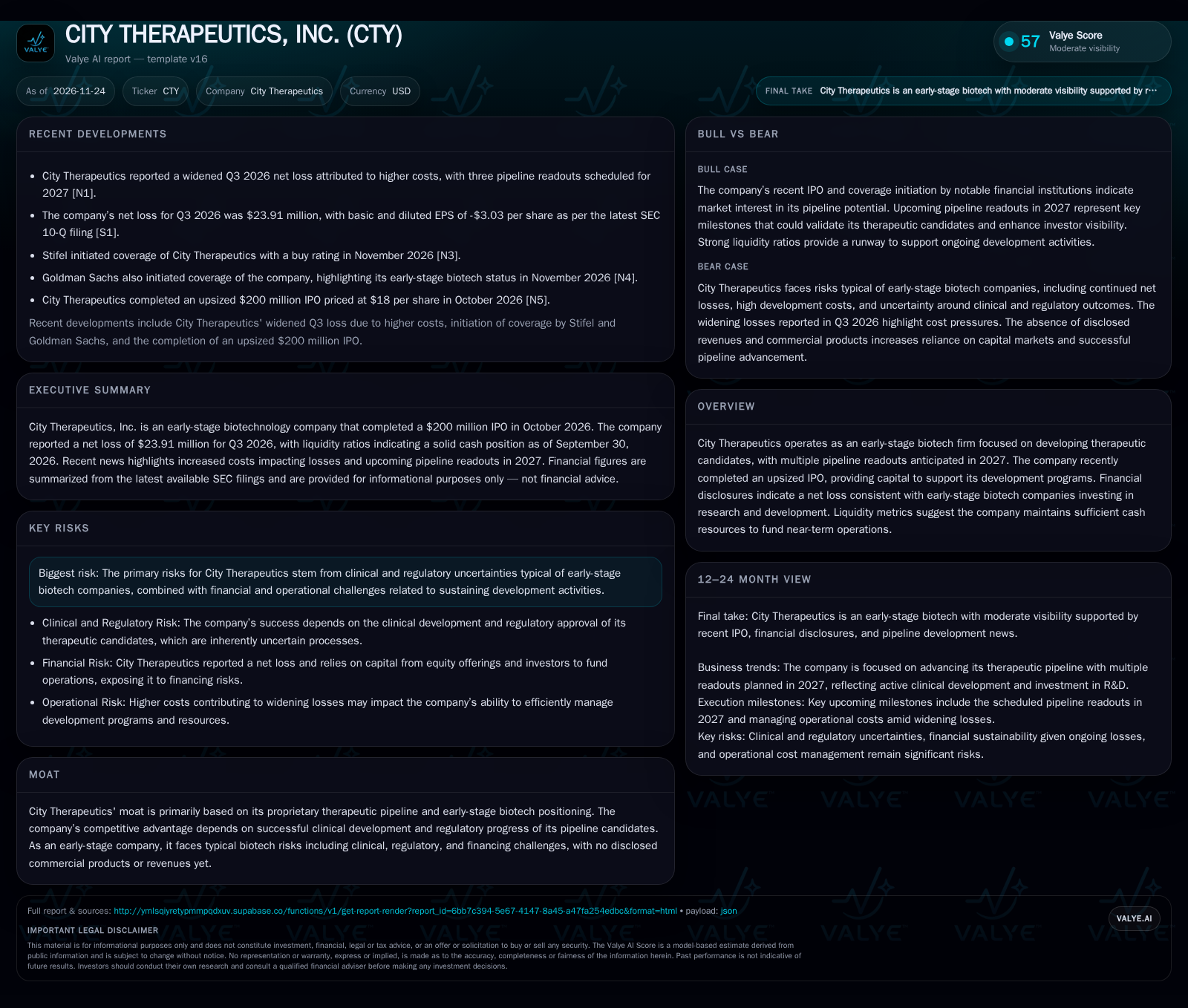
City Therapeutics raised $200M in its October 2026 IPO and ended Q3 with $142M in cash. Despite widening losses, the company’s liquidity supports ongoing R&D and three pipeline readouts expected in 2027. The investment case hinges on upcoming clinical data, with financial sustainability and execution risk remaining central concerns. [S1] [N1] [N5]
As major sell-side firms initiate coverage, investors are left weighing the potential for breakthrough validation against the perennial risks of development setbacks and cost escalation.
IPO Proceeds Bolster Cash as Losses Mount Ahead of 2027 Pipeline Readouts
City Therapeutics completed an upsized $200 million IPO at $18 per share in October 2026, providing a substantial infusion of capital. As of September 30, 2026, the company reported $141.99 million in cash and cash equivalents and current assets of $146.58 million, with a current ratio of 2.4 and a cash ratio of 2.33—metrics that demonstrate a reported liquidity position for an early-stage biotech. However, Q3 2026 saw net losses widen to $23.91 million, attributed to higher costs, likely reflecting increased R&D activity as the company advances its pipeline. The next major milestones are three clinical readouts scheduled for 2027, which will be critical in determining the value of City Therapeutics’ development programs and its ability to attract further investment or partnership. [S1] [N1] [N5]
R&D Investment Drives Cash Burn; Future Economics Hinge on Clinical Success and Partnering
City Therapeutics’ business model is characteristic of early-stage biotech: heavy upfront R&D spending, no disclosed product revenue, and full reliance on external capital. The $23.91 million quarterly net loss reflects the high fixed costs of running clinical programs, regulatory preparation, and maintaining a skilled scientific team. With $142 million in cash, the company appears funded for several quarters of development, especially given the absence of commercial manufacturing or sales infrastructure at this stage.
The company’s path to value creation depends on successful clinical development and regulatory approval. If one or more pipeline candidates deliver positive data in 2027, City Therapeutics could pursue lucrative licensing deals, partnerships, or eventual commercialization. Such deals often involve upfront payments, milestone-based cash flows, and royalties, providing non-dilutive funding and leverage for additional R&D. Conversely, negative or inconclusive readouts would likely force the company to raise additional capital on less favorable terms or to reprioritize its pipeline.
The economics of City Therapeutics’ R&D investment also depend heavily on the efficiency of its clinical trial design and execution. Adaptive trial designs or platform trial approaches, if employed, could reduce time and cost to pivotal data readouts, thereby extending the cash runway and enhancing capital efficiency. Conversely, traditional sequential trials with high patient enrollment requirements could amplify burn and delay value inflection points. Moreover, the company’s ability to leverage external innovation through collaborations or in-licensing could diversify risk and optimize resource allocation. The timing and structure of potential licensing deals will be critical, as early-stage biotechs often face valuation challenges that influence deal terms and the balance between upfront and milestone payments.
Pipeline Differentiation and Platform Potential Versus Intense Biotech Competition
City Therapeutics’ competitive position is currently defined by the promise of its proprietary therapeutic pipeline, which remains largely unvalidated in the public domain. The company’s ability to establish a durable advantage will hinge on demonstrating clinical efficacy and safety that differentiates its candidates from both established therapies and the crowded field of other development-stage biotechs. Early-stage biotech is a high-risk, high-reward sector, with many competitors racing to address overlapping indications, often with similar modalities.
Switching frictions are low for customers (patients, physicians, payers) until products reach the market and demonstrate either superior outcomes, lower costs, or better delivery mechanisms. Should City Therapeutics’ readouts be positive, intellectual property protection and the potential for platform expansion may confer some defensibility. However, the lack of disclosed commercial products or partnerships means there is currently no evidence of network effects, high switching costs, or entrenched market share.
In assessing competitive positioning, it is also relevant to consider the evolving regulatory and reimbursement landscape that could impact the commercial viability of City Therapeutics’ candidates. Even with clinical differentiation, payer acceptance may hinge on demonstrated cost-effectiveness or real-world outcomes, which are typically established post-approval but can influence earlier development strategies. Additionally, the company’s platform potential may be enhanced by modularity or adaptability to emerging therapeutic modalities, such as gene editing or novel delivery systems, which could create longer-term competitive moats. However, the rapid pace of innovation in biotech means that technological obsolescence remains a risk, underscoring the need for ongoing pipeline renewal and intellectual property management.
Breakthrough Readouts Catalyze Partnerships and Transform Funding Outlook
In a favorable scenario, City Therapeutics’ 2027 pipeline readouts deliver robust efficacy and safety data, validating the underlying science and attracting interest from larger biopharma partners. This could lead to non-dilutive capital infusions through licensing or collaboration agreements, accelerating further development and potentially supporting a transition to late-stage trials or regulatory submission. If the company’s platform demonstrates applicability across multiple indications, it could command premium valuations and improve its negotiating leverage.
Evidence that would confirm this scenario includes: positive top-line clinical results disclosed in 2027; announcements of major partnership or licensing deals; and an increase in R&D pipeline breadth or external funding commitments. Conversely, delays in trial timelines, marginal efficacy, or safety concerns would challenge this narrative and undermine the investment case.
Clinical Progress with Mixed Results and Ongoing Cash Burn Define the Next Phase
The most plausible trajectory for City Therapeutics is incremental clinical progress, with at least some pipeline readouts in 2027 providing signals of efficacy but not definitive proof of commercial viability. Absent clear breakthrough data, City Therapeutics may need to raise additional equity or seek smaller-scale partnerships to continue operations.
Confirmation of this scenario would come from timely pipeline updates that show progress but do not trigger major partnerships or transformative funding. Signs of continued net losses, moderate R&D expansion, and periodic capital raises would reinforce a status quo of steady but unproven advancement. This scenario would be challenged if either a major clinical win or a significant setback sharply alters the company’s risk profile or funding needs.
Clinical Setbacks and Cost Escalation Force Dilution or Strategic Retrenchment
The principal risk is that one or more of City Therapeutics’ lead candidates fail to meet clinical endpoints in 2027, resulting in a loss of investor and partner confidence. Coupled with continued high operating costs and no product revenue, this would force the company to seek additional dilutive financing or to cut back its R&D footprint. In severe cases, the company could be forced to out-license assets at distressed valuations or wind down certain programs entirely.
Early warning signs for this scenario would include negative or inconclusive clinical data, missed pipeline milestones, further widening of quarterly losses, or difficulty raising capital on reasonable terms. An inability to secure partnerships or meaningful external validation would further erode the company’s strategic options.
Milestones That Will Determine If City Therapeutics Can Deliver on Its Promises
The outcome and timing of the three major pipeline readouts scheduled for 2027 are pivotal; positive top-line results would meaningfully alter the company’s outlook. [N1]
Quarterly net cash burn and updates to R&D spending will show whether the company is maintaining cost discipline or facing unsustainable escalation. If disclosed, tracking quarterly operating cash flow trends would help test this thesis. [S1]
Announcements of partnership, licensing, or collaboration deals with larger biopharma firms would indicate external validation and non-dilutive funding potential.
Disclosures of additional capital-raising activity—such as follow-on offerings or debt issuance—would signal the adequacy (or inadequacy) of current liquidity for ongoing operations.
Progress in expanding the pipeline or advancing candidates into later-stage trials would demonstrate the platform’s scalability and management’s execution capability.
Any regulatory feedback or clinical trial delays reported would be early signals of execution risk that could impact timelines and investor confidence.
Changes in coverage or sentiment from major institutional analysts may influence market perception, but sustained value will ultimately depend on clinical and operational milestones.
Disclaimer: This is research-only, informational analysis and not investment advice. It may include AI-generated interpretation and general industry context. Always verify important details using primary sources.

Comments