
TV Channels Network: Exclusive Content Ambitions Collide with Early-Stage Financial Realities
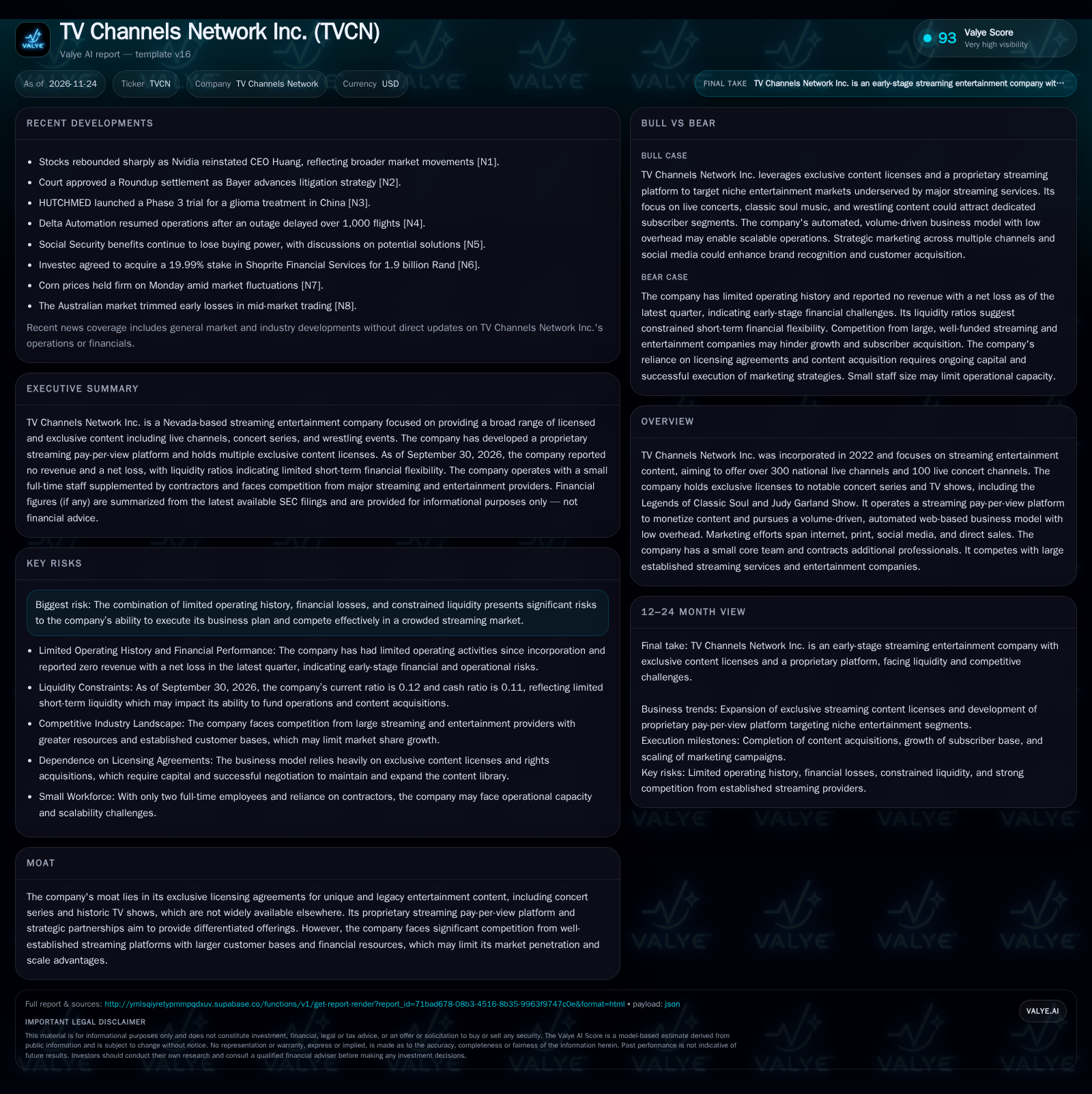
TV Channels Network Inc. is building a streaming platform around exclusive legacy concert and entertainment content, but with zero revenue and a strained liquidity profile, the business must quickly validate demand and monetize its differentiated library to survive the capital-intensive race against established streaming giants.
The company’s model targets niche audiences via automated, low-overhead operations, yet faces formidable competition and must rapidly prove content monetization to justify further investment and forestall operational risk. Execution on subscriber acquisition, content engagement, and financial runway will determine whether its unique content strategy can yield sustainable economics in a crowded market. [S1] [S2]
TV Channels Network Inc., a Nevada-based streaming startup, is betting on exclusive rights to legacy entertainment and concert content to carve out a place in the crowded digital media landscape. With ambitions to offer hundreds of live channels and a proprietary pay-per-view platform, the company is targeting niche audiences overlooked by mainstream streamers. The company’s future now hinges on its ability to convert unique content into paying users before financial constraints undermine its market entry.
Exclusive Content and Platform Launch, but No Revenue Traction Yet
TV Channels Network Inc. has secured exclusive streaming rights to a range of entertainment assets, including the Legends of Classic Soul Concert Series, PBS On Tour Concert Series, World Class Pro Wrestling, Lone Star Wrestling events, and 26 episodes of The Judy Garland Show. The company has also developed and launched a proprietary streaming pay-per-view platform intended to monetize these assets. Despite these foundational steps, as of September 30, 2026, the company reported zero revenue and a net loss of $28,947 for the quarter. The company reported a current ratio of 0.12 for the period. The company employs just two full-time staff and relies on contract professionals for operations. [S1] [S2]
These facts signal that while the content library and platform infrastructure may provide a unique market proposition, the company has yet to demonstrate actual consumer demand or monetization capability. The company reported cash and liquidity metrics for the period; these figures do not by themselves establish operating runway, investment capacity, financial flexibility, or financing capacity.
Volume-Driven Streaming: Margin Promise Versus Scale Realities
TV Channels Network’s economic thesis is built around high-margin, low-overhead streaming: once content licensing and platform development costs are incurred, incremental viewership should, in theory, drive gross margins upward thanks to the low variable cost structure of digital distribution. The company’s exclusive content may allow for differentiated pricing—especially through pay-per-view events or niche subscription bundles—targeting superfans of classic concerts, legacy TV, or wrestling.
However, the business is capital intensive upfront: acquiring and maintaining exclusive licenses, developing and marketing the platform, and securing technology infrastructure all require significant ongoing investment. With zero reported revenue, the company’s ability to cover fixed costs is unproven. The model’s success thus depends on achieving sufficient scale (in terms of active users and paid events) to offset these fixed investments, while keeping customer acquisition costs (CAC) manageable in a highly competitive environment.
In streaming, operating leverage can be substantial with a sufficiently large and engaged user base; without it, fixed costs rapidly erode capital. The company’s small core team and contract-heavy structure may help keep cash burn low, but could also limit pace and scope of execution, especially when rapid iteration or hands-on content curation is required.
Competing for Niche Audiences Against Scale-Driven Streaming Titans
TV Channels Network faces direct competition from major streaming providers such as Amazon Prime, Hulu, DIRECTV Now, and Netflix, as well as live event specialists like Live Nation and Clear Channel. These incumbents benefit from enormous content libraries, global distribution, established user bases, and deep marketing budgets—structural advantages that drive down per-user costs and make subscriber acquisition more difficult for new entrants. [S1]
The company’s main competitive angle is its exclusive, legacy-focused content: classic soul concerts, vintage TV, and wrestling events not widely available on mainstream platforms. If these assets resonate with dedicated niche audiences—particularly those underserved by current streamers—TV Channels Network could carve out a defensible segment. However, content exclusivity is a double-edged sword: it can drive initial interest, but if the target audience is too narrow or fails to convert to paying users, the business risks irrelevance.
Switching frictions in streaming are generally low; consumers can add or drop services with minimal hassle. This places a premium on unique value, strong community engagement, or integration with other services to foster retention. Without a sustainable pipeline of fresh exclusive content or network effects, customer stickiness may be limited.
If Niche Content Finds Its Audience: From Zero to Scalable Monetization
The most favorable outcome for TV Channels Network would see its exclusive legacy content catalyzing rapid audience acquisition in targeted niches—such as classic concert enthusiasts, nostalgia-driven TV fans, or wrestling communities. A successful marketing push (leveraging social media and referral partnerships) could drive awareness and initial trial. If the pay-per-view and subscription offerings prove compelling, the company could quickly transition from zero revenue to a base of recurring or event-driven income.
Confirmation of this scenario would be visible in a sharp uptick in paid user registrations, rising average revenue per user (ARPU), and the company’s ability to announce new exclusive content deals funded by early cash inflows. Positive user engagement metrics—such as high repeat purchase rates or social media buzz—would further validate product-market fit. Evidence of outside funding or strategic partnerships could extend the runway and support scaling efforts.
To falsify this upside, watch for stagnant or declining user growth, inability to convert trial users into paying customers, or negative feedback on content value.
Early Monetization Struggles and Cash Burn Define the Probable Near Term
The most plausible scenario is one in which TV Channels Network continues to struggle with early monetization, facing slow ramp-up of paying users while cash burn persists. Efforts to market exclusive content may yield some engagement, but not at the scale or conversion rates required to cover fixed costs or attract substantial new investment. The company may secure small-scale funding or bridge loans, but operational constraints—such as a tiny full-time staff and limited marketing reach—would hamper rapid iteration and growth.
Supporting evidence would include continued quarterly net losses, minimal or modest revenue growth, and persistent liquidity pressures. In this scenario, the company may be forced to scale back ambitions, renegotiate content licensing terms, or seek a strategic acquirer. Falsification would require evidence of break-out revenue growth or a substantial funding event that materially extends operational runway.
Liquidity Crunch and Execution Delays Could Force a Strategic Reset or Shutdown
If the company is unable to generate revenue quickly or raise additional capital, its acute liquidity deficit could precipitate a cash crunch, forcing it to halt operations, surrender content licenses, or enter into distressed asset sales. Execution delays—caused by limited staffing, technical issues, or weak marketing traction—could further erode confidence and exhaust remaining resources.
Confirmation of this downside scenario would be evident in missed payrolls, default on contractual obligations, public disclosure of going concern risks, or the abrupt departure of key personnel. If the company announces the termination of content licenses, winding down of platform operations, or a fire-sale to a competitor, the thesis of sustainable niche streaming would be effectively falsified.
Milestones That Will Test TV Channels Network’s Content Monetization Thesis
First reported revenue from pay-per-view or subscription services—any material figure would indicate initial market traction. [S2]
Growth in active user accounts or paid subscribers, if disclosed, to gauge audience adoption.
Details on new or renewed exclusive content licenses, which could expand addressable market or deepen user engagement.
Updates on fundraising or capital infusion events to relieve short-term liquidity constraints.
Disclosure of customer acquisition costs and retention rates, which would clarify the economic viability of the marketing model.
Changes in the company’s staffing or contractor base, signaling operational scaling or contraction.
Evidence of strategic partnerships with larger platforms, content owners, or distribution channels.
Any regulatory, legal, or contractual issues affecting the company’s ability to deliver or monetize licensed content.
Disclaimer: This is research-only, informational analysis and not investment advice. It may include AI-generated interpretation and general industry context. Always verify important details using primary sources.

Comments