
Brand Engagement Network: AI Platform Promise Collides with Structural and Financial Frictions
Brand Engagement Network Inc. (BNAI) has made strategic moves in AI-driven customer engagement, launching the iSKYE platform and forging partnerships in hospitality and mental health.
The company’s future will turn on its ability to resolve governance issues, secure non-dilutive funding, and prove durable commercial traction in its chosen verticals. [S2] [N1] [N4]
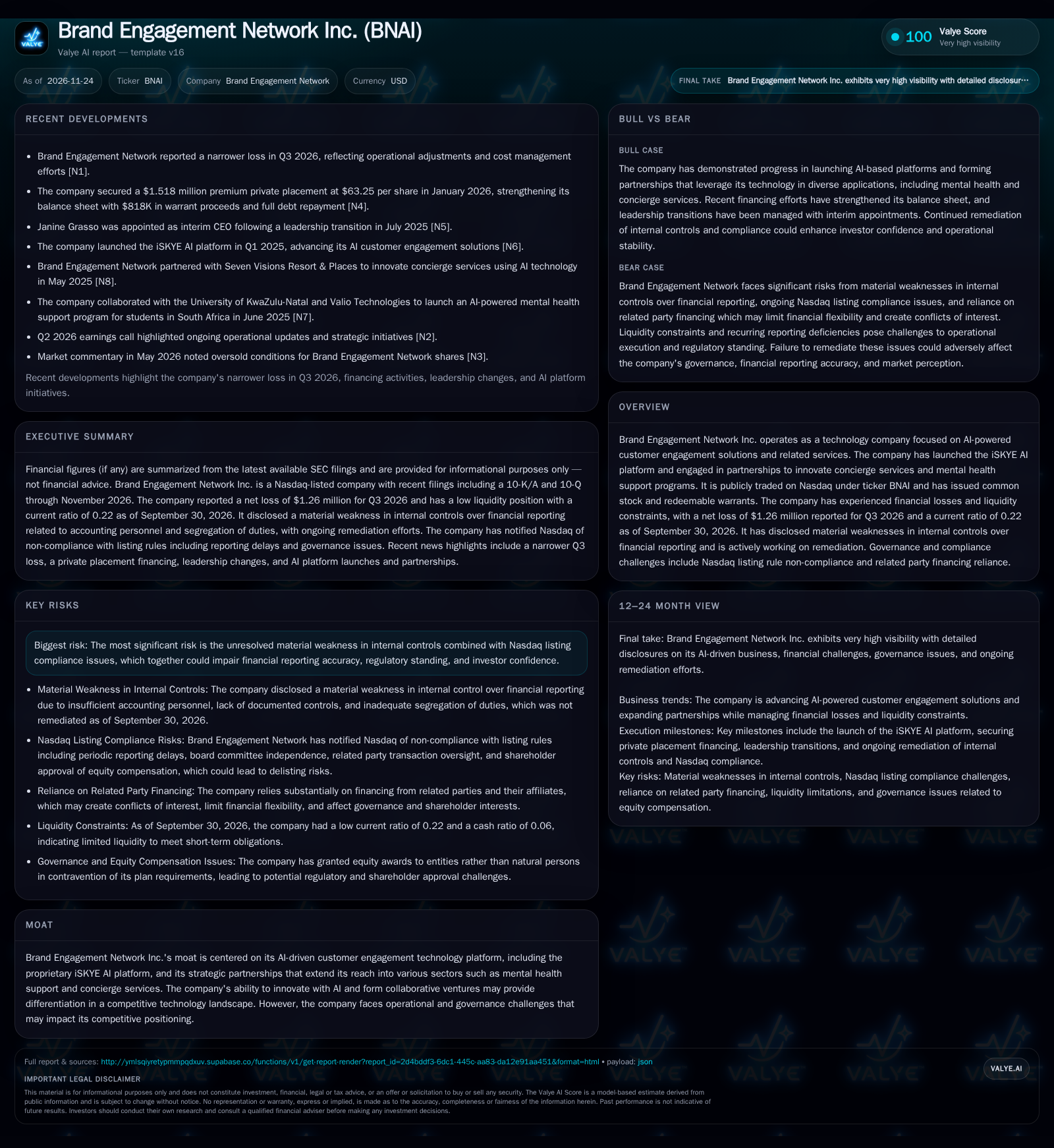
Brand Engagement Network Inc. sits at the intersection of AI innovation and acute structural fragility. Its iSKYE platform and AI-driven partnerships reflect credible ambition in customer engagement technology, but the company’s ability to capitalize on these initiatives is increasingly constrained by unresolved internal control failures, persistent liquidity shortfalls, and a pattern of governance lapses that threaten its Nasdaq listing. For BNAI, the next twelve months represent a defining test: can it convert technical promise and partnership momentum into durable commercial viability before regulatory and financial realities force a strategic reset?
Recent Moves: Platform Launches and Financial Strain Define the Present
Brand Engagement Network Inc. launched its proprietary iSKYE AI platform in early 2025, positioning the company to deliver AI-powered customer engagement solutions across hospitality and mental health verticals through partnerships with entities such as Seven Visions Resort & Places and the University of KwaZulu-Natal. These moves illustrate a clear intent to commercialize AI in real-world settings. The company also disclosed a $1.26 million net loss for Q3 2026, and ongoing material weaknesses in internal controls remain unresolved, despite remediation efforts. These factors, combined with continuing Nasdaq compliance issues, mean that operational progress is occurring in the shadow of existential financial and governance risks. [S2] [N1] [N6] [N7] [N8]
How the Economics of AI Engagement Could (or Could Not) Scale
Brand Engagement Network’s core business thesis rests on monetizing AI-powered customer engagement, where the iSKYE platform acts as the technological backbone. In theory, platform economics in this space are attractive: high upfront development costs may be offset by low incremental delivery costs, especially if sold as SaaS or usage-based licenses to enterprises in hospitality, healthcare, or other service-driven verticals. If the company can secure long-term contracts or recurring revenue streams from its partnerships, operating leverage could eventually turn positive as fixed costs are absorbed over a growing customer base.
However, current financial disclosures indicate negative operating leverage, with persistent net losses and a reported cash balance. The company’s reliance on related-party financing and episodic private placements (such as the $1.518 million raise in January 2026) suggests an inability to generate self-sustaining cash flows. Without clear evidence of recurring, high-margin software revenue or robust customer retention, the company’s economics remain speculative. The risk is that fixed costs in R&D and compliance will continue to outpace revenue, forcing further dilution or strategic retrenchment. [S2] [N4]
The scalability of AI engagement platforms like iSKYE hinges critically on the balance between customer acquisition costs and lifetime value. If Brand Engagement Network can secure enterprise clients with multi-year commitments, the amortization of initial onboarding and integration expenses over time could enhance unit economics. However, this assumes that the platform’s AI capabilities deliver measurable ROI improvements for clients, such as increased customer retention or operational efficiencies, which would justify sustained subscription fees. Conversely, if client outcomes are marginal or difficult to quantify, pricing power and contract renewals may suffer, undermining revenue predictability and margin expansion.
Another important consideration is the platform’s adaptability to diverse verticals and evolving client needs. AI engagement solutions must continuously incorporate new data sources, regulatory requirements, and user interaction modalities to remain competitive. The associated R&D and compliance costs can be substantial and ongoing. Therefore, the company’s ability to develop modular, update-friendly architectures and automate compliance workflows will influence long-term cost structures. Failure to manage these elements could erode gross margins and exacerbate liquidity pressures, especially if revenue growth is slow or uneven across sectors.
Competitive Pressures: Differentiation Versus Replicability in AI Solutions
The AI-powered engagement space is crowded, with numerous startups and established enterprise software companies targeting customer experience automation, virtual concierge, and mental health support. Brand Engagement Network’s iSKYE platform may offer differentiated features or integrations, but the barriers to entry in AI-driven SaaS are typically low unless protected by proprietary algorithms, exclusive data access, or sticky enterprise contracts.
Strategic partnerships in hospitality and education could create early credibility, but the durability of these relationships—and whether they translate into recurring, scalable revenue—remains unproven. Larger incumbents with deeper technical and commercial resources could rapidly replicate or outcompete similar offerings, especially if BNAI’s internal control and governance issues erode customer or investor trust. The company’s long-term edge will depend on its ability to demonstrate superior outcomes, integration depth, or unique datasets that competitors cannot easily match.
In addition to technical differentiation, Brand Engagement Network’s competitive positioning depends on its go-to-market strategy and ecosystem partnerships. Effective integration with existing enterprise software stacks, such as CRM or EHR systems, can increase switching costs and deepen customer relationships. However, building these integrations requires both technical resources and strong channel partnerships, which may be challenging under current financial constraints. Moreover, the company must navigate competitive dynamics where larger incumbents can bundle AI engagement features into broader offerings, potentially commoditizing standalone platforms like iSKYE unless they demonstrate unique value propositions.
Customer trust and data security also represent critical competitive factors in AI-driven engagement solutions. Given heightened regulatory scrutiny around data privacy, especially in healthcare and hospitality, Brand Engagement Network must ensure robust compliance frameworks and transparent data governance. Any lapses could not only invite regulatory penalties but also damage reputational capital, making customer acquisition and retention more difficult. Thus, the company’s internal control weaknesses and governance issues may indirectly amplify competitive risks by undermining stakeholder confidence in its operational integrity.
What Success Would Look Like: Commercial Traction and Governance Turnaround
In a favorable scenario, Brand Engagement Network successfully remediates its internal control weaknesses, restores Nasdaq compliance, and leverages its iSKYE AI platform to secure multi-year contracts with marquee customers in hospitality and mental health. These contracts would need to generate recurring, high-margin software revenue and serve as proof points for broader market adoption. If the company can demonstrate measurable improvements in customer engagement metrics or cost reductions for clients, it could justify premium pricing and attract additional enterprise customers.
Evidence confirming this scenario would include: a clean audit opinion on internal controls, public disclosure of contract wins with credible renewal terms, growing deferred revenue or backlog, and a shift from related-party to third-party or operational cash flow-based funding. A falsification would be continued reliance on insider financing, persistent reporting deficiencies, or customer churn.
Most Likely Trajectory: Incremental Progress with Ongoing Constraints
The most plausible near-term outcome is a period of incremental improvement in operations and governance, but with continued financial fragility. Brand Engagement Network may achieve modest commercial wins—such as pilot deployments or small-scale renewals—while making slow progress on internal control and compliance remediation. However, persistent liquidity constraints and the need for further dilutive financings will likely limit the company’s ability to scale or invest aggressively in product development and sales.
Confirming evidence would include gradual improvement in current ratio, reduced net losses, partial remediation of internal controls, and steady if unspectacular growth in reported customer engagements. Falsifying evidence would be a material worsening of liquidity, a new wave of regulatory sanctions or delisting threats, or the loss of key partnerships.
How Failure Manifests: Liquidity Exhaustion and Regulatory Fallout
A negative scenario would involve Brand Engagement Network’s liquidity eroding further, leading to missed payroll or vendor payments, or triggering loan defaults. Failure to remediate internal controls and Nasdaq compliance could result in trading suspension or delisting, further constraining access to capital and impairing customer and partner confidence. In this environment, related-party financing may dry up or become prohibitively expensive, forcing a sale of assets or business lines at distressed valuations.
The scenario would be confirmed by a sharp drop in cash balances, disclosure of going-concern warnings, loss of critical partnerships, or formal Nasdaq delisting actions. A falsification would require new, non-dilutive funding or an unexpected large-scale commercial win that materially improves liquidity and outlook.
Milestones That Will Determine Whether BNAI’s AI Ambitions Survive
Resolution status of the material weakness in internal controls—specifically, independent audit findings and whether additional personnel and process automation have closed the gap.
Nasdaq compliance updates, including whether the company regains full listing status and addresses board independence and reporting timeliness.
Disclosure of new or expanded customer contracts for the iSKYE platform, ideally with multi-year or recurring revenue terms.
Concrete evidence of recurring (vs. one-off) revenue streams, such as deferred revenue growth or customer retention rates, if disclosed.
Progress on governance reforms, such as compliance with equity compensation rules and related-party transaction oversight.
Retention and expansion of existing partnerships in hospitality and mental health, and any new verticals or geographies entered.
Any signals of customer or partner attrition, or negative feedback on the iSKYE platform’s performance or integration.
Disclaimer: This is research-only, informational analysis and not investment advice. It may include AI-generated interpretation and general industry context. Always verify important details using primary sources.

Comments