
Future Money Acquisition Corp: SPAC Structure, Governance Strain, and the Race Against the Clock
The company’s ability to deliver value now hinges on management’s capacity to execute a timely and credible business combination while restoring governance confidence.
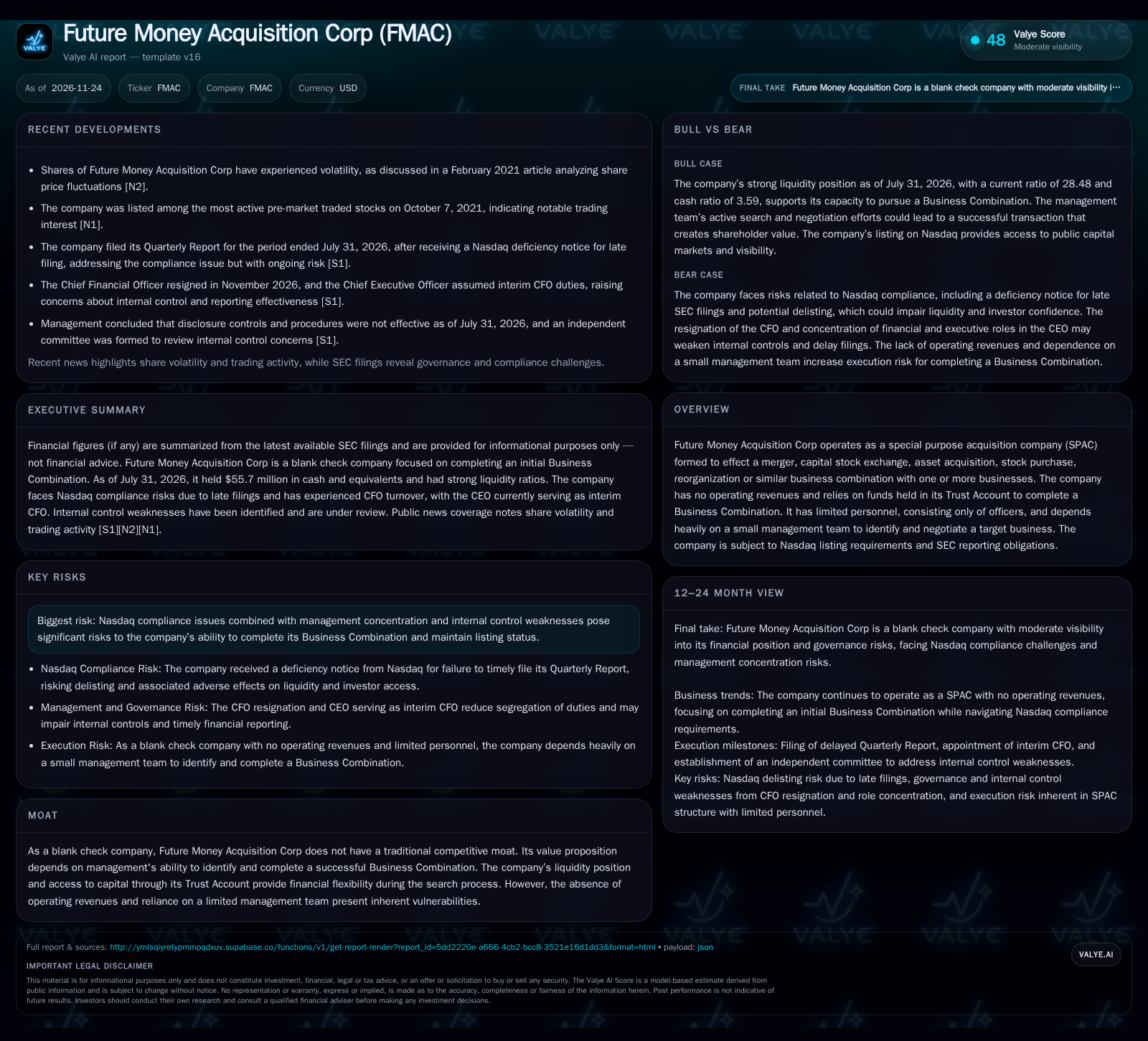
The CEO’s dual role as interim CFO highlights governance and internal control weaknesses. With no operating revenues and time pressure to complete a business combination, execution ability and governance remediation are pivotal to the SPAC’s outcome. [S1]
Future Money Acquisition Corp (FMAC) represents the classic promise and peril of the SPAC model in late 2026.Armed with $55.7 million in cash and a reported current ratio, the company’s financial resources are, on paper, sufficient to pursue a business combination. Yet, this runway is undercut by regulatory and governance setbacks: a Nasdaq deficiency notice for late filings, the abrupt resignation of the CFO, and the CEO’s assumption of interim financial duties. With no operating business and the SPAC clock ticking, FMAC’s fate now hinges on management’s ability to restore compliance, demonstrate internal control credibility, and execute a deal that justifies shareholder confidence. [S1]
Liquidity, Leadership Turnover, and Listing Risk Define FMAC’s Immediate Situation
As of July 31, 2026, FMAC reported $55.7 million in cash and cash equivalents against $15.5 million in current liabilities, for a current ratio of 28.48. This substantial liquidity, sourced from its March 2026 IPO and private placement, is earmarked for identifying and executing a business combination. However, the company received a Nasdaq deficiency notice due to failure to timely file its quarterly report for the same period, putting its continued listing at risk if compliance is not restored. In November 2026, the CFO resigned, and the CEO assumed interim CFO duties, reducing segregation of duties and raising internal control risks. Management concluded that disclosure controls and procedures were not effective at the end of July 2026, prompting the formation of an independent committee to address these concerns. FMAC remains a pre-revenue entity with no identified acquisition target or substantive business negotiations. [S1]
SPAC Economics: Assets in Trust, the Deal Deadline, and Dilution Trade-Offs
FMAC’s business model follows the standard SPAC playbook: investors provide capital through an IPO, with proceeds held in trust until a qualifying acquisition is found. The economics are binary—shareholder value is created only if a compelling business combination is completed before the SPAC’s deadline. Until then, FMAC earns non-operating interest income on trust assets but generates no operating revenue. The capital structure includes ordinary shares and rights (one-fifth share per unit upon deal closing), with dilution risk rising if a deal is consummated at a valuation below trust value or via sponsor-friendly terms.
Operating leverage is minimal pre-combination, as the company has no employees beyond its officers and incurs only modest G&A and professional fees. Capital needs are fully front-loaded; the company’s ability to fund operations or a break fee in the event of a failed deal depends on cash outside the trust. Upon a successful merger, economics shift dramatically: the acquired business’s profitability, capital requirements, and growth prospects become the new determinants of value, but these are currently unknown. If a deal is not completed within the SPAC’s allowed timeframe, funds are returned to public shareholders, typically net of expenses, with the sponsors’ capital at risk.
SPAC Market Saturation, Sponsor Reputation, and the Challenge of Attracting Quality Targets
FMAC operates in a crowded field of SPACs, all seeking attractive private companies willing to go public via merger. Its chief competitive levers are the amount of cash in trust, sponsor reputation, and speed of execution. However, FMAC has not yet identified or entered discussions with any target, placing it behind SPACs that have announced or closed deals. The company’s governance issues—highlighted by late filings and CFO turnover—may further disadvantage it in winning the confidence of high-quality targets, who often demand certainty and credibility from their SPAC partners.
Substitute pathways for private companies include traditional IPOs, direct listings, or mergers with other SPACs. In a market environment where many SPACs are chasing a limited pool of attractive targets, FMAC’s lack of a differentiated industry focus—while mentioning AI, Web3, or intelligent manufacturing as possible areas—means it competes broadly. Governance lapses and the risk of delisting may further erode negotiating leverage or deter sophisticated targets concerned about post-merger regulatory scrutiny.
If Governance Is Restored and a High-Quality Target Emerges, Shareholder Value Could Be Unlocked
The optimistic scenario requires FMAC to rapidly restore Nasdaq compliance, appoint a credible permanent CFO, and demonstrate that internal controls are effective. This would signal to potential targets and investors that the SPAC is a credible transaction partner. If FMAC can then leverage its $55.7 million in cash and remaining trust assets to secure a business combination with a private company in a high-growth sector (such as AI or advanced manufacturing), it could deliver above-trust value to shareholders. Evidence that would support this scenario includes the timely appointment of experienced financial leadership, withdrawal of the Nasdaq deficiency notice, a public announcement of a signed merger agreement, and positive market reaction to the proposed target’s fundamentals.
A Likely Middle Outcome: Compliance Restored, but Deal Quality and Value Creation Remain Uncertain
The most plausible outcome is that FMAC regains compliance and maintains its Nasdaq listing by addressing SEC reporting and internal control weaknesses. A permanent CFO is appointed, and the independent committee’s recommendations are implemented. The company then accelerates its search for a business combination, but with limited time and market competition, it may select a target that is adequate but not exceptional. In this scenario, the merger may be completed with minimal premium to trust value, with public shareholders redeeming shares and sponsor economics diluted. Evidence for this path would include timely regulatory remediation, progress updates on CFO recruitment, and the announcement of a deal with a private company of moderate scale or growth prospects.
Delisting, Deal Failure, or Redemption Wave Could Erode or Destroy Public Shareholder Value
In the worst-case scenario, FMAC fails to regain Nasdaq compliance, resulting in delisting and loss of public market access. If governance and internal control issues persist, the company may struggle to recruit a credible CFO or attract any viable target, leading to SPAC liquidation and return of trust assets at a loss (net of expenses and redemptions). Alternatively, even if a deal is announced, poor governance and a weak target could trigger a shareholder redemption wave, leaving insufficient cash for the post-merger entity and eroding sponsor and public shareholder value. Evidence confirming this scenario would include ongoing SEC reporting failures, prolonged CFO vacancy, Nasdaq delisting, or the announcement of SPAC liquidation due to failure to complete a combination.
Milestones That Will Determine Whether FMAC Can Deliver on Its SPAC Mandate
Progress toward the appointment of a permanent, experienced Chief Financial Officer, and public disclosure of the same.
Withdrawal or closure of the Nasdaq deficiency notice, indicating restored compliance with SEC filing and listing requirements.
Updates from the independent committee regarding remediation of internal control and disclosure weaknesses.
Announcement of a signed business combination agreement, especially if accompanied by transparency around target financials, sector, and strategic rationale.
Redemption rates at the time of business combination vote, which would reveal public shareholder confidence in the deal.
Any material changes in trust account value or the emergence of significant deal-related expenses that could affect per-share redemption value.
If disclosed, the timeline and process for extending the SPAC’s deadline or seeking shareholder approval for such extension.
Disclaimer: This is research-only, informational analysis and not investment advice. It may include AI-generated interpretation and general industry context. Always verify important details using primary sources.

Comments