
CyberloQ Technologies: Proprietary Authentication Platform Seeks Traction Amid Severe Financial Constraints
CyberloQ Technologies offers proprietary multi-factor authentication (MFA) and credit management tools, including smartphone-based access controls, cloud-secure data transmission, and a white-labeling capability aimed at institutional partners.
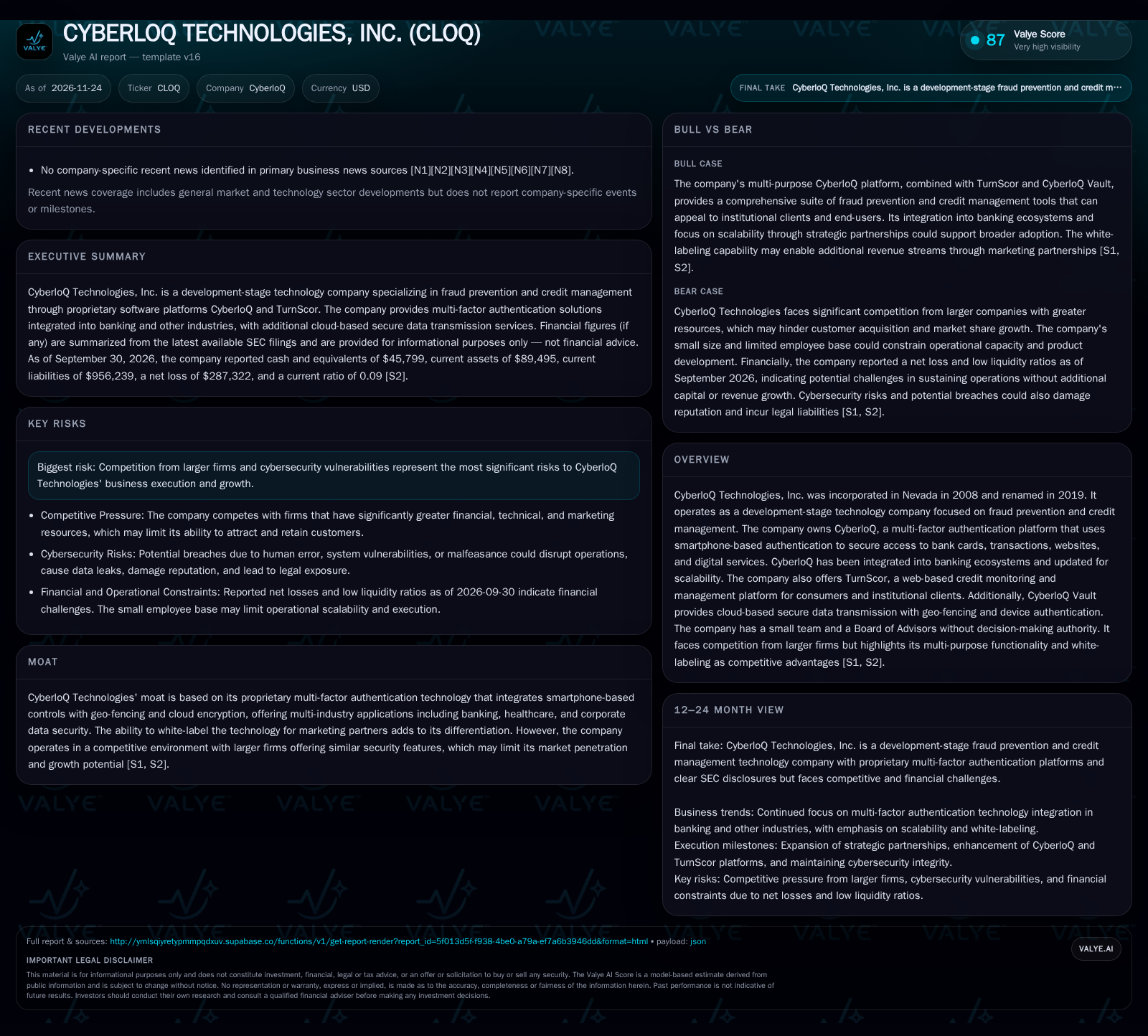
CyberloQ Technologies offers proprietary multi-factor authentication (MFA) and credit management tools, including smartphone-based access controls, cloud-secure data transmission, and a white-labeling capability aimed at institutional partners. While the technology is integrated with banking ecosystems and positioned for scalability, the company faces a net loss, a current ratio of just 0.09, and negligible reported revenue. With only two full-time employees and substantial competition from better-capitalized firms, CyberloQ’s viability hinges on quickly converting partnerships into recurring revenue or raising new capital to fund continued development and operations. [S1] [S2]
CyberloQ Technologies, Inc. is attempting to carve out a niche in the increasingly crowded fraud prevention and credit management market with its proprietary multi-factor authentication (MFA) platform, smartphone-based access controls, and secure data transmission solutions. Despite technical integration with banking systems and a product suite designed for white-label institutional adoption, the company’s financials reveal a precarious position: minimal cash, current liabilities that dwarf assets, and virtually no revenue. The strategic question is whether CyberloQ can convert its technology into actual customer contracts and recurring revenue before its financial runway disappears, or whether the company must rely on new external funding to survive.
Recent Financials and Product Positioning Define an Inflection Point
CyberloQ Technologies stands at a critical juncture, with its September 2026 balance sheet showing just $45,799 in cash and equivalents and current liabilities of $956,239, resulting in a current ratio of 0.09 and a cash ratio of 0.05 [S2]. Net income for the latest reported period was a loss of $287,322 [S2]. These figures highlight acute liquidity constraints and a high risk of operational disruption without immediate improvement in revenue or capital infusion.
On the product front, CyberloQ’s core offering is a proprietary MFA platform that leverages smartphones for transaction-specific access controls, geo-fencing, and cloud encryption [S1]. The company has updated its infrastructure for scalability and integrated its technology into banking ecosystems, suggesting technical viability and readiness for broader adoption if commercial traction can be established [S1].
How CyberloQ’s Platform Could Capture Value—And Where Economics Break Down
CyberloQ’s business model aspires to blend subscription-based software revenues with potential one-time integration or licensing fees, particularly if its MFA and credit management solutions are adopted by financial institutions or enterprises through white-label agreements. The platform’s multi-purpose functionality and cloud-based delivery could, in theory, create high-margin, recurring revenue streams—especially if deployed at scale across multiple partners.
However, the economic reality is currently defined by negligible revenue ($1,104 reported for the period ending June 2022) [S2], insufficient to cover even minimal operating costs. The company’s ultra-lean team—just two full-time employees—limits both fixed costs and organizational capacity, but also constrains speed of development, customer acquisition, and support. The company reported cash and liquidity metrics for the period; these figures do not by themselves establish operating runway, investment capacity, financial flexibility, or financing capacity. Unless the platform achieves rapid partner adoption, the economics could remain negative, with fixed costs (even if low) quickly overwhelming the tiny revenue base.
A critical factor influencing CyberloQ's economic viability is the scalability of its subscription model in the context of customer acquisition costs (CAC) and lifetime value (LTV). If the company can secure institutional partners with multi-year contracts, the LTV of each customer could justify upfront sales and integration expenses. However, given the highly competitive landscape, the CAC may be elevated due to the need for specialized sales efforts and technical customization. Without a clear pathway to reduce CAC or increase LTV through upselling or cross-selling additional features, the unit economics may remain unfavorable, limiting sustainable growth potential.
Another economic consideration is the platform’s reliance on cloud infrastructure and ongoing security updates, which introduces variable costs that scale with user base and transaction volume. While cloud delivery enables rapid deployment and updates, it also requires continuous investment in cybersecurity measures to maintain compliance and trust. If CyberloQ cannot balance these operational expenses with revenue growth, margin compression could occur. This dynamic underscores the importance of achieving a critical mass of paying customers to spread fixed and variable costs effectively and reach profitability thresholds.
Differentiation Versus Scale: Can CyberloQ Outmaneuver Larger Security Players?
CyberloQ operates in a market dominated by large, well-capitalized competitors—including major banks with in-house security stacks and established security technology vendors. The company points to its multi-purpose MFA functionality, smartphone integration, and white-labeling capability as points of differentiation [S1]. In theory, these features could appeal to institutions seeking customizable, branded security solutions without building from scratch.
Yet, the scale and trust advantages of incumbents present formidable barriers: larger firms can outspend on R&D, sales, and marketing, and are often perceived as lower-risk partners for banks and enterprises. Furthermore, the MFA and secure transmission space is crowded with both specialized vendors and bundled offerings from broader IT security providers. Unless CyberloQ can demonstrate superior ease of integration, unique features, or cost advantages, customer acquisition will remain a challenge. Its small team may also be a liability when competing for large contracts that demand robust long-term support.
What a Commercial Breakthrough Would Look Like—And Evidence That Would Support It
The most favorable scenario for CyberloQ involves converting its existing technology integrations and white-labeling capabilities into multi-year contracts with one or more institutional partners, such as banks, fintechs, or enterprise IT providers. This would likely be evidenced by a sudden step-change in reported revenue, new customer announcements, or backlog disclosure if applicable.
Such a breakthrough could unlock operating leverage, as incremental costs for cloud-based software delivery are low relative to potential contract value. If CyberloQ can demonstrate even modest customer retention and expansion within its partner base, it may attract additional institutional interest and, potentially, outside investment on improved terms. Early evidence could include new partnership press releases, pilot program launches, or a material uptick in deferred revenue or contract billings (if disclosed in future filings).
Survival Mode: Incremental Progress or Extended Runway Needed
The most plausible near-term path is one in which CyberloQ continues to make incremental technical improvements and pursues institutional partnerships, but struggles to close large-scale deals fast enough to materially change its financial profile. In this scenario, the company may pursue bridge financing, convertible debt, or small equity raises to extend its operational runway while seeking a breakthrough contract.
Confirmation would come in the form of minor but steady increases in revenue, incremental partnership announcements, or small capital raises that stave off insolvency. Falsification would be evidenced by a lack of new business wins, further shrinkage in cash balances, or eventual filing for bankruptcy or restructuring if external funding cannot be secured.
Liquidity Exhaustion and Competitive Displacement
In the adverse scenario, CyberloQ’s lack of cash and inability to generate revenue or secure funding lead to operational shutdown. The company’s limited resources prevent it from keeping pace with customer demands, maintaining security updates, or responding to cyber threats—potentially resulting in reputational damage or even data breaches.
This scenario would be confirmed by further deterioration in cash and working capital, layoffs or resignation of key personnel, or public disclosure of going-concern doubts in future filings. The company could also lose whatever market relevance it has if competitors launch similar or superior offerings, eroding any remaining commercial opportunity. A total absence of new partnerships or customer wins would further validate this negative outcome.
Concrete Developments That Could Reshape CyberloQ’s Outlook
Disclosure of new institutional contracts, especially with banks or fintechs, would provide the clearest evidence of commercial traction.
A material increase in recurring revenue or backlog (if disclosed) would indicate successful monetization of the platform.
Evidence of additional capital raises—such as equity, debt, or strategic investment—would extend the financial runway and test investor confidence.
Expansion of the employee base or hiring of key technical/sales personnel would suggest ramp-up for growth or customer support.
Announcements of product enhancements, integrations, or certifications (e.g., compliance with banking security standards) would support claims of technical differentiation.
Reported customer retention or renewal rates (if disclosed) would help validate the stickiness and value of the platform.
Disclosure of cybersecurity incidents or breaches would test the real-world resilience and reputation of CyberloQ’s technology.
Any going-concern warnings or auditor notes in future filings would signal heightened financial distress.
Disclaimer: This is research-only, informational analysis and not investment advice. It may include AI-generated interpretation and general industry context. Always verify important details using primary sources.

Comments